


How Jeh Aerospace is turning global supply pain into India’s big aerospace opportunity


However, large engine makers and tier-one suppliers in the US and Europe struggled with talent shortages, soaring costs and production delays. Even today, if an airline places an order for a new aircraft, delivery can take up to a decade.
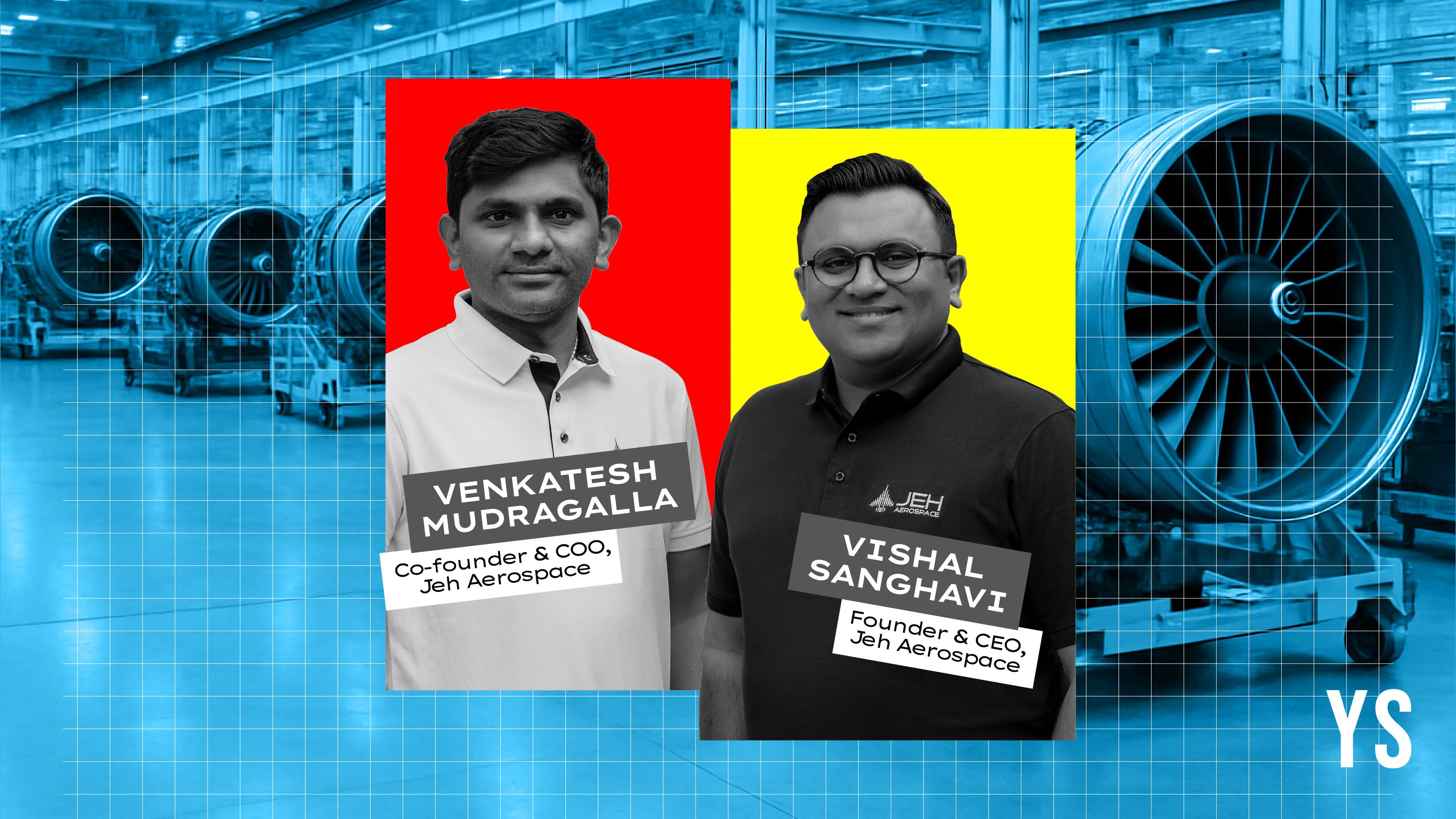
Inside this slowdown, two Indian engineers saw a rare opening. “We noticed a huge supply chain crisis,” says Venkatesh Mudragalla, Co-founder and COO of “The demand shot up, but the supply never caught up. We saw a clear white space and asked ourselves how India could solve this problem.”
Mudragalla grew up in Hyderabad and always loved aircraft. After studying aeronautical engineering, he joined the Tata Group when it was entering aerospace and spent 12 years across its joint ventures, working with global players like Boeing, Rolls-Royce and GE. “I had the opportunity to learn from some of the best people in the world,” he says.
There he met Vishal Sanghavi, co-founder and CEO, who was the first employee of the Tata–Lockheed JV. They worked together for over a decade and developed a shared viewpoint on the industry’s widening supply-chain challenges.
Jeh Aerospace manufactures aero-engine components, specialising in hard metals like Inconel, titanium, nickel and cobalt steels.
These materials are extremely difficult to machine and measure, and are typically used in the hottest parts of engines. About 70% of an aircraft is aluminum.
“Only 30% is hard metal, and that is where the real crisis is,” says Mudragalla. The startup produces components as small as a few inches and up to one metre in length, along with fixtures and ground support equipment up to three metres.
The flagship facility, a 60,000 sq ft plant in Kotur, Hyderabad, runs largely in-house production supported by a controlled ecosystem of Indian suppliers. Jeh provides engineering, quality and process support to these partners to raise their capability. But the company’s most unusual differentiator is its software-first approach.
Core manufacturing focus
Jeh Aerospace was founded in August 2022. It is headquartered in Georgia, US, with operations in Hyderabad, to make it easier for American tier-one and tier-two engine manufacturers, such as XXX, to work with India.
“For many of them, India is still a very different world. They are more comfortable working with an American company,” explains Mudragalla.
He adds that they often don’t fully understand how India works – the culture, the way factories operate, and how local processes differ from what they are used to. Having a US base removes that hesitation and makes the first engagement far easier.
The startup spent its first year with just the two founders, travelling, meeting customers and building supplier partnerships. Manufacturing began in late 2023, and the first deliveries rolled out in 2024.
.thumbnailWrapper{
width:6.62rem !important;
}
.alsoReadTitleImage{
min-width: 81px !important;
min-height: 81px !important;
}
.alsoReadMainTitleText{
font-size: 14px !important;
line-height: 20px !important;
}
.alsoReadHeadText{
font-size: 24px !important;
line-height: 20px !important;
}
}

Digital-first approach
“We are a digitally native startup,” says Mudragalla. “From the time we get a purchase order till we deliver a component, everything happens on a digital platform.” Every workstation features a screen displaying drawings, models, routing sequences, instructions, and NC programmes, which are digital instructions that guide Computer Numerical Control machines in cutting and shaping a part, including tool paths, speeds, and cutting steps.
All machine data, vibration, temperature, and spindle behaviour, is captured and analysed. Jeh has added a Databricks layer and has begun work on an AI engine to generate smart recommendations. The early results are basic but useful: the system can identify when a machine is not running at its optimal performance, when a tool may require attention, or when an operation is taking longer than expected.
However, as Mudragalla explains, these insights help engineers adjust the machines and cut down errors.
“The system isn’t fully automated yet, but many checks now come from our digital platform,” he adds. “We want AI to make the process faster and more reliable. We are in the early days, but AI will play a strong role in manufacturing.”
Jeh also runs an internal Centre of Aerospace Skill, training operators using classroom instruction, simulators and AR/VR modules. Operators can practise running a five-axis machine without occupying the real, expensive equipment. This, Mudragalla says, cuts physical training time by 50% and helps scale talent far more efficiently.
.thumbnailWrapper{
width:6.62rem !important;
}
.alsoReadTitleImage{
min-width: 81px !important;
min-height: 81px !important;
}
.alsoReadMainTitleText{
font-size: 14px !important;
line-height: 20px !important;
}
.alsoReadHeadText{
font-size: 24px !important;
line-height: 20px !important;
}
}

Rapid growth metrics
In just 18 months of operations, Jeh Aerospace has built an order book of $150 million, signed long-term contracts of five to ten years, and delivered more than 1,50,000 engine components to the US. It currently works with five customers, including its first client, RH Aero of Cincinnati and US Precision of Vermont, along with the Solestra Group. Three new customers are ramping up this year.
“Every customer we onboard has the potential to grow to $10–15 million per year,” he says.
The startup works entirely on a B2B export model, with all of its current business coming from the US. Its contracts are long-term, giving it steady and predictable revenue instead of one-time projects. Jeh expects to reach double-digit million-dollar revenue this year, growing 3-4x from its first year of operations.
Funding and team expansion
Jeh Aerospace has raised about $13-14 million so far. Its seed round in January 2024 was led by General Catalyst, and its Series A in August 2025 was led by Elevation Capital, with General Catalyst joining again.
IndiGo’s venture arm also invested, making Jeh its first portfolio startup. The startup now has about 120 employees and expects to reach 250 by March next year.
Jeh Aerospace competes with well-established tier-two manufacturers in the US and Western Europe.
“We bring the best of both worlds, India’s talent and cost advantage, along with a strong US presence and customer access,” Mudragalla says, adding that their digital systems are a key differentiator, with every step of production tracked on a single platform and all machine data captured in real time, whereas something many global competitors still do on paper. “Our digital maturity is far ahead of what you usually see in aerospace,” he says.
The biggest challenge for Jeh Aerospace was the capital-heavy nature of aerospace manufacturing. As Mudragalla explains, the team had to find creative ways to work with suppliers so they didn’t need huge investments upfront. These hurdles shaped how they built a model that could grow quickly without high costs.
Future expansion plans
Looking ahead, the startup is scaling rapidly. It is adding a 200,000 sq ft second facility, internally called Mach 2, which will be fully AI-driven. The space will be ready by the first quarter of 2026 and operational by the second quarter. New product categories will also be introduced next year, though not yet disclosed.
According to Expert Market Research, the aerospace market is projected to grow from about 30.72 billion in 2025 and is also projected to grow at a CAGR of around 7.10% through 2035. “In the next five years, if India reaches 10%, we want Jeh Aerospace to play a meaningful part in that growth, that’s our goal,” he says.
Discover more from News Link360
Subscribe to get the latest posts sent to your email.