


Key takeaways from Commvault’s CXO roundtable on what true data resilience looks like

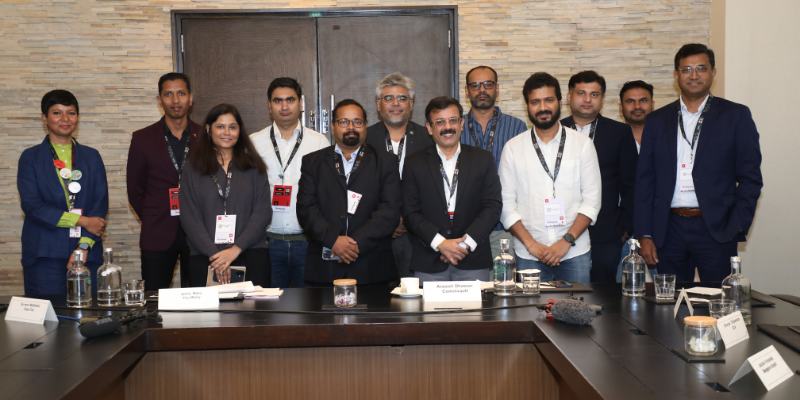

To decode what “true resilience” looks like in this landscape, Commvault and YourStory hosted an exclusive closed-door roundtable titled ‘The CXO playbook for data resilience: Protecting data, AI, and innovation.’
Participants included Aneesh Dhawan, Director Enterprise Sales, Commvault; Sreekanth Vaniveettil, CTO, Quess Corp; Shreyas Chidambara, Chief Information Security Officer (CISO), Ola; Suhas Suresh, Director of Information Technology, Razorpay; Ankur Sharma, Co-founder & Chief Product Officer, InstaMojo; Anshul Sharma, Director of Engineering, Scaler AI Labs; Vilas Jacob, CISO, Innoviti Technologies; Suvesh Malhotra, CTO, ClearTax; Naseem Halder, Group CISO, Navi; Shikha Chouksey, Co-founder, Orbitwall; and Jacxine Fernandez, Senior Vice President – Information Security, ICT Governance & Revenue Management, Bangalore International Airport Ltd.
Data quality as the non-negotiable foundation
A clear consensus emerged from the discussion: AI systems live and die by the quality of the data they consume. A Gartner report suggest that poor-quality data costs organisations nearly $12.9 million annually and significantly degrades model performance.
One participant shared how its AI-led platform processes billions of invoices and compliance filings each year, demanding automated checks for freshness, accuracy, and consistency. Their internal system validates data from ingestion to output. Another one highlighted strict refresh cycles to prevent model drift and bias, ensuring decisions aren’t based on stale or outdated information.
A recurring concern was AI’s ability to bypass traditional role-based access controls. One of the leaders noted that while humans are restricted by role-based access control policies, AI agents can access data far more broadly unless new guardrails are put in place. Row-level and column-level permissions are now becoming essential, especially for startups working across multiple clients.
As one participant put it, “If humans need access controls, AI needs them even more.”
End-to-end data protection across the lifecycle
CXOs described a multi-layered protection strategy — encryption, masking, secure backups, network isolation, and continuous monitoring. A few leaders referenced the RBI’s upcoming AI audit guidelines, which will scrutinise not only how data is used but also how models access and act on that data.
Many companies are isolating LLM training environments from the open internet to prevent unintentional leakage. For high-risk onboarding flows involving Aadhaar or KYC documents, AI + human co-verification remains mandatory.
Enterprises further shared how AI is helping them scale, but with caution.
Edtech platforms now run over 1 lakh AI-led mock interviews.
Staffing giants use AI for document checks and fraud detection across lakh-plus hires every quarter, but strictly within VDI shells to prevent data extraction.
Some even stressed the need for explainable AI. “You cannot show me data I cannot explain; I am responsible for real-world consequences.”
The threat landscape is evolving rapidly. Security heads warned that attackers now use AI to generate polymorphic, constantly mutating attack patterns. Traditional signature-based defenses can’t keep up. The message was clear, AI-driven threats require AI-driven defense.
Resilience as a mindset, not just technology
Another recurring insight throughout the conversation was resilience means more than just systems and software; it’s a cultural shift. One leader summed it up, “If there were a button that restored everything instantly, everyone would press it. Resilience is about preparing for the moments when that button doesn’t exist.”
To strengthen this mindset, companies are:
- running continuous cybersecurity awareness programmes,
- enforcing tighter controls around identity providers and connectivity layers,
- conducting regular assessments and post-incident reviews.
With growing AI adoption, organisations are also doubling down on protecting users who now directly interact with LLM-powered systems, many of which still use publicly available models.
For large enterprises operating across multiple clouds and regions, compliance is also becoming increasingly complex. While deleting data from production systems is straightforward, ensuring the same deletion from backups, replicas, and archival stores is far harder.
Commvault addressed this challenge by explaining how their systems sit closest to the data, indexing it end-to-end and mapping where every fragment resides. This will support organisations on their journey to comply with Digital Personal Data Protection Act’s “right to forget” requirements across distributed cloud architectures.
Smart storage and the economics of scale
With unstructured data exploding, the old approach of maintaining multiple copied snapshots is no longer viable. Smart storage, driven by deep deduplication, compression, and tiered retrieval, is helping organizations manage data more efficiently while reducing unnecessary duplication. But more copies is not equal to more safety. In ransomware scenarios, infections often spread to every copy. This is why air-gapped backups are now considered essential.
The one question every CXO must ask today is, “What is the real cost of downtime for our organisation?” Once leaders define this number, resilience stops being an IT issue and becomes a board-level priority.
Commvault’s India-based engineering teams work closely with customers to continuously improve recovery speeds and robustness. As one panelist put it, “If there’s a scenario we haven’t covered yet, we want to know. Our job is to help make every recovery faster, smarter, and stronger.”
Discover more from News Link360
Subscribe to get the latest posts sent to your email.