The Ingredients for a Successful Cellphone Ban: What Teachers Say
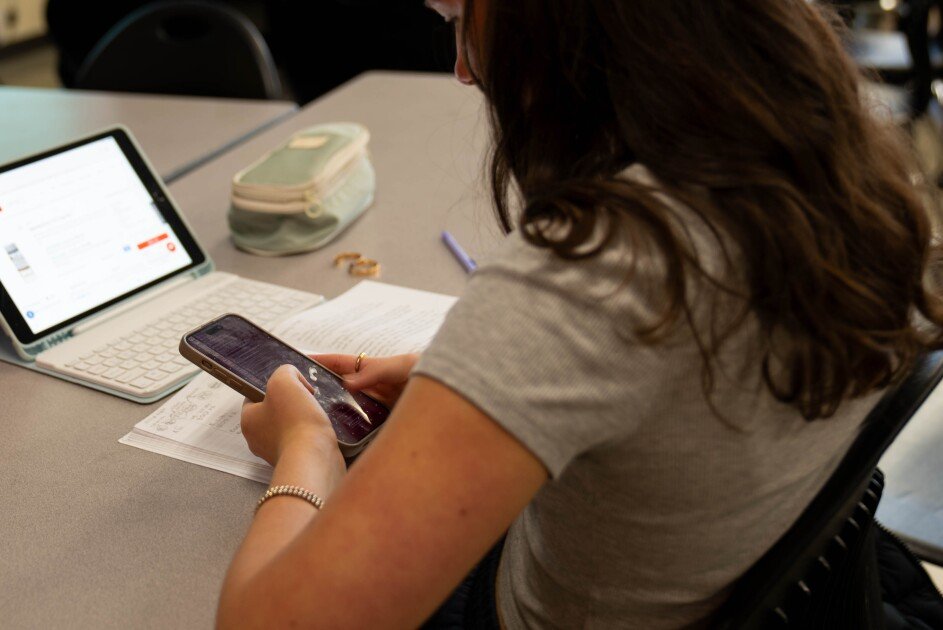
Restrictions on cellphone use help teachers manage classrooms better, making it so they don’t have to constantly police students who text and scroll throughout class. Plus, schoolwide bans seem to have improved students’ concentration and engagement with their peers, early research and anecdotal reports show.
Researchers have found that cellphone restrictions can also reduce teachers’ stress and have the potential to improve their job satisfaction.
Schools, though, have implemented cellphone restrictions in different ways. Some are strict about access, ensuring that students aren’t on their phones throughout the school day. Others allow students to have their phones on them but switched off and stowed away in their backpacks during class. In those cases, students can only take them out during lunch or between classes.
Policies differ, but there’s a common thread among policies that work, teachers say: Administrators need to back up their teachers.
“It’s easier when the administration is willing to be the bad guy,” said Kathryn Campbell, an English teacher at the private Archbishop Murphy High School in Everett, Wash.
As recently as a few years ago, Campbell would encourage students to use their phones “as a second computer” to look up facts. While students then still scrolled social media or text, Campbell said it was only after the pandemic that students “were glued to their phones and couldn’t function without them.”
The school implemented a cellphone policy in 2024 that doesn’t allow students to use their phones during instructional time, though they have access to phones during passing periods and lunch.
Campbell asks her students to put their phones into caddies, which stay near her desk, locked. If students resist giving up their phones when they enter the classroom, Campbell said her response is simple: “We tell them, ‘You know what? We’re just following the rules. That’s all we can do.’”
Administrators need to follow up with frequent reminders
Students may need frequent refreshers on their school’s cellphone policies—sometimes even every day. At Fort Pierce Westwood Prep Academy in Fort Pierce, Fla., principal David Alfonso makes a daily announcement over the PA system about putting phones away once students enter the classroom.
Jodie Scales, an English teacher at the school, said the daily reminders help. Once students enter the classroom, they know they have to leave their phones in their bags, which stay at the front of the class.
If students don’t keep their phones and bags at the front of the room, or if they have the phone on them, there is no warning, Scales said.
“We hit the call button, the cellphone gets picked up by the school discipline group. They take the student to in-school suspension,” she said. “There are no questions asked, no debate with the student. We don’t lose any more class time.”
Students can only get their phones back after school.
Scales said the school gives students plenty of reminders about the policy. In addition to the daily announcement, there are signs outside each classroom about putting phones and headphones away. Scales even duct-taped a poster to the floor that reads: “If you’ve reached this point and you still have your cellphone, turn around.”
The volume of reminders has helped. Scales only calls in the school discipline group once or twice a month to take away phones.
Teachers need to be consistent, too
The advantage of having a uniform policy backed up by the administration is that teachers don’t have to establish new boundaries with their students in every class.
Stephanie Hasty, a teacher at Seneca Valley High School in Germantown, Md., said it’s “less mean” to enforce the cellphone policy if every teacher follows the same rules. Students can’t argue that other teachers let them use their phones.
Hasty’s school follows the state’s guidelines on cellphone use, banning it during instructional time but allowing it during lunch and between classes.
It’s important that teachers don’t create their own rules, independent of the school’s policy, said Scales, at Fort Pierce Westwood Prep. A younger teacher in her school, for instance, allowed students to use their phones in the last few minutes of their class.
“It took another teacher she respected to tell her that that’s what makes it hard on the rest of us. In our school, [having the cellphone out] is not acceptable,” she said. “The younger teacher is very supportive of the policy now.”
Even with established rules, students may test the boundaries. In Campbell’s class at Archbishop Murphy High School, students sometimes hold onto their phones to see if she will notice.
Campbell has made some adjustments for students who are extra anxious about not having their phones.
“With some of them, it just needs to be on my desk and not hidden away,” she said. “I have several places around the classroom where they can charge their phone and that seems to kind of lighten the anxiety.”
Teachers can model good cellphone behavior
In many schools, there are no set rules for how much teachers can use their own phones in class. But all three teachers Education Week spoke to said they are conscious about not using their phones in front of students.
“We are all tethered to our phones,” said Hasty, “but I don’t mind not using my phone. Students need to know we’re all in this together.”
Scales’ phone sits on her desk, and she occasionally glances at it to check the time. But she doesn’t text or scroll during class. Like Hasty, Scales wants to model better cellphone behavior for her students.
In addition to staff modeling good cellphone behavior, Campbell’s school also hosts seminars for students on internet etiquette or managing screen time. One tip shared with students is to step away from their screens after a 20-minute session.
“We frontload that for them at the beginning of the year,” she said, noting that the lesson is especially relevant for freshmen who might not be as used to working on computers in class.
Some teachers have mixed feelings about the blanket bans
Teachers may generally favor the iron-fisted cellphone policies, but some say they could be open to using cellphones in class for academic purposes.
Scales said she wishes there were a “middle ground” where phones could become learning devices again, instead of outlawed technology.
Before her school’s policy kicked in, Scales would ask her English learners—largely Spanish speakers—to pull out their phones to translate her lessons. Now, these students follow along the translation that pops up above Scales’ PowerPoint presentation, which is an adjustment for them.
Campbell said her school’s policy could work better if parents were completely on board with it. Parents need to implement “non-screen time” at home, too. To encourage logging off, the school has screened documentaries for parents that detail harmful effects of social media on children.
“If parents were partners in this,” said Campbell, “it could be smooth sailing.”
Discover more from News Link360
Subscribe to get the latest posts sent to your email.