


The Congress at 140, a crisis of structure
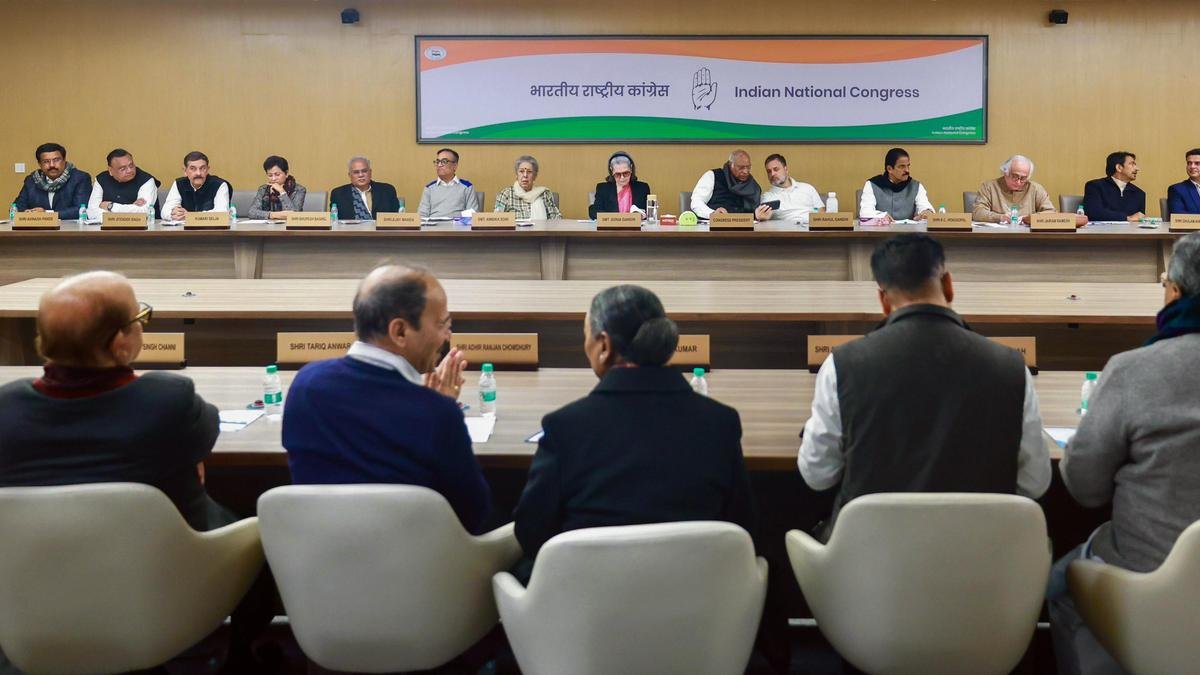
The BJP operates within a dense ideological and institutional ecosystem anchored by the RSS and sustained by a constellation of affiliated organisations. The RSS underpins the BJP with major capabilities in propaganda, election management and booth-level coordination. No other party in India — and arguably none anywhere else — enjoys the advantage of such an external cadre base that continuously replenishes leadership, shapes ideology and undertakes political mobilisation independent of electoral cycles. By contrast, the Congress is not a cadre-based party, leaving it at a severe disadvantage due to the absence of trained workers at the district and booth levels.
Organisational erosion
The organisation that the Congress built in the early decades after Independence has undoubtedly declined, eroded over time by the centralisation and concentration of authority at the apex. The result has been a thinning of local leadership that is capable of sustained mass mobilisation, a sharp departure from an earlier period marked by dense political networks. Since the split of 1969, electoral leadership has progressively substituted for organisational depth, a tendency that persisted even through the 1990s. During that decade, leaders outside the Gandhi family headed the party, but there was little effort to renew or strengthen its internal structures.
At the same time, it would be misleading to describe the Congress today as a tightly centralised party. Indeed, it is arguably less centralised than the BJP, where authority is concentrated far more decisively around a single leader, particularly in the context of State-level electoral strategy. As political expert James Manor has observed with reference to the Karnataka Assembly elections 2023, the Congress has often permitted a markedly decentralised management of campaigns at the State level. The party thus remains loosely structured — plural, internally diverse and heterogeneous. While this was once a source of resilience, it has become a liability in a political conjuncture dominated in India, as elsewhere, by right-wing parties that thrive on ideological uniformity, disciplined mobilisation and strongman leadership. The challenge facing the Congress, therefore, is not simply one of centralisation versus decentralisation, but of rebuilding party capacity without sacrificing the intrinsic pluralism that distinguishes it from the BJP. Comparison with the BJP is misplaced, since it risks implying that the Congress must replicate the BJP’s model as a prerequisite for electoral success.
The myth of decentralisation
Much of the debate on decentralisation proceeds as though this dilemma was unique to the Congress. The fact is that no major party in India operates with genuine decentralisation. The BJP, in fact, maintains tight control over its State organisations, ensuring that Chief Ministers, State Presidents and indeed the Party Presidents remain accountable to the central leadership. The current BJP President, J.P. Nadda, and the recently appointed Working President, Nitin Nabin, hold office by nomination rather than by a vote of party members, whereas the Congress conducted elections for the post of Party President in 2022, an exercise that, whatever its limitations, was a sign of internal democracy.
Nonetheless, the absence of electoral processes within the BJP has received limited public or media scrutiny. Attention has instead centred on the centralisation of power within the Congress, suggesting that concerns about internal democracy were a concern only when one particular party was under examination.
This focus on centralisation also overlooks the extent to which the Congress continues to tolerate internal dissent. Unlike most Indian parties, it has allowed senior leaders and internal groupings such as the group of 23 senior Congress leaders, commonly referred to as the G-23, to publicly criticise the party’s functioning and call for elected leadership, collective decision-making, and the revival of institutional structures without facing immediate marginalisation or expulsion. Indeed, many members of the G-23 continue to serve on the Congress Working Committee (CWC), the party’s highest decision-making body. This tolerance of public dissent, however, should not be mistaken for political strength. It is a double-edged phenomenon: while it signals a measure of internal freedom, it also exposes the party’s vulnerabilities and amplifies perceptions of factionalism and indecision. These weaknesses have repeatedly hampered the Congress in States such as Chhattisgarh, Karnataka, Madhya Pradesh, Punjab and Rajasthan, where leadership tussles have blunted political growth. The very openness that distinguishes the Congress also reveals its fragility, underscoring the challenge of reconciling internal debate with decisive authority.
Repeated electoral debacles have exposed the Congress’s structural weakness, most notably its lack of a durable grass-root presence. This deficit has become increasingly apparent as the BJP, backed by vast financial resources and an extensive party apparatus, has expanded into States where it had little presence a decade ago, while the Congress has remained ill-equipped to mount an effective counter. With its loose internal structure and thin local networks, the party has been unable to match what is arguably the most formidable political machine India has ever seen. The Congress’s crushing performance in the November 2025 Bihar Assembly elections, where it managed a very poor strike rate, has brought these shortcomings into even sharper relief.
The Congress’s Rahul Gandhi has on several occasions articulated a sharp critique of his party’s institutional inertia, but his efforts to translate that critique into meaningful reform have repeatedly stalled. Attempts to rework internal hierarchies, challenge entrenched patronage networks, and devolve authority have met with stiff resistance from within the party, preventing it from evolving into an effective State-level organisation. Ironically, many senior leaders who loudly decry the Congress’s organisational attrition have themselves been its biggest roadblocks to real reform. Their critiques, often couched in the language of internal democracy or decentralisation, have at times served more to preserve their own influence than to strengthen the party. This dynamic has produced a paradoxical environment: the Congress is simultaneously marked by vocal criticism of its decline and constrained by entrenched figures who, while claiming to champion reform, benefit from maintaining the status quo.
Where the party’s problem lies
The real problem confronting the Congress is not centralisation per se, but weak internal democratisation. While decision-making authority has long been concentrated around the Gandhi family, the party’s deeper weakness lies in its failure to nurture State- and district-level leadership or to create institutional pathways through which new voices can assume responsibility. It lacks the internal mechanisms that would allow central authority to be exercised through capable, accountable and socially embedded leaders. This helps explain the continued dominance of dynastic leadership and a narrow cohort of senior figures, even as the party struggles to mobilise support across States or sustain a credible opposition.
Institutional restructuring and renewal are imperative precisely for this reason. The Congress needs leaders who are rooted in mass support rather than have office-bearers in Delhi with limited connection to the ground. This is particularly vital in an increasingly unequal political arena, where the BJP enjoys overwhelming advantages in financial resources, media access and narrative control. With electoral bonds struck down but electoral trusts now taking their place continuing to channel the bulk of corporate funding to the ruling party, and with much of the mainstream media aligned with power, Opposition politics cannot rely on episodic mobilisation alone. Only a revitalised party, driven by a radical progressive vision and capable of sustained mass engagement, can offset these structural disadvantages and enable the Congress to emerge as a credible and durable alternative to the Right.
Zoya Hasan is Professor Emerita, Centre for Political Studies, Jawaharlal Nehru University
Published – January 17, 2026 12:16 am IST
Discover more from News Link360
Subscribe to get the latest posts sent to your email.