CEAT has earmarked close to ₹1,300 crore for the expansion. The investment will be funded through a mix of debt and equity. The company said its leverage levels will remain within internal limits, with the current debt-equity ratio at 0.6 and debt-to-EBITDA at around 1.5–1.6.
The company added that its capital expenditure in the coming years is expected to remain at similar levels as a percentage of sales.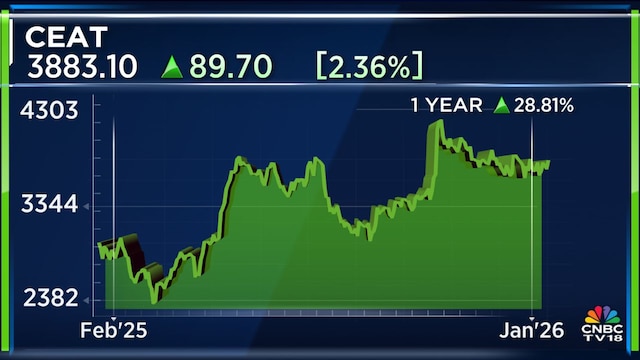
The company reported its third-quarter results on January 19, 2026. Consolidated net profit rose 60.3% year-on-year to ₹155.7 crore, compared with ₹97.1 crore in the same period last year, helped by strong volume growth across segments and improved market sentiment.
CEAT currently has a market capitalisation of ₹15,700.91 crore. Its shares have gained more than 28% over the past year.
These are the edited excerpts of the interview.
Q: Quarter three appears to be a good one in terms of growth. And as I’m looking at it, mix replacement is a large part of your business. So, could you tell us the trends that we saw in the past quarter? Are they expected to continue? And if you could help us out with what the volume growth is that you’re targeting for this year and the next?
A: The past quarter has been good. After the goods and services tax (GST) revision in the month of September, initially we saw trade downstocking, but it’s all come back, and there is good sentiment in both original equipment manufacturers (OEM) and replacement markets in the domestic area. We have seen mid-teens to high-teens kind of growth in replacement. And we have had a base effect of OEM. Our last year’s base was a little bit lower, so there is good growth in OEM as well.
We’ll have to wait a while, maybe a couple of quarters, to see if this kind of impetus continues, because quarter three usually is a weak quarter for us because of the onset of winter in the North and East. It has broken the trend because of these changes primarily, and that’s why we have brought forward our investment plans in passenger car tyres as well.
Q: Let’s talk a little bit more about that. Then you’re looking to add closer to 35 lakh tyres per annum, and that capacity is expected to come on stream in the first half of the fiscal year 2027-28 (FY28). Break it down for us. What would that be in terms of the total capacity addition, and how do you fund it? You have earmarked close to ₹1,300 crore, so the breakup is between debt and internal accruals.
A: Yes, we will add about 35 lakh tyres through the year, and overall capacity after this addition will be about 60,000 tyres per day. So, you can multiply that by 350 days to get the annual capacity. And this will service all segments — replacement, OE, and Independent Business (IB) primarily. The expansion is coming up at Chennai, which is a brownfield expansion, so we don’t expect too much uncertainty there.
It will be funded by a mix of debt and equity. Our ratios, as we see going forward, will be well within our internal control limits. The debt-equity currently at 0.6. Debt-to-EBITDA is also around 1.5–1.6, so we don’t expect to worsen those ratios too much, as we have been regularly incurring capex, if you have seen over the last few years. And so, the capex guidance for the next few years will also be similar as a percentage of sales.
Also Read | CEAT MD says demand improving across segments, margins holding steady
Q: So, you’ll be at roughly around two crore capacity. Then this is roughly around a 15 to 20% increase in your total capacity. That should be a fair estimate, right?
A:
60,000 per day, yes.
Q: Credit growth was 16–17, 18%, and it fell as low as 8%. Now it’s back at about 13–14%. When you look at where this credit growth is going, autos is right up there. And this is an instant injection of liquidity. So, credit growth is equal to sales pretty much. One-to-one. Are you getting that sense that this could be — I don’t think expectations from auto companies that we speak to are of anything great, maybe better, etc. But is it possible, as credit growth picks up and continues to move higher, driven by all these policy measures, that this turns out to be pretty – we see a meaningful upside surprise in terms of auto volumes? Is there any sense of this in your interactions with OEMs?
A: Yes, there was a structural change in the four-wheeler auto sales, where we see the emergence of sports utility vehicles (SUVs), even first-time buyers going straight to the SUV, leading to value growth, but the volume growth was muted in terms of the number of cars. Post the GST, that thing has changed because the small car volumes have come back. So that means a larger number of tyres, of course. But we’ll have to wait and see whether the structural change towards consumer preference of higher vehicles, bigger vehicles — the SUVs — is going to come back.
But the overall numbers are going to increase. How much we will have to see for the next two quarters. Two-wheelers and farming are going to see secular growth because we have seen the growth momentum coming back more from the smaller towns. So, we believe that these are still — two-wheeler is an under-penetrated category, and there is scope for growth in terms of the number of vehicles there.
Because of the credit growth, which you mentioned, we have seen a bounce-back in the commercial vehicle segment as well, which is truck and bus. And this was kind of not growing in the first half, nor was the passenger vehicle in terms of numbers. So, these growths have come back. Yes, it has been bullish, but we’ll have to see a couple of more quarters to see how much it sustains.
Q: What percentage of your overall revenues or volumes go to the US? I know it’s small, but can you give us a number? And on the back of the punitive tariffs, what has been the volume in quarter three, and what is the outlook on margins for quarter four, given the way rubber prices have panned out and the currency depreciation?
A: So, I’ll answer the US question first. Less than 3% of our turnover goes to the US, and as I’ve been maintaining in the past, for us it’s important to get a toehold in terms of creating the distribution and logistics infrastructure in the US. So, we have been absorbing the tariff impact to a certain extent and passing it on to a certain extent. That strategy continues over quarter three and also quarter four.
We have not seen any drop in sales turnover to the US, though it remains small, and the impact on the bottom line is muted. We see this as a very big growth market, so we stay invested in the US. So, that’s the US part. No impact on the bottom line, but we are setting it up for growth in future.
Overall margins, if you see standalone margins, have inched up from 13.7% to 14.1% in this quarter because of higher turnover and growth. We expect the raw material situation to be flattish in quarter four, maybe slight inflation at max, up to 1%, so mostly flattish, maybe slight inflation. That is the kind of situation.
By the end of February, we will see an uptick in volumes — the seasonal volumes, which kick in for the period of March to June, and the summer volumes. So, we expect the overall margin for the company to move in a similar zone.
Q: Your net debt is around ₹2,930 crore. Does this number stabilise around this mark? Because you’ve got a CapEx as well that’s lined up, and would it be fair, going by your commentary and the CapEx that you’re adding, that you will be looking at growing at least at mid-teens for the next couple of years?
A: Value growth this year, I can say, will be close to that, because for the first three quarters, as per published results, you can see we have grown by mid-teens. So, we want to continue that trend for this year.
Next year, it’s too difficult to predict two years at once, but we are laying the foundation, as the US is one of the growth measures. We are laying the foundation for domestic growth in terms of OE approvals as well as replacement channel expansion, especially in the premium side, which is the SUV side. So, we are planning for at least double-digit growth going forward.
For the full interview, watch the accompanying video
Catch all the latest updates from the stock market here
Catch the latest Budget 2026 expectations updates here
Catch all the latest updates from the Q3 earnings here
Discover more from News Link360
Subscribe to get the latest posts sent to your email.