
Sona BLW CEO says Europe capex push and supplier stress could benefit Indian auto firms

Singh pointed out that multiple competitors have already slipped into insolvency, forcing global carmakers to rethink where they source parts from. “There is a strong and urgent need to resource from other countries,” he said, adding that capable suppliers with stable balance sheets stand to gain.
His comments come at a time of deeper economic engagement between India and Germany. German Chancellor Friedrich Merz visited the Bosch campus in Bengaluru on January 13 during a two-day official trip to India, highlighting closer economic and technology ties between the two countries. The visit also marked 75 years of diplomatic relations and 25 years of their strategic partnership.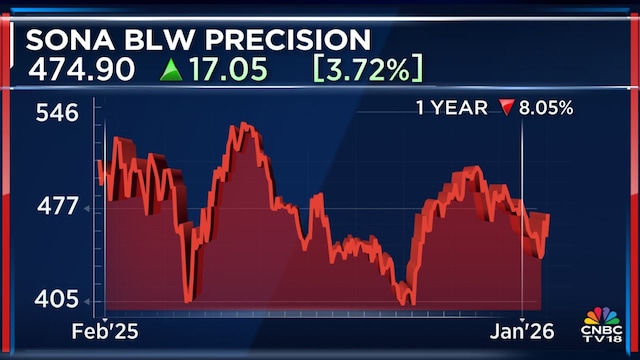
Sona BLW currently has a market capitalisation of ₹29,457.14 crore. Its shares have fallen more than 8% over the past year.
These are edited excerpts of the interview.
Q: Let me begin with the India-EU FTA that’s expected to be signed today. Europe is approximately 16% of your overall revenues, which is lower than 25% than it was last year. If the FTA comes through, how does it impact your business? Could you put it in numbers and your own expectations?
A: The FTA would be a positive. We have a fairly strong pipeline of inquiries from the EU. A lot of European original equipment manufacturers (OEMs) and European tier-ones are very interested in resourcing to India. I think it’s not just because of the FTA; it is also because there is a structural weakness in European tier-one, tier-two suppliers. A lot of them are going, I’d say they are in financial difficulties, and because of that, there is a strong and urgent need to resource from other countries and from capable suppliers who do not carry the same financial risk. So, yes, it will be another positive, in a way, to diversify away from the US and get more EU business.
Also Read | Leela Palaces sticks to mid-to-high teens growth outlook for FY26
Q: But the main reason for the optimism surrounding the EU is opportunities driven by the financial distress at some of the smaller OEMs?
A: A lot of our direct competitors, three direct competitors, have filed for insolvency in the last six months. So, all of the geopolitical uncertainty, etc., has been obviously very bad for weaker players. As I always say, we have this hypothesis of anti-fragility. There are companies with strong balance sheets with strong capability, who tend to gain in periods of disruption. This happened to us during COVID. After COVID, we saw a lot of Asian suppliers go under, and we benefited from that.
A similar theme is playing out right now. I guess what we are seeing for our sector, I think it will be playing out for other auto components as well as engineering companies.Q: So, you’re saying three of your direct competitors are under pressure, having filed for insolvency. What does this mean in terms of growth for you coming in? And are these all European OEMs? What does it mean for growth coming in from Europe? And tell us a little bit more about the visibility in the North America business, given the tariffs.
A: So, the North American business hasn’t grown. There is uncertainty, but the way our contracts and the kind of parts we do, our mission-critical parts, so they’re not that easy to replace. The replacement cycle is very long.
And the second thing, the US has done. There are two kinds of tariffs: Section 232 tariffs, which are sectoral, and then the other country tariffs. A majority of light vehicle components come under the sectoral tariffs. They are still under the whole 25% regime.
There is no difference if you’re from India or any other place; it’s 25% for everyone. In that case, you are basically as competitive as you used to be. The only downside we see is that demand in the US market is weaker than it used to be. That’s about it.
Also Read | V-Mart cuts FY26 revenue growth forecast to 15–18% after weak festive sales
So, what we have done is we have grown tremendously. This quarter was almost 40% growth. The US has not kept up with 40% growth, so other segments have grown, and India has grown for us, and hopefully, Europe will grow in the future. So that’s where it is. It seems to be all working out, to be honest, where we stand.
Q: But you heard that speech from Germany’s Friedrich Merz. They’re looking to start to spend. They want to spend, and they want to do some things they haven’t done for many years. So, the pendulum was on one end, and when the pendulum starts moving, it really just stops at equilibrium. It goes — let’s see if that is the case.
A: I hope so. I mean, re-industrialisation of Germany and Europe at large will be very good for the entire world economy. If you look at the last 10 years, the European car market, or car production, has been only going one way — it is down. So, if they start spending, if they put money in capex, that is good news for all kinds of suppliers. And obviously, being from India, we are probably in the best place we could be in the world right now.
For the full interview, watch the accompanying video
Catch all the latest updates from the stock market here
Catch the latest Budget 2026 expectations updates here
Catch all the latest updates from the Q3 earnings here
Discover more from News Link360
Subscribe to get the latest posts sent to your email.