


The Paradox of Originality: Why Copying Makes You More Creative

It sounds almost offensive in a culture that celebrates “being different” as the highest creative virtue. Yet, if you look closely at how real work is made—writing, design, music, filmmaking, entrepreneurship—imitation is not the enemy of originality. It is often the entry point.
Originality Is Often a Result, Not a Starting Point
Most people don’t fail at creativity because they lack talent. They fail because they demand originality too early. The pressure to be “unique” from day one produces a specific kind of paralysis: you keep waiting for a fresh idea that feels fully yours, and you end up producing nothing.
Imitation reduces that pressure. It gives you a path. When you copy something well—an essay style, a headline structure, a poster layout, a song chord progression—you are not just reproducing an output. You are learning decisions: what to include, what to remove, how to pace, how to guide attention, how to create impact.
This is why copying is a reliable teacher. It forces you to notice details you would otherwise miss. You start seeing why a paragraph feels effortless, why a hook works, why a scene lands, why a design looks clean. And as soon as you start seeing those patterns, you can start using them.
Originality, then, becomes less like a miracle and more like a byproduct: a combination of learned patterns filtered through your taste, your constraints, and your lived context.
Copying Is Not Theft—It’s Training (When Done Right)
The fear around copying usually comes from one word: plagiarism. And that concern is valid. Copying someone’s work, publishing it as your own, and trying to pass it off as original is unethical and often illegal.
But the “paradox” here is about a different kind of copying: study-copying. Practice-copying. Skill-building copying.
It’s the difference between:
- recreating a great Instagram carousel to understand layout and hierarchy, and
- reposting the same carousel with only the logo changed.
The first builds capability. The second damages credibility.
Healthy copying is honest in its intent: you are borrowing form to develop craft, not stealing substance to fake achievement. Over time, your own preferences begin to bend the borrowed form, and that is where a personal style starts to appear.
How Uniqueness Actually Emerges
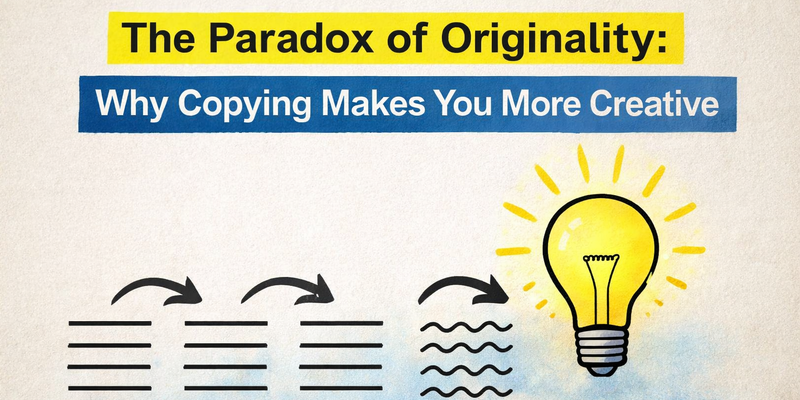
The attached idea says we imitate others and “watch our uniqueness emerge over time.” That “over time” is the key part most people skip.
Your uniqueness doesn’t arrive as a single, identifiable moment. It appears gradually through repetition and small choices:
- You consistently write shorter intros than the writers you admire.
- You prefer sharper, simpler headlines.
- You add more real-world examples because you think readers need grounding.
- You avoid certain tones because they feel fake in your voice.
- You choose certain themes again and again because they matter to you.
Those preferences are not “invented.” They’re revealed. And the only way they reveal themselves is by producing enough work for patterns to form.
In creative fields, style often looks like identity, but it is frequently the outcome of volume: the accumulation of choices made repeatedly under real constraints.
A Practical Way to Use This Idea
If you want to turn this paradox into an actual workflow, try this simple method:
Pick 3 references you genuinely admire
Not 20. Not “everything.” Just three strong examples: articles, reels, ads, scripts, posters, interviews—whatever matches your domain.
Copy the structure, not the content
If it’s an article, copy the flow: hook, context, core insight, examples, takeaway.
If it’s a design, copy the layout: spacing, type hierarchy, visual balance.
Make one deliberate change every time
Change the tone. Swap the pacing. Add one extra example. Reduce one section. Replace a cliché with a sharper line. These small changes are how your voice starts to show up.
Repeat until the style becomes yours
After 10–20 iterations, you’ll notice you’re no longer “trying to be original.” You’re making choices faster, with more confidence, and with a clearer sense of what feels like you.
The Real Message: Stop Waiting, Start Producing
“Copy, copy, copy and something new comes along” is not a celebration of unoriginal work. It’s a reminder that originality often lives on the other side of repetition.
If you’re building a brand, writing stories, creating content, designing assets, or developing products, the biggest advantage is not brilliance—it’s momentum. Copying (as a learning tool) gives you momentum. It keeps you in motion long enough for your own voice to arrive.
So the paradox is not that originality is fake. The paradox is that the fastest route to originality is often the disciplined practice of imitation—followed by the patience to keep going until your uniqueness becomes impossible to hide.
Discover more from News Link360
Subscribe to get the latest posts sent to your email.