

Why People Choose Illusions Over Truth: Nietzsche Explained
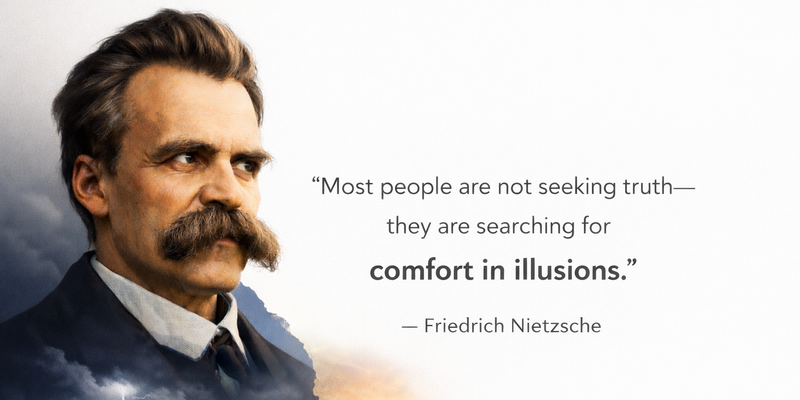

It is an uncomfortable line, precisely because it sounds less like philosophy and more like diagnosis.
Nietzsche’s quote doesn’t accuse people of being unintelligent. It suggests something more human and more difficult to admit: that we often prefer narratives that soothe us over facts that unsettle us.
This idea lands hard in any era, but it feels especially relevant now, when information is abundant and certainty is easy to purchase—through ideology, influencers, echo chambers, or a perfectly tailored social feed. The “illusions” Nietzsche points to are not always obvious lies. They can be half-truths, selective memories, exaggerated optimism, scapegoats, or simplified stories that protect us from ambiguity. They can also be the internal stories we tell ourselves: I’m fine. This will solve itself. I don’t need to change.
The appeal of illusions
Truth is demanding. It asks for attention, patience, and the willingness to revise your beliefs. Comfort, on the other hand, offers immediate relief. Illusions work like emotional shortcuts: they reduce complexity, protect identity, and keep anxiety at bay.
That’s why misinformation spreads faster than nuance. That’s why people cling to “what feels right” even when evidence disagrees. And that’s why personal growth is often delayed not because people don’t understand what they should do, but because accepting the truth would force a painful decision: to take responsibility, to grieve, to confront a fear, or to admit that a long-held belief was wrong.
Illusions aren’t always “bad”
Nietzsche’s quote can sound harsh, but it becomes more useful when read with precision. Humans rely on comforting stories for survival too. Hope, faith, and optimism can be necessary. Some illusions—like believing you can improve, even before you have proof—can push you forward. The problem begins when comfort becomes the goal, and truth becomes negotiable.
A healthy mind needs both: meaning that sustains you and reality that corrects you. The danger is not comfort itself; it is comfort that refuses scrutiny.
How this plays out in public life
In politics, business, and media, “comfort in illusions” often looks like slogans replacing policy, identity replacing evidence, and outrage replacing understanding. Stories that flatter a group spread; stories that complicate the group’s self-image are rejected. The result is a culture where being right matters less than feeling validated.
Even journalism, at its best, fights this gravitational pull. Reporting that confronts cherished myths will always face resistance—because it threatens the emotional safety of a familiar worldview.
How this plays out in private life
The quote cuts even closer in personal relationships and self-perception.
- In relationships, illusions keep people stuck: They will change, this is normal, love should not be this hard, I can fix it alone.
- In careers, illusions postpone action: I’ll start when I’m ready, I need one more course, it’s too late for me.
- In health, illusions bargain with reality: It’s probably nothing, I can ignore it for now.
These are not failures of character. They are protective instincts. But they come with a cost: illusions demand maintenance. Truth, once faced, demands movement.
What Nietzsche is really challenging
Nietzsche is not merely calling people dishonest. He is challenging the impulse to treat truth as a threat rather than a tool. Because once truth becomes optional, everything becomes manipulable—by others and by ourselves.
The quote asks a sharp question: What am I protecting by avoiding the truth?
Sometimes the answer is pride. Sometimes it’s fear. Sometimes it’s grief. Often it is the simple exhaustion of confronting complexity.
Choosing truth without losing compassion
If comfort is the first instinct, truth can still be the second choice—the deliberate one.
A practical way to live this quote isn’t to become cold or cynical. It’s to build a habit of gentle honesty:
- Separate what you want to be true from what is supported by evidence.
- Look for the parts of a story you avoid, not just the parts you enjoy.
- Ask whether a belief makes you more capable—or simply more comfortable.
- Stay open to complexity, even when it slows down certainty.
Nietzsche’s line endures because it names a tension that never disappears: we are meaning-seeking creatures living in a world that doesn’t always cooperate with our preferred meanings. The challenge is not to eliminate comfort, but to stop confusing comfort with reality.
Because illusions feel good—until they collapse. Truth is harder—but it tends to hold.
Discover more from News Link360
Subscribe to get the latest posts sent to your email.