
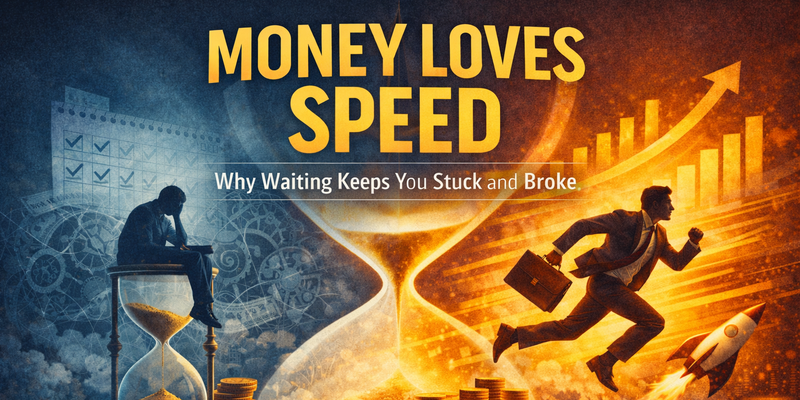
Money Loves Speed: Why Waiting Keeps You Stuck and Broke


In practice, this isn’t about becoming hyper-busy. It’s about shortening the gap between intent and execution, especially on the small, high-leverage actions that turn ideas into outcomes.
What “money loves speed” really means
When people say money loves speed, they usually mean one thing: opportunities reward the doer, not the daydreamer. A business idea, a career plan, a savings goal, a side project none of these pays you for thinking about it. The reward shows up only when the idea moves into the real world: a call made, a product shipped, a proposal sent, a system built, a habit repeated.
Speed here is not running faster. It is reducing friction. It is deciding faster, starting sooner, and learning quickly from small attempts rather than waiting for perfect certainty.
Why waiting becomes expensive
Waiting feels safe because it looks like preparation. But often it is disguised avoidance—waiting for more clarity, more confidence, more money, more time, or the “right moment.”
The problem is that time adds costs:
- Momentum fades. The energy that comes with a new idea is time-sensitive.
- Doubts multiply. The longer you wait, the more reasons appear to not start.
- Competition increases. Markets and careers do not pause while you prepare.
- Windows close. Some openings are seasonal: a hiring cycle, a trend, a customer need, a moment of demand.
This is what the quote means by “poverty loves waiting.” Not poverty only in the financial sense, but poverty of options—fewer chances, fewer relationships, fewer experiments, fewer outcomes.
The execution gap is where most goals die
Many people are not short on ideas. They are short on follow-through. The execution gap is the space between “I should” and “I did.”
That gap is usually filled by three things:
- Overplanning: researching endlessly to avoid the discomfort of starting.
- Perfectionism: believing the first attempt must be flawless.
- Fear of judgment: delaying so you don’t have to risk being wrong publicly.
Speed breaks this cycle. Not by removing fear, but by moving in spite of it—small, simple, and fast.
How to build speed without burning out
Healthy speed is not chaos. It is structure.
1) Turn ideas into the next physical step
An idea stays vague until it becomes an action you can do in 10–30 minutes.
Not “start a business.” Instead: “message 10 potential customers” or “draft a one-page offer.”
Ask: What is the next step I can complete today, even if it’s imperfect?
2) Use “48-hour rules” for decisions that don’t deserve months
Many choices are reversible: posting content, testing an offer, applying for a role, reaching out to a mentor, launching a small service. If the downside is limited, decide quickly and adjust later.
Speed comes from accepting that learning happens after you move.
3) Replace “someday” with a calendar slot
Waiting thrives in open time. Action thrives in scheduled time.
If it matters, give it a date, a time, and a duration—even 30 minutes.
4) Ship small, then improve
A simple version today beats a perfect version next month. You can refine after feedback arrives. In fact, feedback is often the only thing that makes refinement meaningful.
5) Track “time-to-action” like a metric
If you want a practical measure: how many days pass between deciding and doing?
Reduce that number steadily. This is one of the most underrated productivity and income skills.
Speed creates compounding results
When you act faster, you do not just complete tasks sooner. You increase the number of attempts you can make in a year. More attempts mean more lessons, more connections, and more chances to get it right.
Speed also builds identity. Each time you execute quickly—send the message, publish the draft, make the call—you reinforce a quiet belief: I’m the kind of person who follows through.
The takeaway
Codie Sanchez’s quote isn’t a motivational poster. It is a warning and a strategy in one sentence: delays can drain your potential, while action creates options.
If you have an idea you keep revisiting, treat it as a signal. Pick one next step that takes under 30 minutes. Do it today. The world rewards motion—and waiting rarely pays interest.
Discover more from News Link360
Subscribe to get the latest posts sent to your email.