On the other end was an old friend, a former India cricketer, with some practical advice: after two decades in domestic cricket — 16 seasons with Himachal Pradesh and six as a professional with Pondicherry — perhaps it was time to move on.
There was a lucrative offer from a prominent legends’ league featuring retired players. The money was good. The grind would be lighter. The future, secure.
Dogra listened. But he was torn.
The hunger to compete in India’s premier domestic tournament still burned bright. Yet the road ahead seemed uncertain.
In the middle of that dilemma, he dialled another number, that of Mithun Manhas.
That conversation changed everything.
Manhas, then the cricket director at the Jammu and Kashmir Cricket Association, urged Dogra not to give up on mainstream cricket. Instead, he offered him a fresh challenge — the role of guest player-cum-captain for the Jammu and Kashmir team.
After days of deliberation, Dogra said yes.
In 2024, when he took charge, he could not have imagined that two years later he would guide J&K to its maiden Ranji Trophy title. Initially, though, the appointment sparked controversy. A section of the cricket fraternity questioned whether his perceived closeness to Manhas had tilted the scales in his favour.
Dogra let his bat, and leadership, respond.
“Initially, the runs were not coming. So, of course, the pressure was mounting. But somehow, I was enjoying this new journey with the bunch of boys,” he tells Sportstar.
Integration was his first task. He made it a point to involve everyone.
“I took advice even from the youngest member of the team. Before every innings, we would get into a huddle: seniors, juniors, everyone spoke. Every opinion was valued.”
That culture of inclusiveness began to reflect in performances. Under the watchful eye of head coach Ajay Sharma, preparation standards rose. P. Krishnakumar and Dishant Yagnik brought freshness to bowling and fitness drills. Within the dressing room, Dogra became Paras bhaiya — the elder brother who backed talent unconditionally.
“I have always believed in taking everyone together on a journey. The players knew that if they had it in them, I would be the first person to support them,” he says.
The results followed.
J&K stunned a star-studded Mumbai at home, defeated Baroda in its den, and came agonisingly close to a semifinal berth before conceding a one-run first-innings lead to Kerala.
“That hurt every member of the team,” Dogra recalls. “Last year, Abid (Mushtaq) dropped a catch and Kerala’s last-wicket pair added 81 runs to take a one-run lead. It stayed with him.”
Redemption came a season later. Mushtaq clung on to a sharp chance in the quarterfinal against Madhya Pradesh. “You should have seen his expression. That was the spirit of this team — owning mistakes and making amends.”
Dogra’s own journey mirrored that arc. He endured a lean patch with the bat and even contemplated retirement.
“I was not sure if I should continue playing because the runs weren’t coming, and I thought I was blocking a place where a junior player could break in…”
Once again, Manhas intervened.
“Mithun bhai said, ‘ Tujhe khelna hoga (You will have to play)’. Don’t give up.” I listened.
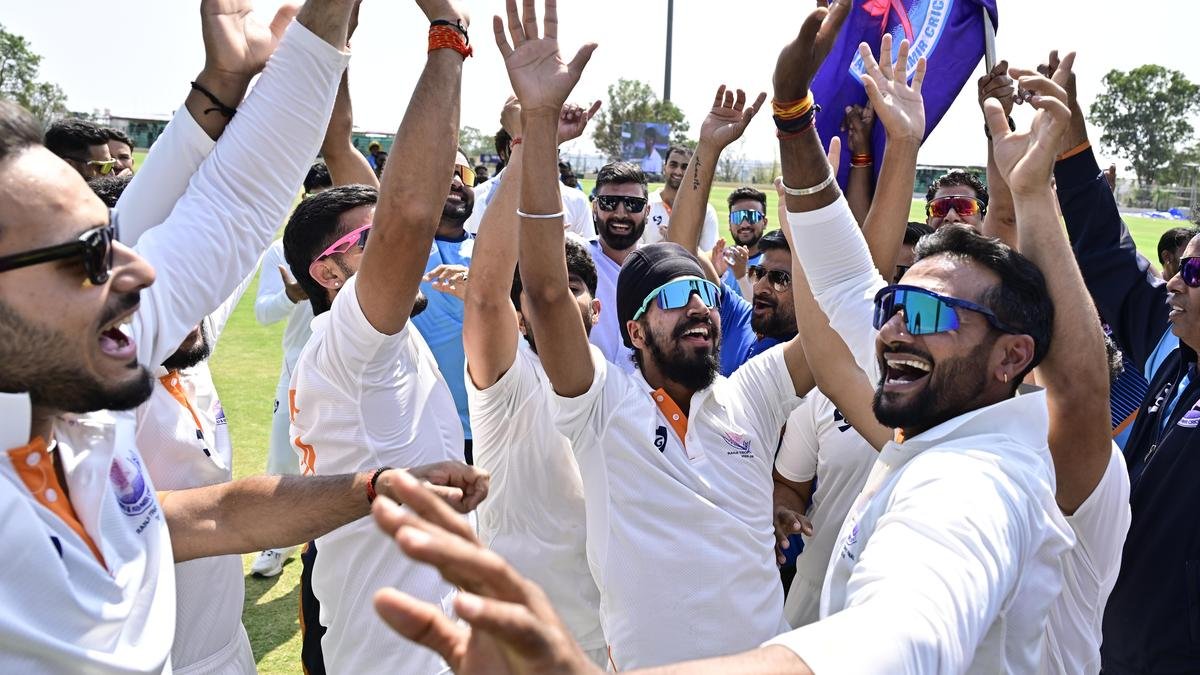
The response was emphatic. During the semifinal this season, Dogra became only the second cricketer in history to cross 10,000 runs in the Ranji Trophy. By the end of the campaign, he had accumulated 637 runs — vital contributions in a title-winning season.
“I have always believed in keeping things simple,” he says. “I don’t lose my cool often.” But even perfect stories have flawed moments.
“This time, I did lose my cool… And I regret that,” he says.
In the final against Karnataka in Hubballi, Dogra was involved in a heated exchange with substitute fielder K. V. Aneesh. Frustrated by persistent short-pitched bowling from Prasidh Krishna and irritated by chatter from close quarters, Dogra walked up to Aneesh and, in a flashpoint moment, their helmets collided.
“The Karnataka fast bowlers, especially Prasidh, peppered me with the short ball, and I was struggling to read his length. So I was already a bit irritated and angry with myself. In between, Aneesh’s chatter continued. I couldn’t take it beyond a point, so I thought I would go up to him and ask him to stop. What I did not realise then was that my helmet had actually hit his helmet,” he says.
He admits it was momentary.
“I was angry with myself. When I saw the footage later, I apologised immediately. Such things shouldn’t happen,” Dogra says.
Importantly, the episode did not derail the team’s focus. “Our bowlers, led by Auqib Nabi, were outstanding across conditions. When Nabi had a tough day, someone else stepped up. Everyone fought for a common goal,” Dogra says. Selection headaches became a luxury rather than a problem.
In the dressing room after the final, Abdul Samad summed up the team’s journey: win or lose, this side knows how to fight.
For Dogra, the triumph carried deeper, personal resonance. On February 28, 2009, he lost his father. Seventeen years later, on another February 28, he lifted the Ranji Trophy — the biggest prize of his career — dedicating it silently to the man who shaped his early cricketing dreams.
What next remains undecided. He will consult Manhas and his well-wishers before taking a call on his future. But whatever he chooses, Dogra knows this much: the true legacy lies beyond statistics.
Jammu and Kashmir’s maiden title will inspire a generation in the region to believe that dreams are not confined by geography. And for Dogra, that belief is the greatest trophy of all.
Published on Mar 11, 2026
Discover more from News Link360
Subscribe to get the latest posts sent to your email.