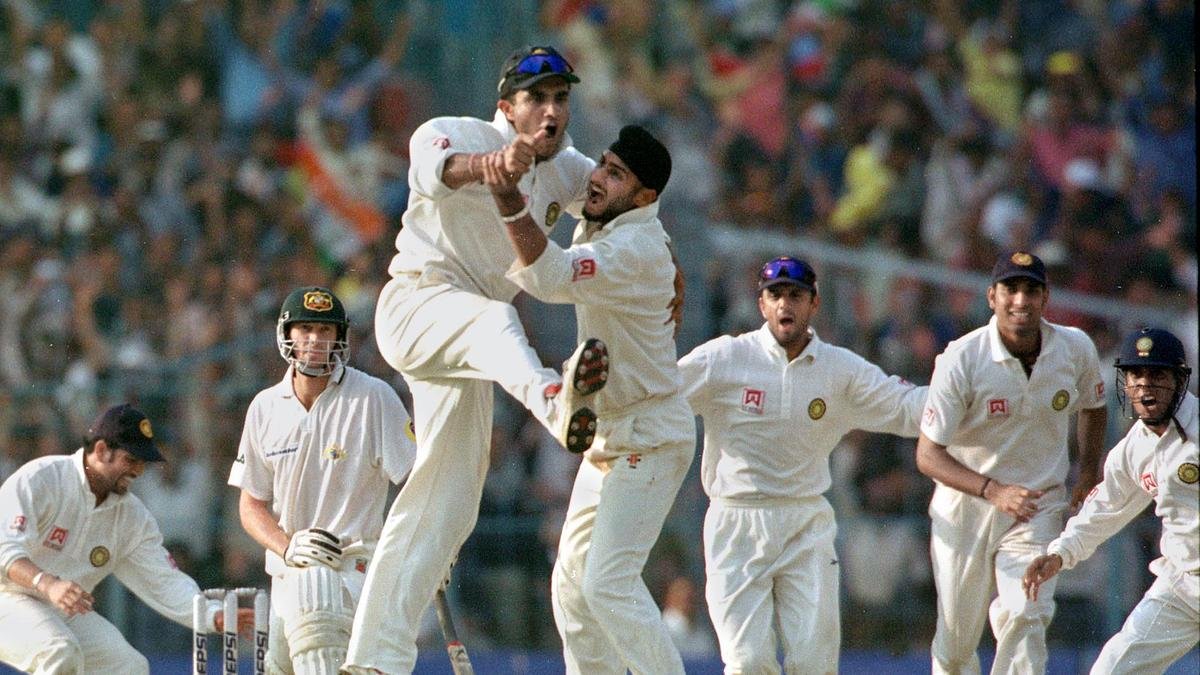
Being a Kolkata boy who had grown up playing on these pitches, I knew that on a fifth-day surface at Eden Gardens, when the cracks widen and sharp turn sets in, chasing anything substantial is never easy. I was sure of that.
Still, time was slipping away. An hour into the morning session, we were in two minds: declare or wait. I kept turning to our coach, John Wright, for reassurance. Each time I asked, he would say, “Wait, wait…”
The stands were packed. Yet, inside the dressing room, doubt lingered. Suddenly, an attendant walked in with a chit. It was for me. It read, “What’s happening? Why are you not declaring? The spectators are getting impatient…”
ALSO READ | Dravid recalls Eden Gardens 2001: Fever, hospital stay and the 376 partnership with Laxman
It was from my father. As a seasoned administrator, he understood the pulse of a crowd. I remember wondering where he was watching from. “Up in the box,” someone said. Even now, I smile at that moment. The crowd outside was restless; my father sensed it before I did.
Soon after, we declared.
We did not have Anil Kumble, who was injured, but we trusted what we had: Venkatapathy Raju, Harbhajan Singh and Sachin Tendulkar. On a wearing surface, that was a formidable spin attack. Now it was about holding our nerve.
Years later, people still say that rotating the bowlers and giving Sachin the ball alongside Harbhajan was a masterstroke. I call it instinct. Leadership is about reading the moment, sensing momentum, and not being afraid to change course. You grow into that.
Harbhajan was exceptional in that series. Seven wickets in the first innings had given him confidence, and he was bowling beautifully again. My job was to keep him attacking from one end and rotate from the other to create uncertainty in the Australian camp. Sachin responded with three priceless wickets – Matthew Hayden, Adam Gilchrist and Shane Warne. Sometimes captaincy is about trusting your best players at the right time.
While Harbhajan took six wickets in the second innings as well, it was important to give him short breaks so he could return with renewed intensity. That is where the experienced campaigners – Sachin and Raju – came into play. After a steady start, Australia crumbled in the final session, losing wickets in clusters. Even when we sensed victory, it was important not to get carried away. Staying in the moment was crucial.
That Australian team was built differently. It had champion cricketers capable of turning a game in a session. We had to be cautious, especially as this was the ‘final frontier’ for the Steve Waugh-led side, unbeaten at that point and chasing a first Test series win in India in 31 years.
When Michael Slater and Justin Langer troubled us early, we regrouped between overs. One good spell, one sharp catch, could shift the match. On turning pitches in India, the game can flip in three overs. One wicket becomes two, then three. The tide turns quickly. The key was to hang in, bowl the right areas and hold our catches at slip, short leg and silly point.
We never lost belief. Everyone had one goal: to bounce back in the series. That was not easy after the heavy defeat in Mumbai. But that is the beauty of a three-match series. Lose one and you still have room to recover.
The Eden Test had already pushed us into adversity.
ALSO READ | Was only 50-60% fit: Laxman on the 281 that changed the 2001 Eden Test
We were bowled out for 171 in the first innings. When Australia enforced the follow-on, we had a decision to make. V.V.S. Laxman had been our best batter in the first innings with 59. He was in rhythm, seeing the ball well. So, we promoted him to No. 3. It was bold in that context.
Sometimes, small tactical changes create history. What followed from Rahul Dravid and Laxman was, in my view, the finest exhibition of Test batting under pressure I have witnessed. Their partnership was not just about skill; it was defiance. They bent the game until it turned.
That innings brought us back into the match and instilled self-belief. As they battled the heat, the cramps and some nasty deliveries, they sent a message: this Indian team was built differently too. They did not look at the opponent; they focused on their job. That mindset changed Indian cricket.
We won the match. Then the series. And that changed everything.
As a team, we never believed in preparing poor pitches. Look at the scores in that series – all high-scoring, ranging from 400 to 500. We wanted good wickets because good wickets demand improvement.
ALSO READ | Laxman and Dravid changed the fate of Indian cricket: Sadagoppan Ramesh
On good surfaces, fast bowlers remain in the game and learn to bowl long spells. Batters and bowlers are tested. On poor pitches, limited skills can survive. On good ones, you evolve. That philosophy helped us overseas.
When we toured Australia in 2003–04, I scored a hundred in Brisbane. Rahul and Laxman delivered in Adelaide. Virender Sehwag in Melbourne. Sachin and Laxman in Sydney. Different players, different moments, but everyone stood up. That builds a great team.
We were not just trying to win a Test or a series. We were building character. We reached the ICC finals in 2000, 2002 and 2003.
We fought hard in Australia. We won in Pakistan. We returned to England in 2007 and triumphed. It was largely the same core group, playing fearless cricket everywhere—England, South Africa, West Indies, Australia. Not just at home.
Through all of it, John Wright stood beside me not merely as a coach but as family. I still consider him an elder brother. When his family visited England, they stayed with us because he was busy with the team. That relationship mattered. It meant that when I made a bold decision on the field, I knew he had my back. That trust filters into performance.
Looking back, one decision here or there could have changed everything in that second innings. Cricket is fragile. But that evening in Kolkata, as the sun dipped and the noise swelled, I realised something: great teams are not built in comfort. They are forged when doubt whispers loudly, and you choose belief instead.
Over the next five or six years, we never lost that belief. Of course, there were difficult phases and criticism when results went against us. In those days, without social media, the noise was easier to manage. We chose not to dwell on setbacks. Instead, we built a pool of talent that could carry the baton forward.
I am glad we did. None of it would have been possible without the team’s backing, without unity, without the courage to dream.
But it all began in Kolkata. That afternoon, we not only won a match; we sowed the seeds for long-term dominance.
(As told to Shayan Acharya)
Published on Mar 15, 2026
Discover more from News Link360
Subscribe to get the latest posts sent to your email.