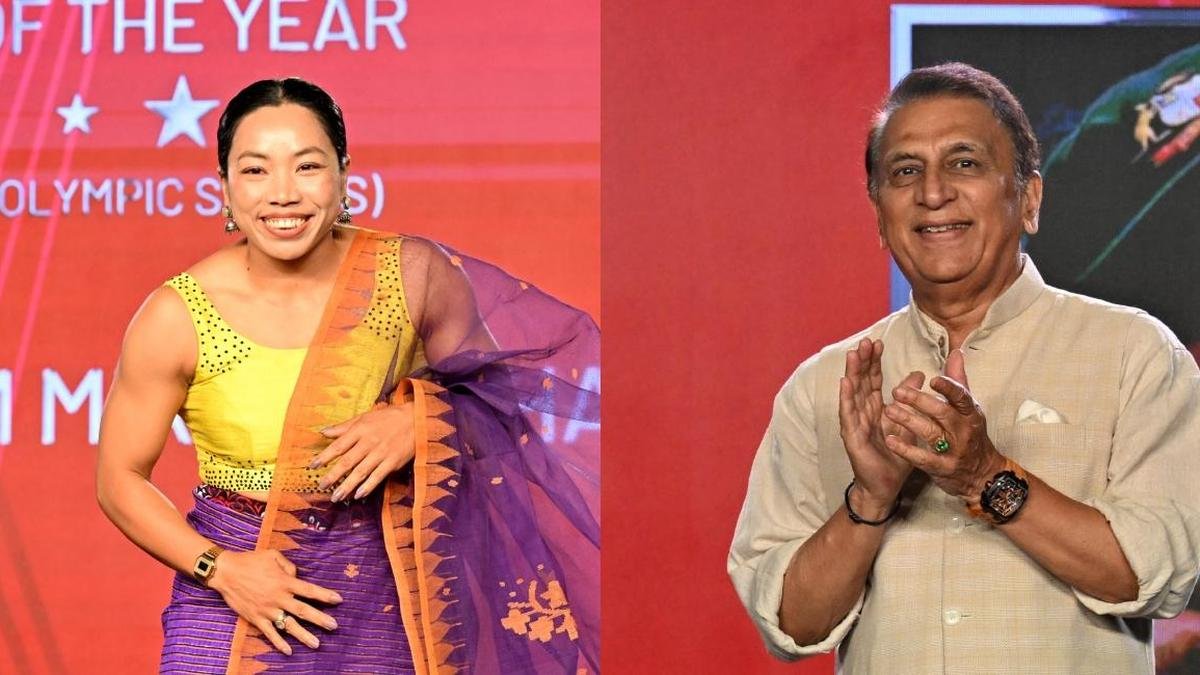
The night had all the makings of a spectacle. India’s finest athletes were present. The room was full of stories and the easy shimmer of achievement.
But the moments that stayed were not choreographed. They happened in the margins, in pauses, in glances. They happened in the small acts we no longer pay attention to.
Earlier, under the lights, Sunil Gavaskar had faltered mid-sentence. His tribute to Nari Contractor, whose career was cut short by a Charlie Griffith bouncer that fractured his skull, was an ode to a boyhood hero. For a moment, the room fell silent, as if aware it was sharing something intimate between two legends.
Later, at dinner, the meal was Parsi, laid out in tribute to Contractor. Gavaskar sat with him and his family, easing into conversation, into memory, into food, with mutton dhansak served warm, the evening finding them unguarded.
A few steps away stood Mirabai Chanu.
She was not restless, not insistent. She simply waited.
When someone asked why, she said, almost apologetically, “Gavaskar Sir toh khana kha raha hai, main wait kar loongi. Ek photo lena hai (Gavaskar sir is having dinner, I will wait. I want a picture with him).”
There was no performance in it, no awareness of its own grace. Just a simple understanding that a man eating his meal should not be interrupted.
We have grown used to urgency: the tap on the shoulder, the phone already out, the half-formed smile that asks without asking. We move as if every moment must be claimed, captured, posted.
Gavaskar, immersed in conversation, took his time. Eventually, someone leaned in to tell him that Mirabai was waiting. He looked up, with that familiar warmth on his face, and said, “An exception can be made for an Olympic champion.”
He rose immediately.
What followed was unplanned and therefore perfect. Mirabai stepped forward, a little shy, a little thrilled. Rani Rampal drifted in, Sakshi Malik followed, and soon there was a small gathering not of icons but of people laughing, leaning in, sharing space.
Across the room, conversations stretched into the night. Around another table, ten former captains of the Indian women’s cricket team found themselves trading stories with Gavaskar and Glenn McGrath. Diana Edulji spoke of Gavaskar’s long support for women’s cricket. Jhulan Goswami admitted, with a smile, that she had once tried to bowl like McGrath, his posters up on her wall. McGrath, who once terrorised Indian batters, now stood patiently through every request, generous with his time.
The evening loosened, as good evenings do. Glasses filled and emptied. Laughter lingered. By the time the clock edged towards two, it felt less like an event and more like a gathering that was reluctant to end.
We walked Gavaskar and M.M. Somaya down the grand staircase, the hotel now quieter, the night finally catching up.
And then, almost inevitably, the other side of it appeared.
In the lobby, a few eager figures hovered, slipping wordlessly beside familiar faces, angling for a photograph, completing the act before a sentence could be exchanged. Gavaskar paused, looked at one of them, and said gently, “First, say hello, ask me how I am doing.”
It was not a reprimand. It was a reminder.
Because somewhere along the way, we have begun to treat people as moments to be captured rather than lives to be acknowledged. A photograph has become proof, not memory. Proximity, flaunted in WhatsApp groups, has replaced connection.
And yet, earlier that night, an Olympic medallist had stood aside and waited, not out of obligation but out of instinct.
Perhaps that is what humility really is. Not the grand gesture, not the speech, not the applause. Just the decision to see another person fully, to give them space, time, dignity.
To let them finish their meal.
Published on Mar 26, 2026
Discover more from News Link360
Subscribe to get the latest posts sent to your email.