
PNG means natural gas is lighter than air. This means that if gas leaks somewhere, it blows upwards and spreads quickly. At the same time, LPG is heavier than atmospheric air. That is, if LPG leaks, it starts accumulating on the ground below and this is the reason why LPG leakage can be more dangerous because it collects at one place and increases the risk of blast. For this reason, if seen from safety point of view, PNG is considered safer than LPG. Now friends, if you understand this much then let’s start the real story.
Is PNG different from natural gas?
Let us tell you that PNG is not a separate gas but it is the same natural gas which reaches your house directly through the pipeline. Now the question arises, how is natural gas made? Let us tell you that natural gas is also a fossil fuel. When due to any natural disaster like flood, volcano or earthquake, these animals and plants get buried under the soil. With time, thick layers of soil and stones start accumulating on them. Due to lack of oxygen and continuously increasing temperature and pressure, they gradually undergo chemical changes and finally get converted into natural gas, crude oil and coal. Natural gas contains the highest amount of methane. This gas is very light, clean and burns quickly. For this reason it is used as fuel. Many times drilling has to be done even under the sea. When gas reserves are found, the gas is taken out by laying pipelines there. The gas that comes out of the ground is not suitable for direct use. It is called Raw Natural Gas. There are many types of impurities in it. Like water steam, carbon dioxide, hydrogen sulphide and dust particles etc.
Now if this gas is used like this then it can be dangerous and can also harm the machines. Therefore the next step is gas processing. Raw natural gas is sent to a processing plant. Here it is cleaned in several steps. First of all, water moisture is removed from the gas because moisture can cause rust in the pipeline. After this, poisonous elements like carbon dioxide and hydrogen sulphide are removed.
Hydrogen sulphide is especially a very dangerous gas. After this the gas is further refined so that mainly only methane is left in it. By then this gas has been purified to a great extent. This gas is later used in different ways. If it is compressed at high pressure then it becomes CNG and if it is sent through pipeline then it becomes PNG. That means the gas is the same, just the way of using it is different. The entire distribution system of PNG works on a very large network which is called City Gas Distribution Network.
How does PNG reach your home?
Many companies handle this network in India. Like Indraprastha Gas Limited, Mahanagar Gas Limited and GAIL. Now let us understand how this entire system works. First of all, natural gas is sent to different cities through huge transmission pipelines. These pipelines are hundreds of thousands of kilometers long and are laid underground. In these the gas remains under high pressure. Now when gas reaches the city, it is not sent directly to the houses.
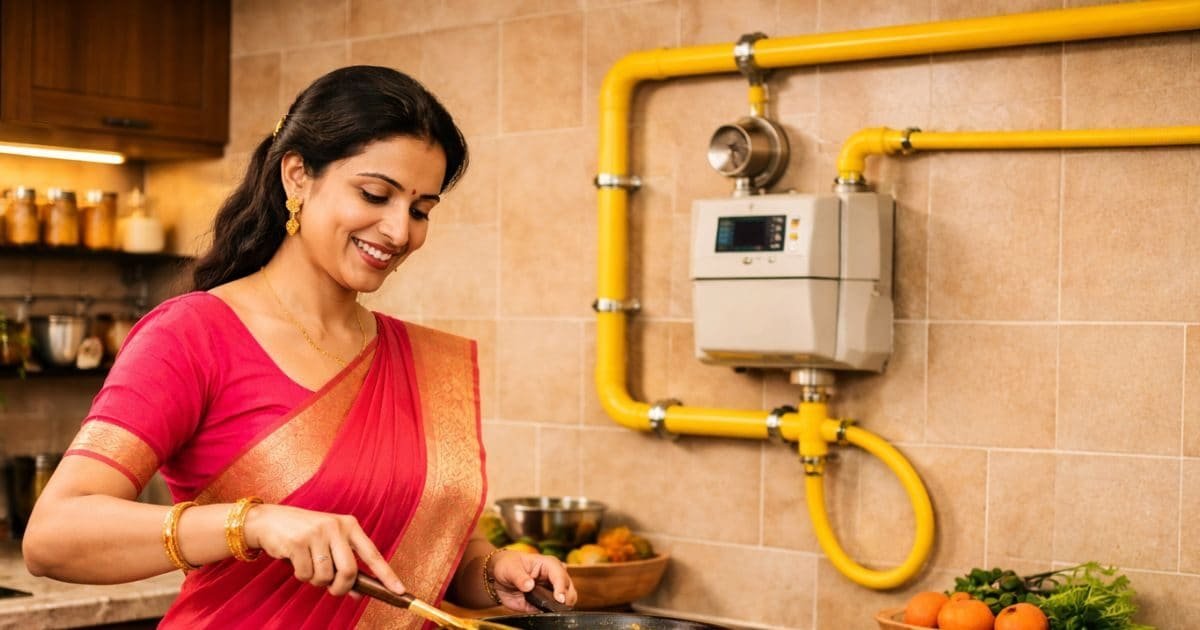
First of all this gas goes to a city gate station i.e. CGS. Here the pressure of the gas is reduced because sending high pressure gas to homes can be very dangerous. After this the gas is sent through a network of small pipelines. Now this gas gradually starts reaching every colony, every street and every house. Now comes the turn of your house. When a PNG connection is taken, a thin pipeline is brought to your home. A meter is installed outside the house. Just like an electricity meter. This meter measures how much gas you use. After this the gas reaches directly to the stove in your kitchen.
Benefits of PNG
The biggest advantage is convenience i.e. there is no fear of running out of cylinder and no hassle of booking. Secondly, it provides continuous supply. Third, it is a clean fuel which causes less pollution and fourth, it is also economical in the long run. But, PNG is not available everywhere. There may be initial cost of installation and if there is any problem in the pipeline, the supply may also stop. It has many types of safety systems. Like pressure control, automatic cut off and leakage detection.
Discover more from News Link360
Subscribe to get the latest posts sent to your email.