Ajay Kumar Verma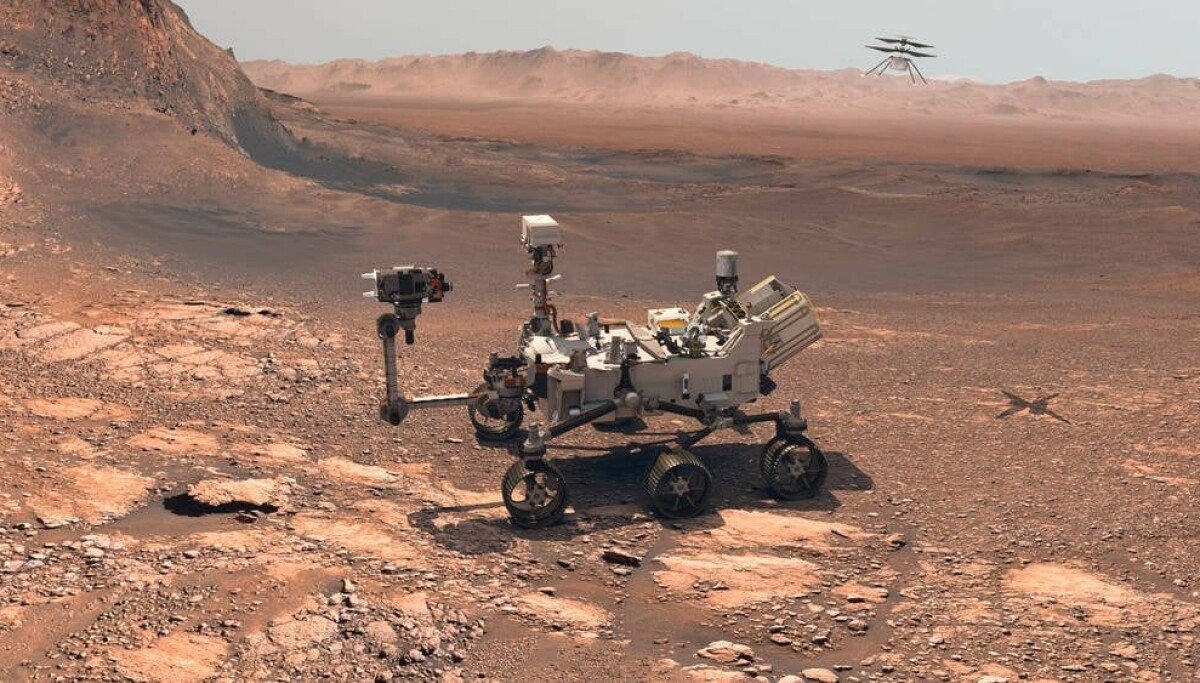
offbeat
Scientists remain skeptical, plead for someone to bring the rocks home
Yet another Martian rock formation has revealed what may be signs of ancient life on the Red Planet. While these findings aren’t as scientist-wowing as those reported last year, they add to growing evidence that ancient Mars contained organic carbon and may once have been habitable.
An international team of scientists working on examining Martian rock samples collected and analyzed by the Perseverance rover reported in Science Advances Wednesday that they’d found signs of macromolecular carbon (MMC) in the Martian rock dubbed Cheyava Falls. Like most of the other life-affirming samples collected from Mars, this one comes from Jezero Crater, where Perseverance has spent the entirety of its five-year mission.
Jezero Crater, and particularly the long-dried riverbed known as Neretva Vallis that fed what’s believed to be a large lake that once filled Jezero, has been the site of several potential signs of ancient life on Mars, and it’s no different in this case. Two instruments at the end of Perseverance’s arm, the Scanning Habitable Environments with Raman and Luminescence for Organics and Chemicals (SHERLOC) and the Wide Angle Topographic Sensor for Operations and eNgineering (WATSON), were collectively responsible for the discovery of MMCs in Cheyava Falls.
MMCs found on Earth are often associated with organic compounds essential to life, including carbohydrates, lipids, proteins, and nucleic acids, and there’s a distinct possibility that the MMCs found on Mars could have come from similar sources.
The Cheyava Falls team was also excited to link their findings to a discovery made by Curiosity in 2018, which found evidence of similar materials more than 3,500 kilometers away in Gale crater.
The potentially organic matter discovered by Curiosity was dubbed “kerogen” by that team. From a strictly scientific standpoint, kerogen can be used interchangeably with MMC, but the Cheyava Falls team opted to avoid that terminology in order to “avoid implications of biogenicity.”
That said, it’s still exciting to the team, and the widespread discovery of MMCs across Mars could indicate that “habitability … and the availability of organics, may have been widespread across the planet billions of years ago.”
This discovery hasn’t led the researchers to jump to conclusions, however. As they note in the paper, there are a number of lifeless sources of MMCs that could be the cause of their detections, with meteorite impacts and abiotic synthesis of organic matter that could both be responsible.
“There are multiple potential pathways to form abiotic organics on Mars, including condensation from igneous systems and associated volatiles, serpentinization, carbonation, and the electrochemical reduction of carbon dioxide in aqueous/hydrothermal fluids,” the team noted.
In other words, this is nowhere near the confounding mystery that NASA admitted it had on its hands in September of last year.
Perseverance drilled a core sample called Sapphire Canyon from the Cheyava Falls rock, which NASA said last year contained potential signs of ancient life that it couldn’t readily explain through abiotic processes, though non-biological explanations remain possible.
“A year ago we found what we believe to be signs of microbial life on Mars’ surface,” then-acting NASA administrator and transportation secretary Sean Duffy said at a press conference last year. “After a year of review [the scientific community] has come back and said it can’t find another explanation.”
Jezero Crater has given up other signs that it may have been a vibrant, living ecosystem too. In March, researchers reported that the same region also turned up signs of nickel compounds that indicate the formation of enzymes related to bacterial biological processes, but again those signs are also explainable by non-biological action.
Proof of life requires samples brought to Earth
Both the report released Wednesday and the research leaders behind it are unequivocal on what it’ll take to confirm the growing body of evidence that there was once life on Mars: Samples need to be returned to Earth for inspection.
“The instruments on the Perseverance rover were not designed to distinguish between rocks that formed through biologic or abiotic processes, but they are able to identify compelling rocks to sample for possible return to Earth,” SHERLOC principal investigator and NASA Jet Propulsion Laboratory scientist Kyle Uckert told us in an email.
Uckert reiterated to us that humanity’s best chance at fully understanding whether the various organics detected in Jezero Crater is some sort of sample-return mission, and he explained that rocks they sampled for the study are packaged, sealed, and waiting for the possibility that something like that still happens.
That’s far from a sure thing at this point, as NASA’s Mars Sample Return plans are essentially scuttled at this point – something Uckert and his co-lead author, Planetary Science Institute researcher Ashley Murphy, declined to weigh in on when asked.
Meanwhile, China is already pressing ahead with its own Mars sample-return mission, with launches planned for 2028 and a sample return targeted for around 2031. China already has a leg up on the US in the sample return space, with the China National Space Administration returning samples from the far side of the Moon to Earth in 2024.
NASA has collected samples from an asteroid and returned them to Earth, to be fair, but Mars is still a long way off, and life or no life, getting samples back to prove it is going to be a race that China may win if its current plans work out. ®
Discover more from News Link360
Subscribe to get the latest posts sent to your email.