Ajay Kumar Verma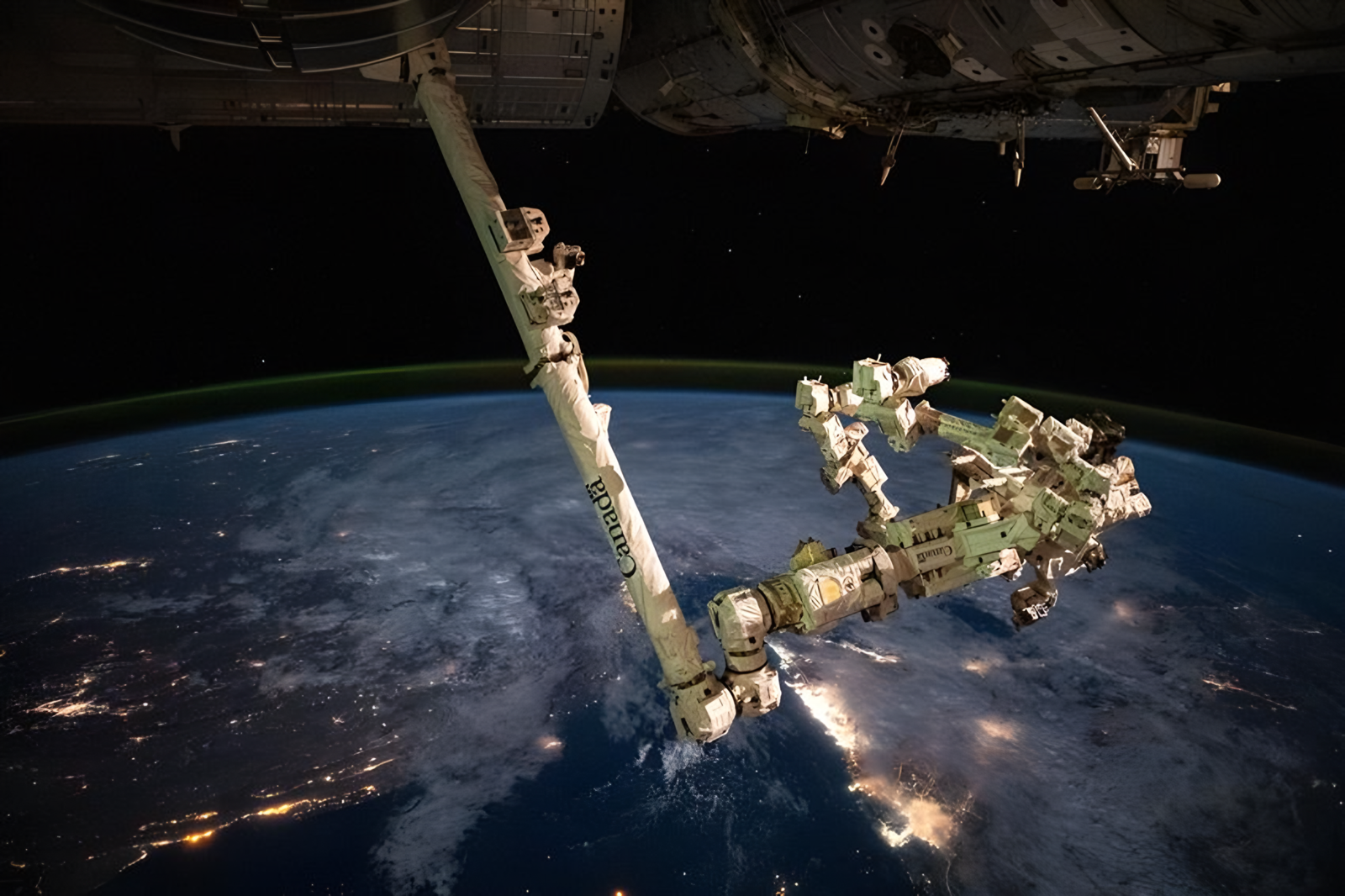
What Caused Canadarm2 to Fail
On the morning of May 27, during routine operations, one of Canadarm2’s wrist joints drew elevated motor current and refused to move as commanded. The fault signature — power consumed, no motion produced — pointed to a seized or failed motor-gearbox assembly inside the joint. NASA engineers and the Canadian Space Agency placed the arm in a safe, stable configuration and suspended all standard operations while they analyzed the fault.
Canadarm2 is not optional equipment. The arm — formally the Space Station Remote Manipulator System — is the mechanism that captures every unpiloted cargo ship approaching the station’s U.S. segment, including SpaceX Dragon and Cygnus vehicles carrying food, supplies, and scientific hardware for the seven-person crew. Without it, the station faces severe limitations in receiving cargo and conducting exterior work. A July crew rotation is already waiting: the Soyuz MS-29 crew vehicle is due to launch to the station next month, and a functional Canadarm2 is a prerequisite for the operations that schedule depends on.
Why the Arm Was Built to Be Fixed in Space
Canadarm2 launched to the ISS on April 19, 2001, aboard Space Shuttle Endeavour. It was designed with a 15-year service life. It has now operated for 25 years — a decade beyond what engineers originally projected — because of a design decision made before it ever left Earth: every major component of the arm was built to be removed and replaced in orbit.
The Canadian Space Agency built the arm around seven motorized joints — one elbow in the middle and three rotary joints at each wrist-and-shoulder end — each one a discrete, bolt-on unit. The arm’s two Latching End Effectors, the grappling hands at each tip, are similarly swappable. At 17.6 metres and 1,800 kilograms of titanium, Canadarm2 can never be brought back to Earth for depot-level servicing: it was never designed to survive re-entry, and it never will be. The modular architecture was the only engineering path to a long operational life. The arm was built so that people in spacesuits can take it apart and put it back together, piece by piece, indefinitely.
This is not the first time that approach has been called upon. In June 2002, just over a year after installation, spacewalkers replaced a wrist roll joint that had seized. Across two spacewalks in late 2017 and early 2018, both Latching End Effectors were swapped after showing signs of wear. Tuesday’s procedure follows the same maintenance logic that has been baked into the program since launch.
“Canadarm2 was originally designed for 15 years of use, but as the space station exceeded expectations, so did the Canadarm,” Jason Dyer, the Canadian Space Agency’s deputy liaison manager for the spacewalk, said at the June 25 briefing at Johnson Space Center. “Now just passing 25 years of use, it is aging gracefully and it is showing signs of wear.”
Bill Spetch, NASA’s ISS operations and integration manager, confirmed at the same briefing that the arm is essential to station operations through the planned decommissioning of the facility in 2030.
What Williams and Meir Will Actually Do Out There
The wrist joint that failed weighs 91 kilograms. Reaching it, however, requires a larger first step: Williams and Meir must begin by detaching a 408-kilogram Latching End Effector — one of the arm’s two grappling hands — that is currently blocking access to the faulty component. Once the Latching End Effector is moved aside, the two astronauts will unbolt the failed wrist joint, install the spare that has been pre-positioned aboard the station, restore all electrical, data, and video connections, and reattach the Latching End Effector. Every movement is monitored by engineers on the ground to protect both the arm and the station’s other systems.
Inside the station, SpaceX Crew-12 pilot Jack Hathaway and ESA astronaut Sophie Adenot will carry out their own task with a certain irony: they will operate Canadarm2 itself to carefully position the arm so that Williams and Meir can work on it. CSA astronaut Jenny Gibbons will guide the pair from mission control in Houston.
Williams will wear a suit with red stripes for identification. Meir will wear an unmarked suit.
A Crew That Has Done This Before
Williams and Meir previously worked together on Spacewalk 94 in March 2026, where Meir logged a seven-hour, two-minute EVA. Meir has considerably more time outside the station: on October 18, 2019, she and Christina Koch conducted the first all-female spacewalk in history, a seven-hour-and-seventeen-minute job replacing a battery charge-discharge unit on the station’s power system. The pair completed two more all-female spacewalks together in January 2020.
Williams arrived at the station in November 2025 aboard the Soyuz MS-28 spacecraft and has been on orbit for approximately seven months.
What Comes Next for Canadarm2 and Its Successor
A successful repair would restore Canadarm2 to full operational capability and clear the way for NASA’s planned schedule over the coming weeks: three additional spacewalks and the July crew rotation. The station’s ability to capture the Soyuz MS-29 crew vehicle depends, in no small part, on getting this arm’s wrist working again.
There is a longer context. Canadarm3, the next-generation successor arm built by MDA Space — the same Canadian company that built Canadarm2 — was originally destined for the Lunar Gateway space station. In March 2026, NASA paused the Gateway program in favor of a direct lunar surface base architecture. MDA Space CEO Mike Greenley has said the company is continuing development of Canadarm3 and exploring ways to adapt it for the lunar surface or for commercial space stations in low Earth orbit. The future of Canadian robotic arms in space remains unsettled.
For now, the most operationally critical Canadian-built robot anywhere in space is the one Williams and Meir will be working on Monday morning.
How to Watch NASA Spacewalk EVA-95 Live
Live coverage of EVA-95 begins at 7:00 a.m. ET on Monday, June 30 on NASA+, Amazon Prime Video, Netflix, and NASA’s YouTube channel. The spacewalk itself is scheduled to begin at 8:35 a.m. ET and is expected to last approximately six and a half hours. NASA’s social media accounts will carry updates throughout the day.
Frequently Asked Questions
What is Canadarm2 and why does the ISS need it?
Canadarm2 is a 17.6-metre robotic arm built by Canadian company MDA Space and owned by the Canadian Space Agency. It is the International Space Station’s primary tool for capturing arriving cargo vehicles — including SpaceX Dragon and Cygnus supply ships — positioning spacewalking astronauts around the station’s exterior, and performing exterior maintenance. Without it, the station cannot berth unpiloted cargo ships, severely limiting its ability to receive food, equipment, and scientific hardware.
What caused Canadarm2’s wrist joint to fail?
On May 27, 2026, one of Canadarm2’s seven motorized wrist joints drew elevated motor current during routine operations but failed to produce any movement — a fault pattern consistent with a seized or failed motor-gearbox assembly inside the joint. NASA and the Canadian Space Agency determined the joint could not be repaired remotely and required a physical replacement, which will be performed during the June 30 spacewalk.
How does a wrist joint get replaced on a robotic arm in orbit?
Williams and Meir must first detach a 408-kilogram Latching End Effector — one of the arm’s two grappling hands — to gain access to the failed 91-kilogram wrist joint beneath it. They will then unbolt the failed joint, install the spare already pre-positioned aboard the station, restore all electrical, data, and video connections, and reattach the Latching End Effector. The entire procedure is expected to take roughly six and a half hours, with engineers on the ground monitoring every step.
How can I watch the ISS spacewalk live on June 30?
Live coverage begins at 7:00 a.m. ET on NASA+, Amazon Prime Video, Netflix, and NASA’s YouTube channel. The spacewalk itself begins at 8:35 a.m. ET and is expected to last approximately six and a half hours.
Discover more from News Link360
Subscribe to get the latest posts sent to your email.