For centuries, the question of what makes something “alive” has fascinated philosophers and scientists alike. Energy use, growth, reproduction, and development are hallmarks of life, but until now, these processes have been observed only in natural organisms. The idea of constructing a living system entirely from non-living chemicals has long belonged to the realm of science fiction.
That boundary has just shifted. An international team of researchers from the University of Minnesota’s College of Biological Sciences, led by Associate Professors Kate Adamala and Aaron Engelhart, has created a fully synthetic life cycle that uses atoms, molecules, minerals, and energy rather than biology to support evolving living machines. The project represents a milestone in the engineering of biology – SpudCell.
Their work, published in a landmark paper, represents a breakthrough in biological engineering and could transform medicine, materials science, and industrial chemistry.
“This is likely the most exciting project I’ve ever worked on,” Adamala said. “We’ve replicated in chemistry what only used to be possible in biology: the complete set of behaviors of a cell. It proves that the most fundamental functions of life, like growth and replication, do not need a mysterious magical spark.”
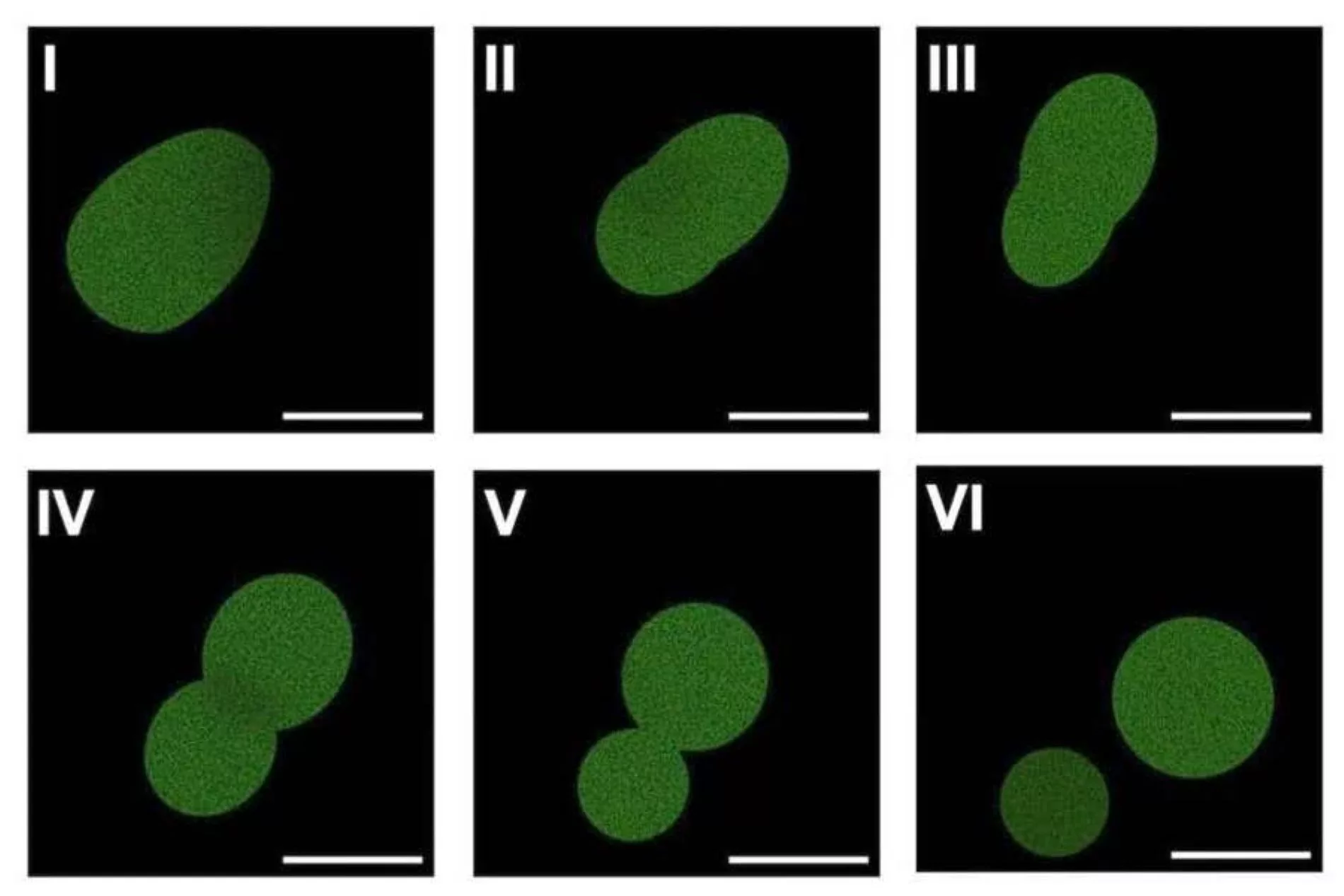
SpudCell is not even a life simulation; it is just life functioning. The synthetic cell is able to replicate its genome, grow in size, and feed on nutrients via osmosis/phase separation (mimicking life-bionics), divide by building an entire neo-membrane around itself, including DNA packaging & structure, maintenance machinery, and simulation of natural selection and competition. SpudCell uses proteins that gather at its membrane until pushed to split, unlike natural cells, which rely on a cytoskeleton for division.
The team witnessed evolution in action: a genetic adjustment upped levels of the fusion protein, and cells expressing it outgrew their cousins by 50 percent, producing more offspring. The variant outperformed the original after five generations, revealing that Darwinian selection can occur in an entirely artificial chemical system.
And the genome of SpudCell is, by most accounts, as minimal as you like. The human genome is ~3 million kilobase pairs; SpudCell’s genome contains 90 kbp and represents the smallest prokaryotic genome we know of (>113 kbp, the speculated minimum). This modular design allows different functions to be independently “programmed” across seven plasmids, permitting successively complex synthetic behaviors.
In order to scale this technology, Adamala and colleagues are launching a new public-benefit research institution called Biotic that will focus on developing shared infrastructure for the engineering of synthetic cells. If successful, the goal is to create open standards, a chassis for synthetic biology, so that labs everywhere can work together without obstacles.
“This was exceptionally difficult work to scale,” Adamala explained. “We had collaborators fly in for in-person demonstrations just to get techniques working. That’s not scalable. Any engineering discipline needs modularity. In our case, those modules must be built in the open.”
Most of the products we rely on, medicines, materials, and industrial chemicals, are made either by hijacking natural cells or through energy-intensive industrial chemistry. Synthetic cells like SpudCell could change that. They could perform molecular transformations that natural biology cannot, producing new drugs, growing novel materials, and manufacturing at biological temperatures instead of industrial extremes.
Imagine medicines built with amino acids evolution never used, or with materials grown rather than synthesized. SpudCell provides the first truly engineerable platform to make that vision possible.
Challenges remain. The seven plasmids must be consolidated into a single, stable genome, and additional molecular machinery must be developed. But the foundation is here: a synthetic cell that lives, grows, divides, and evolves.
“This work is just the beginning,” Adamala said. “To fully realize the promise of this technology, we need a combined international effort. SpudCell is the chassis, and Biotic will set the protocols for collaboration. Together, we can start applying this technology to serious challenges.”
Journal Reference:
- Nathaniel J. Gaut, Christopher Deich, Brock Cash, Tanner Hoog, Aaron E. Engelhart, Katarzyna P. Adamala. A Chemically Defined Synthetic Cell Capable of Growth and Replication.
Discover more from News Link360
Subscribe to get the latest posts sent to your email.