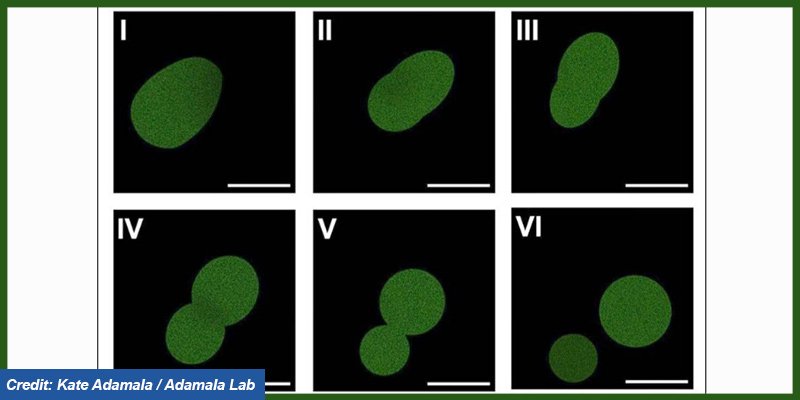
• It is a cell-like system constructed entirely from known chemical components.
• Unlike earlier work on minimal cells that carved down living cells, SpudCell is built entirely bottom-up from individually purified, non-living components.
• The results of the study could be a major breakthrough that could lead to innovation in the medicine and biological engineering fields.
Characteristics of SpudCell:
i) Replicates a biological cell’s life cycle: SpudCell is capable of selection, genome replication, growth, resource acquisition via feeding, and genetically encoded division.
ii) Cell division without a cytoskeleton: Natural cells divide using internal scaffolding called a cytoskeleton, which has been a bottleneck in synthetic cell research. SpudCell sidesteps the need for a cytoskeleton with proteins that crowd together on the membrane surface until the mechanical stress makes the membrane split.
iii) Selection and competition: Researchers introduced a genetic change that increased production of the fusion protein, resulting in cells that grew faster and produced more offspring. After five generations, the faster-growing variant had outcompeted the original. Under nutrient scarcity, the advantage increased, demonstrating selection and competition operating in a fully synthetic chemical system.
iv) Genome organisation: DNA is the programming for all living organisms. A human genome is roughly 3 million kilobase pairs (kbp) in size. Prior analysis had speculated that a minimal genome for a living cell could be as small as 113 kbp. But, SpudCell’s genome is even smaller, at 90 kbp. Rather than a single chromosome, the genome is split across seven separate DNA plasmids. This modular structure allows the team to “program” various functions of the cell independently. With continued development, SpudCell and its successors will be capable of increasingly complex functions and behaviours.
Scope of SpudCell
• Much work remains to turn the construction of individual SpudCells into a true engineering pipeline.
• The cell’s seven DNA plasmids need to be consolidated into a single, more stable genome, and further molecular machinery needs to be built.
• Most of the manufactured products we depend on — medicines, materials, industrial chemicals — require molecular transformations we currently make happen by co-opting natural cells, or using harsh industrial chemistry with huge energy costs.
• Cells built from scratch could perform molecular transformations industrial chemistry cannot.
• That could first transform molecular medicine, building precise therapeutic molecules including drugs incorporating amino acids evolution never used.
• We could see materials that are grown, rather than synthesized, and manufacturing approaches that operate at biological temperatures, not industrial ones.
• Underneath it is a truly engineerable platform, which SpudCell provides for the first time.
Discover more from News Link360
Subscribe to get the latest posts sent to your email.