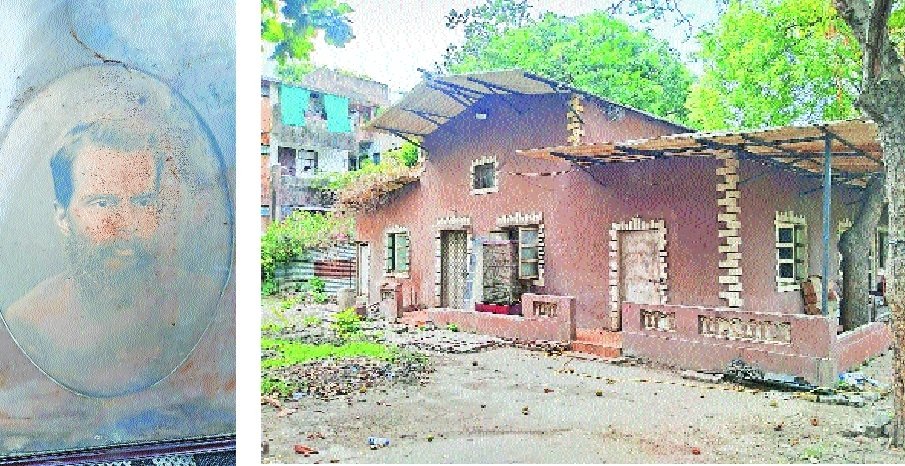
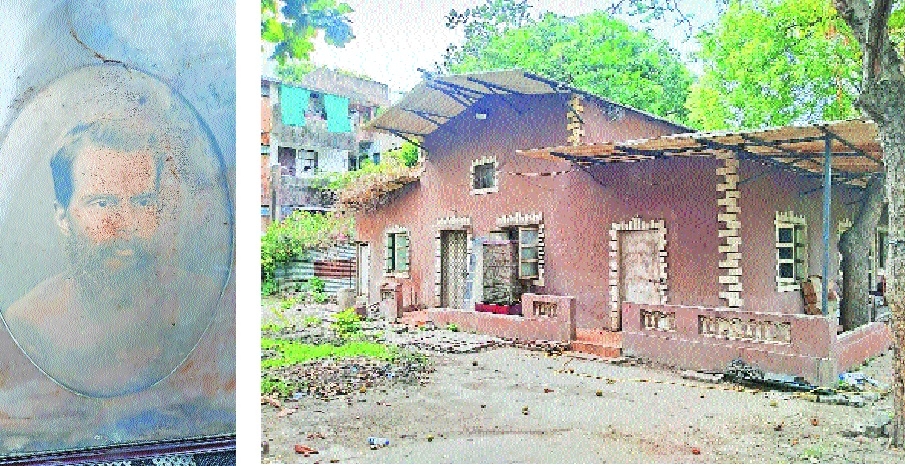
{A photograph of Dr Banerjee shared by his family members. }{‘Ananda Kutir’ built by Dr Radhika Prasad Banerjee in 1907.}
By Reema Mewar :
On a small plot in Dhantoli stands a house that once looked out upon open land. For most residents of Nagpur today, it may be difficult to imagine Dhantoli as anything other than a busy residential and commercial neighbourhood. Hospitals, clinics, apartment buildings and shops line its roads. Vehicles crowd its streets from morning till night, and the constant sound of traffic has become part of the area’s identity.
More than a century ago, however, Dhantoli was a very different place. Large stretches of land remained vacant and sparsely inhabited.
Few people were willing to move there, and the locality was widely regarded as a wilderness at the edge of the city. According to a newspaper clipping preserved by the family of Dr Radhika Prasad Banerjee, many residents were reluctant to settle in the area at all.
It was here, in 1907, that Dr Banerjee built his home.
His bungalow ‘Ananda Kutir’, that still stands
today, has witnessed the transformation of Dhantoli from open land into one of Nagpur’s most prominent neighbourhoods. For over a century, its walls have observed the city’s growth, surviving long enough to become one of the few remaining physical links to a man who once occupied a central place in Nagpur’s public life. Dr Radhika Prasad Banerjee arrived in Nagpur in the late 19th century and devoted his life to medicine and public service. He served as House Surgeon at Mayo Hospital and later taught midwifery and gynaecology at The Robertson Medical School, which was a prominent medical institution established in 1914 in Nagpur, Central India, situated on the campus of the historic Mayo Hospital (established in 1862). Named after Mr Robertson, the Joint Commissioner of the Central Provinces, the school played a vital role in medical education and is today known as the Indira Gandhi Government Medical College & Hospital (IGGMCH).
Over the years, he earned a reputation not only as an accomplished physician but also as a doctor who was deeply committed to serving the poor.
His years of service coincided with some of the most difficult periods in the city’s history.
Nagpur was repeatedly affected by plague outbreaks during the early 20th century, and later by the devastating influenza pandemic of 1918. According to press clippings shared by his family, Dr Banerjee worked tirelessly during both the crises, helping care for patients and alleviate public suffering. For readers today, these years may evoke memories of COVID-19 pandemic. Yet the epidemics that confronted Dr Banerjee stretched over several years, creating prolonged fear and uncertainty in the city. His contribution did not fade from public memory after his death in 1920.
Decades later, on January 11, 1973, Nagpur’s civic leaders chose to honour him by naming a road in Dhantoli after him. According to a newspaper report shared by the family, the road was named by then Mayor Bhau Mulak, who recalled Dr Banerjee’s service during both the plague and influenza epidemics.
The function was held opposite the house that Dr Banerjee had built.
The ceremony was presided over by Dr M B Niyogi, who himself had served as President of the Nagpur Municipality. During the event, Dr Niyogi recalled that Dr Banerjee had been among the first people to build a house in Dhantoli when the locality was still considered a wilderness.
The memory of Dr Banerjee was preserved once again in a letter written by G S Page, former MLA and former President of the Nagpur Municipality. In the letter, a clipping of which has been preserved by the family, Page described Dr Banerjee as an eminent physician who had endeared himself to the people of Nagpur through selfless service extending over four decades. The bungalow itself now stands at a moment of transition. More than a century after it was built, the property may eventually make way for new construction.
Yet the significance of the house lies far beyond its age or architecture. Within its walls survives the memory of a man who served Nagpur during some of its most difficult years. It preserves the story of a doctor who worked through plague epidemics and the influenza outbreak of 1918, who treated the poor, and whose name once became familiar across the city.
The house also preserves the memory of an earlier Dhantoli, when the neighbourhood was still considered a wilderness and the city ended much farther away.
As old homes disappear from Nagpur’s landscape, the city risks losing more than just buildings. It loses physical connections to the people who helped shape its institutions, neighbourhoods and public life. Such stories often survive within families, in preserved letters, old newspaper clippings and personal memories, but gradually become inaccessible to the larger public.
The bungalow of Dr Radhika Prasad Banerjee represents one such chapter of the city’s history. Its eventual disappearance would mark not only the loss of a century-old home, but also the fading of a tangible reminder of a physician who once guided Nagpur through periods of fear, disease and uncertainty. As Nagpur continues to transform, preserving such stories becomes as important as preserving the structures themselves. For within these homes lie not merely old walls but the memories of the people who helped shape the city into what it is today.
Discover more from News Link360
Subscribe to get the latest posts sent to your email.