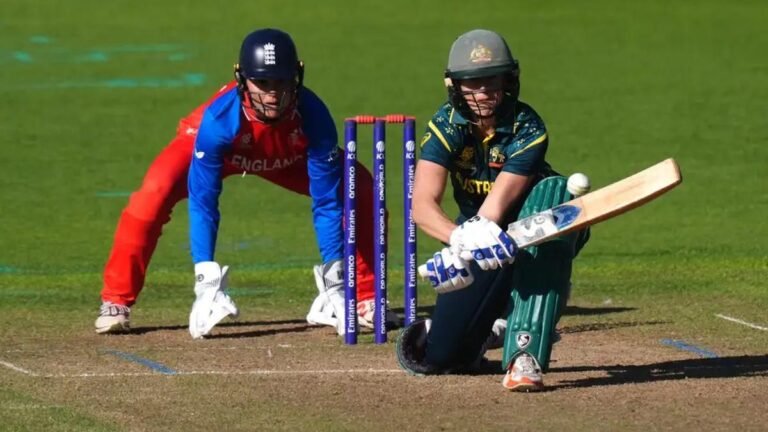
Between England, the home favourite, and that shiny T20 World Cup trophy that has eluded this outfit for 17 years, stands its Ashes rival and annoyingly successful challenger, Australia.
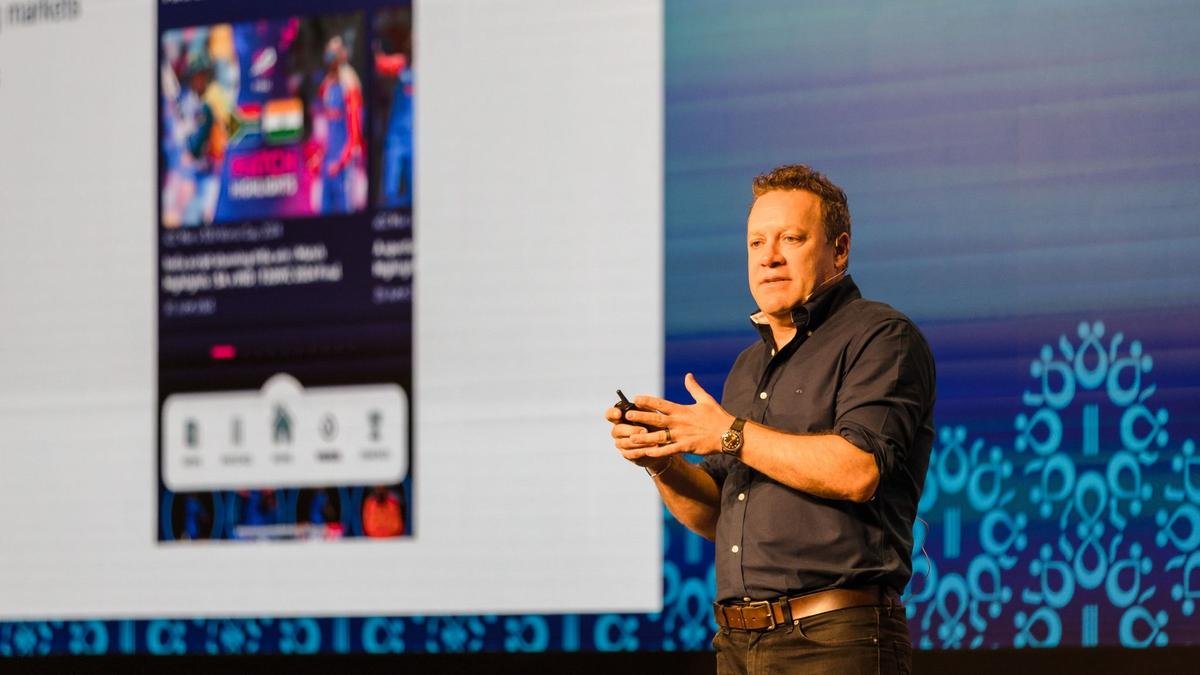
The journey to this summit clash has not just traversed the ups and downs of geography and climate in England, but also countless storylines – of teams and individuals – and riveting subplots, all packaged and brought together to a growing audience for the women’s game by the ICC’s digital team. At the helm of this engine room is Finn Bradshaw.
From a life in journalism, Bradshaw’s journey brought him to the doorsteps of Cricket Australia in the 2010s, after which he moved to Tennis Australia and then eventually to the ICC Headquarters in Dubai in 2020. His biggest career move, incidentally, unfolded in parallel to a global pandemic that brought the world to a near standstill. His six years in the job since have seen each season and each ICC tournament set and surpass several ambitious targets.
Bradshaw was well into his Tennis Australia gig when the 2020 Women’s T20 World Cup unfolded at home. That edition is known best for an audacious campaign to pack the iconic Melbourne Cricket Ground for the final, held on International Women’s Day. A closing show by Katy Perry was on the itinerary, too. 94,000 was the target on the vision board. The MCG delivered a record 86,174.
Guarding against myopia
This push in the first T20 World Cup hosted by the continent was the fruit of a seed planted many years back by Bradshaw’s erstwhile team at Cricket Australia. The board’s big priority was to trigger an interest in the women’s game and pathways to make it stick.
“The number one objective we had there was to make sure that the cricket was properly covered, because in Australia, there would be overseas tours and we’d suddenly find there’s no journalist there as newspapers couldn’t afford to send them. The media was changing, and we just wanted to ensure everything was accessible,” Bradshaw told Sportstar in a Zoom call squeezed between promotional events in London.
“I started with CA in 2013. There was no Women’s Big Bash League (WBBL) yet. Matches weren’t regularly broadcast. I give all the credit to James Sutherland, the then-CEO of CA. His daughter (Annabel) is one of the best players in the world now. That probably gave him a different perspective. But he was passionate from day one to put things like the WBBL, which could improve talent, in place.”
Bradshaw and Co. attached considerable value to building a fandom around the game.
“The first season of WBBL had very few games pencilled for broadcast. It wasn’t seen as a fan product. I remember speaking to James about how we can’t claim to support this with that strategy. If people can’t watch it, how can you possibly inspire the next generation if they can’t see these people?”
“He approved an unbudgeted spend for us to be able to at least produce bare-minimum streaming content. For the first season, every match was available for free. That entire run taught me that patterns don’t fall overnight, but you have to start,” Bradshaw remembered.
By the time 2020 came along, the WBBL had secured a base for the game, not just as an assembly line for talent, but as a galvanisation tool for fanbases loyal to franchises.
“The number one thing that I took from that tournament was that you can be ambitious. When CA announced that MCG final event, a lot of people thought they were crazy. Once you commit yourself to something like that, you force yourself to work out how you will deliver it. We saw Katy Perry get involved. If you think you’ll only go so far, you’ll always hit that ceiling.”

| Photo Credit:
FINN BRADSHAW/ LINKEDIN

Finn Bradshaw is at the helm of the engine room, bringing out the stories and subplots for the growing audience of women’s cricket.
| Photo Credit:
FINN BRADSHAW/ LINKEDIN
Not why, ask why not
That same perspective drove ICC’s Captains’ Carnival on Waterloo Bridge ahead of this edition. One of London’s most prominent landmarks, the iconic Bridge was transformed into a live cricket pitch as the 12 participating team captains came together for an eye-catching launch event for fans on a windy Sunday morning.
“We spoke not just within the ICC but also with the ECB, asking, ‘Well, why can’t we shut it down?’ It just needs the setting of a new standard of imagining what’s possible,” he added.
There is one key line Bradshaw is quick to draw between the events of 2020 and the ICC showpieces thereafter.
“In 2020, there was a huge crowd for the final at the MCG, but a lot of other games were not attended particularly well. If you really want to evolve this as a world-class event, the next step is to ensure our players play in front of as many people as possible, all the time. Whenever fans go, they must get the full ICC World Cup experience.”
Digital has a huge role to play in that. A recent Reuters study published in association with the University of Oxford found that news consumption through social media and video networks, for the first time, has become the single most widely used way of accessing news online (54% of surveyed respondents), across all age groups. This is ahead of news websites and apps (51%). 77% of people globally consume online news video each week. The growth in online video consumption is all happening on third-party platforms (Meta, YouTube, TikTok, etc.). Mainstream news organisations have, on average, seen video consumption on their own sites and apps go down by five percent.
That push is something the ICC has picked up on. The 2025 Women’s ODI World Cup saw the digital arm producing several memorable video pieces and short-format reels, allowing players to take centre stage as stars of the month-long show. Short player biographies that introduced cricketers to the audience were often broadcast exclusives, meant to provide the viewer with a more rounded context of the 22 competitors they would watch at any given point during a game.
The results were there for all to see.
The 2025 Women’s World Cup generated 5.2 billion video views for the ICC, a dramatic leap from the 1.5 billion registered during the 2024 Women’s T20 World Cup. Social media engagement soared to 279 million interactions, more than triple last year’s figure (84 million), while the ICC website and app attracted 8.5 million unique visitors, up from three million in 2024.
Much like the 2024 and 2026 Men’s T20 World Cup, India doing well automatically boosted engagement and consumption of media artefacts.
“In 2025, the title-winning campaign by Team India alone amassed over 87 million views, while the jubilant scenes from the semifinal surpassed 70 million. Powerful images of sportsmanship after the final gathered 40 million views, and a heart-stirring celebration featuring legendary former players crossed 30 million views,” an ICC statement read.
The 2026 Men’s T20 World Cup, at one stage, amassed a viewership of 500 million and a peak concurrent viewership count of nearly 76 million (India vs New Zealand final). The tournament saw nearly 1.3 million in-stadia fans, heartening crowds for games not involving the host nations and massive support for matches involving emerging nations like Nepal, Italy and Scotland.
In just 19 matches, the ongoing Women’s T20 World Cup surpassed the aggregate global digital engagement break (1.7 billion) in ICC channels for the group.
Bradshaw underlines a vital faultline to address amid these gargantuan numbers, lessons from the Indian market ecosystem that could be broadly applied world over.
“India loves its cricket, but the passion for women’s cricket still trails men’s cricket in the country. There are a lot of cricket fans in general who still don’t mark their diary for women’s events as they do for men’s. That’s where we step in. Our work in creating content around this tournament and its players is to create heroes and have big cut-through moments to ensure they are on people’s radar,” he explained.
He identified the ODI World Cup knockouts in Navi Mumbai as a milestone for the trajectory of the women’s vertical. A sold-out crowd of 45,000 watched India beat South Africa in the final; 34,651 watched that historic semifinal where India overcame Australia, and a healthy 21,000-25,000 fans were in attendance for the group games at the venue.
“To be at D.Y. Patil Stadium for the semifinal and final has to be one of the highlights of my career. It really felt like this tipping point of passion for the women’s game. And it gave us incredible momentum coming into this one,” he explained.
Different gender demographics also come with differences in what content formulas work, and this is where his years in journalism come in handy. It also helps that he has this in common with the ICC’s CEO Sanjog Gupta as they sit down to draft plans in the high corridors of power in the international body.
“One thing that has differentiated our social media, in particular, is we try and take on the voice of the fan to some degree. We can’t have an opinion on everything like a fan would, but we try not to be too corporate in the way we talk.
“That also means we are conscious about the fact that there’s not just one type of cricket fan. There may be many different things and types of content they may be passionate about. We have tried to bake it into our plans that there is no one single way of covering a match.”

Finn Bradshaw’s journalism background has helped him navigate through the different formulas of content creation.
| Photo Credit:
FINN BRADSHAW/ LINKEDIN
Finn Bradshaw’s journalism background has helped him navigate through the different formulas of content creation.
| Photo Credit:
FINN BRADSHAW/ LINKEDIN
Creator is king…or queen
This is where the ICC’s ‘creator club’ enters the conversation.
The Reuters report says that a quarter of its respondents globally got their news from news-focused creators or influencers and almost half (46 percent) got news from creators of any type, with respondents finding creators ‘more entertaining, easier to understand and more relatable than traditional news outlets.’
For a few editions now, ICC’s routine match previews feature sports influencers like Sanjana Ganesan and Crystal Arnold. Indian content creator Surbi Vaid is another addition to this pack. In addition to this, nearly a dozen content creators from across the globe are in the United Kingdom covering the tournament, with access to players and match areas. The rewards of that programme were immediate for the ICC. The opening weekend of the World Cup, which included the much-anticipated India vs Pakistan clash, not only saw a record cumulative footfall of 44,844 across three days, but also saw more than 753 million video views across ICC content on social media, a 150 percent increase on the same period of the 2024 Women’s T20 World Cup. A further 617 million+ video views came from the Content Creator Programme, with the hoard driving more than 30 million engagements.
“Tapping creators has allowed us to tap into different languages. Even if you don’t understand English, we want to allow fans to feel that World Cup experience up close and personal and make it relevant. We leaned into it during the men’s World Cup earlier this year and continued with it for this one too. We worked with the member boards to identify creators in the market. We had representation from Germany, Thailand, Brazil, South Africa, etc. It is challenging to particularly draw people from markets where cricket isn’t popular. We wanted to include people from other sectors like lifestyle, fashion, culture, because we want people finding different entry points to the game and these players and staying with it all,” Bradshaw explained.
The resulting figures aren’t just numbers for the ICC or the England and Wales Cricket Board. Both bodies hope to be able to tap into these data sets to convert passing fans to loyal supporters, more so for women.
“We are definitely trying to get more granular in understanding what resonates with women and what about the game gets their attention and getting better at that. It’s a two-fold thing. We want more people as fans of women’s cricket, and we want more women being fans of cricket. Those are not necessarily the same thing.,
“Back when I was at CA, we used to do several things around attending a match. When I was a kid, women didn’t feel very welcome at a cricket match. There were a lot of men drinking a lot of beer. The system had to then try and create a safe, comfortable environment for them.
There are parts we can control, like getting stories out on channels that women follow. We are also working with our member boards to sustain the push outside of the World Cup so that these tournaments are not flashes in the pan,” he added.
Even members of the commentary and analysis team, like Dutch cricketer Logan van Beek turned vloggers during the course of the tournament, giving fans a ringside view of the debutant side, engaging them in match content and capturing the passion of a dedicated family pack and fanbase that cheered this team on through its entire campaign. Personalities and teams stepping up greatly help the ICC, which also has to balance costs alongside producing high-quality consumables for the loyalists.
“We’ve gotten better at identifying where to put energy and our resources. When I started, we were doing a lot of content that was essentially content for TV, but first published on social. Now, even the ideation works with a social-first approach. It helps that teams have their own creators or content units. We can work in collaboration with them. Technology has also helped. We use AI to cut our highlights, so the person otherwise engaged can now focus on more creative things, for example.”
The streamlining helps especially in a window with back-to-back ICC tournaments. From the 2025 Women’s ODI World Cup, the ICC unit has barely had a few months to wipe the slate clean and begin ideating again for the Men’s T20 World Cup. That window has been shorter still between the Men’s showpiece and the Women’s T20 event in England.
“We’re also doing a few things in the way we measure results.”
“We’ve always tracked video views, how many users come to our website and things like that, but for the first time this year, we’re tracking engagement metrics a bit differently. We’re looking at things like searches on YouTube, searches on Google, searches on Gen AI to see if what we’re doing is driving increased interest in the tournament. We want to look beyond a superficial assessment of digital engagement because we can often lose sight of actual growth in the big numbers digital can throw up. We need to ensure people aren’t engaging passively and are actually involved in the communications we are sending their way,” Bradshaw explained.
“When you ask fans what cricket is most meaningful for you, ICC events feature right at the top of that because it’s seen as the ultimate test and the ultimate definition of best in the world. So we do have less casual engagement on that. We obviously have a more global audience than the IPL might. India is a huge base for us, but it is 50-60 percent of our audience as opposed to the IPL, where Indians will make up 90 percent of the total audience. ”Finn Bradshaw
Synergy the key
The Australian also believes that an ICC calendar where there’s at least one key event every year helps build digital relationships between the board, the teams and fans.
“I know from my colleagues in other world sporting bodies that the number of people engaging with their channels outside of a World event is still a work in progress. They still have to wake people up when events come around and get them back on their spaces. Cricket, I think, can sustain that at a higher level.”
But unbridled ambition needs unbridled effort. The ICC actively work with member nations, but tries to be non-intrusive in implementation. Elements like broadcasting contracts take higher precedence.
In the 2025 ODI event, there were marked differences in sustained activations on the ground and online between India and Sri Lanka.
“It’s always a challenge when an event is across two countries, and you’re dealing with two different governments, two different host boards, etc. It will be beneficial to us to only deal with one port. What the numbers say, especially on digital, is that the passion for women’s cricket among Sri Lankans is still a few years behind where it is in India. Our partners in the island nation also came on board right before the tournament, so it all added to the challenge. I think you’ll see a greater response among the Lankan fans during the Champions Trophy,” Bradshaw said.
“We’re often asked about the NBA. It’s a balancing act. Members want a commercial outcome, broadcasters put high value on the archive. We need to respect that but place our limits. We are experimenting in a few markets, but we can’t manage anything concrete now.”
Democratising archival footage has been a major talking point for the ICC, which the board says it is happy to share selectively.
“In America, we’ve got a cricketer called Jomboy, who is a baseball fan. He likes to interpret cricket. We have allowed him to use our archives to create content because he reaches a captive audience in ways we can’t. At some point, we may not have one broadcaster who is in a position to commercialise cricket, as we do. And there’s immense value to it. I don’t think we’re in a position to be comfortable with a free-for-all and trust that it will deliver the outcomes we want. Should that happen, we might be more flexible, like the NBA,” he explained.
The tournament being held in the UK means ECB has been able to tap into the South Asian diaspora to its benefit. But it is a big dent to not have India make the knockouts, the impact of which one will see when the final numbers emerge after the tournament. For now, though, as the tournament tagline says, England truly looks to have ‘caught the spirit.’
Published on Jul 05, 2026
Discover more from News Link360
Subscribe to get the latest posts sent to your email.