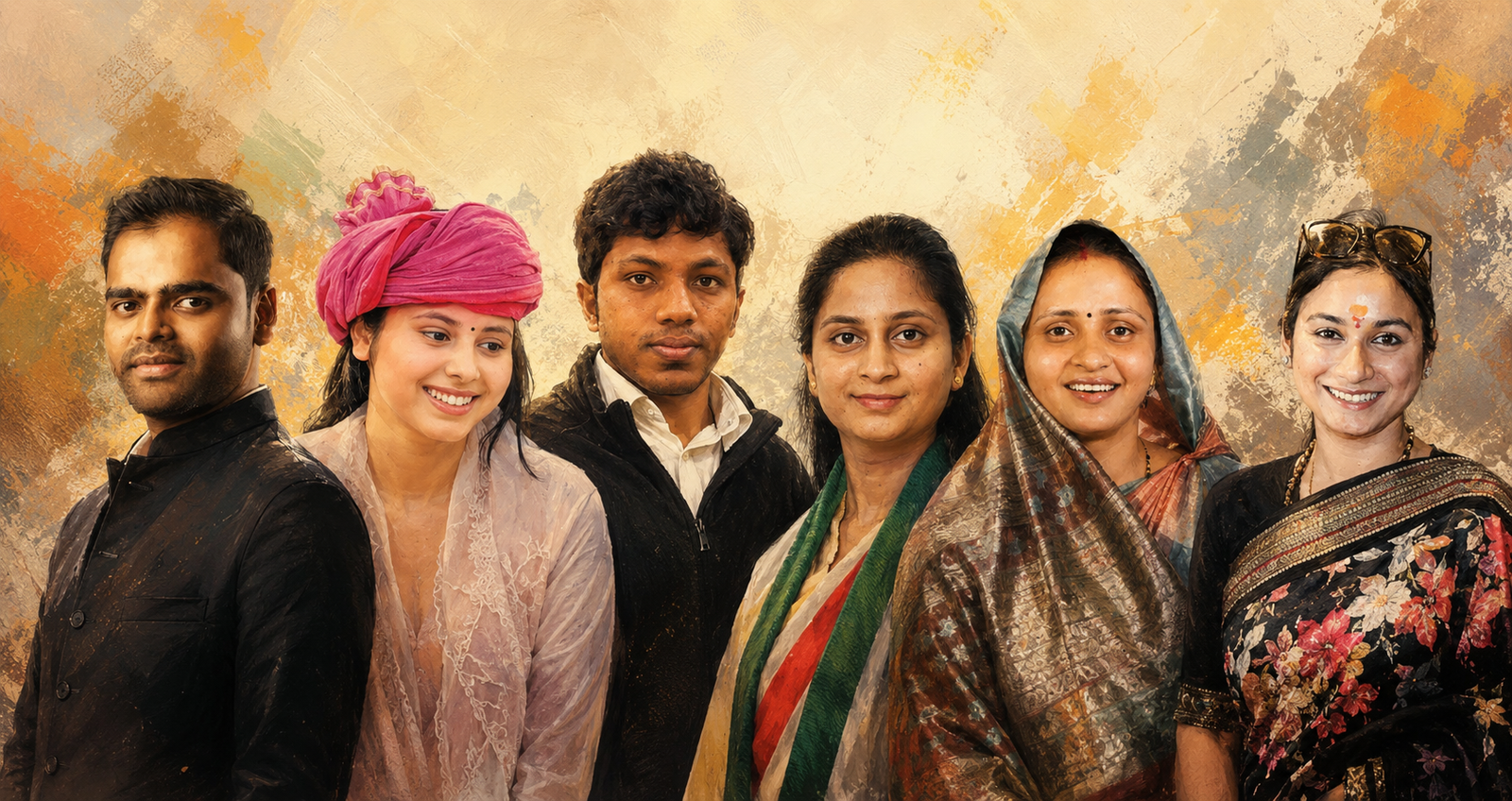
The reason: Gen Z accounts for over a quarter of the country’s population, yet its representation in politics is restricted to just 26 legislators across the country — six Lok Sabha MPs and 20 MLAs, a low number even though the minimum age to contest elections is 25, which rules out a chunk of this demographic.

Defined as those born between 1997 and 2012, or in the age band of 14-29, Gen Z accounts for 36.74 crore, or 25.8%, of the country’s 142.6 crore population in 2026, as per 2011 Census projections. The Gen Z population aged 25 and older alone accounts for an estimated 8.9% of the country’s population.
When the age band is stretched to 40, the number of legislators in this group expands to 397 MLAs and 40 MPs.
6 MPs in Lok Sabha
The current Lok Sabha, elected in 2024, offered the first opportunity for Gen Z representatives to enter the Lower House. The Congress has the most Gen Z MPs at three, followed by the SP at two and the LJP(RV) at one. UP and Karnataka have two Gen Z MPs each, while Bihar and Rajasthan have one each.
The Gen Z MPs are: SP’s Pushpendra Saroj (27) from Kaushambi and Priya Saroj (27) from Machhlishahr in UP; Congress’s Sagar Khandre (28) from Bidar and Priyanka Satish Jarkiholi (29) from Chikkodi in Karnataka, and Sanjna Jatav (28) from Bharatpur in Rajasthan; and LJP (Ram Vilas)’s Shambhavi (28) from Samastipur in Bihar.
These six MPs were the only winners among the 98 Gen Z Lok Sabha candidates in 2024 who accounted for just 1.2% of all 8,360 candidates in the fray.
Four of these six Gen Z MPs are women; four are college graduates; and two hold postgraduate degrees. According to their election affidavits, Priya Saroj, Khandre and Jatav are trained lawyers, Shambhavi holds an MA in sociology, Jarkiholi is an MBA, and Pushpendra Saroj holds an accounting and management degree from a London university.
Five of these six Gen Z MPs belong to established political families; only Jatav, a Dalit MP, does not.
Pushpendra Saroj’s father Indrajit is a former UP minister and national general secretary of SP, while Priya Saroj’s father is a sitting SP MLA and three-time former Lok Sabha MP.
Among the Congress’s Gen Z MPs, Khandre’s father Eshwara is a sitting Karnataka MLA, former state minister and the party’s state working president, while his late grandfather Bheemanna was a four-time MLA and prominent Lingayat leader. Priyanka Jarkiholi, the other Karnataka MP, is the daughter of four-time sitting MLA Satish Jarkiholi, from the prominent Jarkiholi political family that also has members in the BJP.
LJP(RV) MP Shambhavi’s father Ashok Choudhary is a Cabinet minister in Bihar’s NDA government and national general secretary of the Nitish Kumar-led Janata Dal (United).
The Lok Sabha has another 34 MPs aged 40 or under, taking the total number of under-40 legislators to just 40 in the 543-member House. UP has the largest representation in this group at 10 MPs, followed by Karnataka and Andhra Pradesh at five each, and West Bengal and Maharashtra at four each.
20 MLAs in states
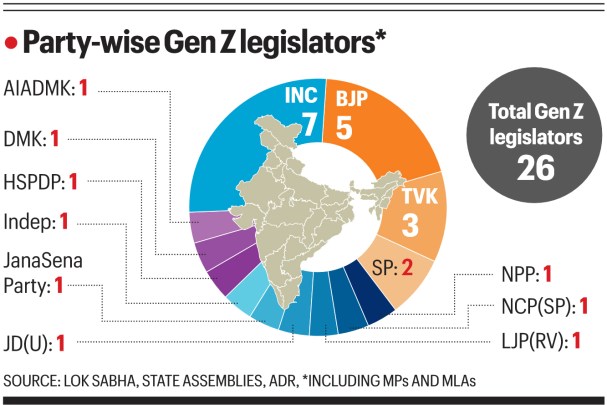
Of the 4,131 MLAs across 28 states and three Union Territories, just 20 belong to Gen Z. Six were elected from seats reserved for Scheduled Castes (SCs) and three from Scheduled Tribes (STs).
Since a Gen Z candidate would have hit the eligible age to contest an Assembly election only in 2022, most of these MLAs were elected in the last two years, with as many as nine elected in 2026 alone.
Tamil Nadu has the most Gen Z MLAs at four after its 2026 Assembly poll — three from the ruling TVK and one from the AIADMK. West Bengal has the next highest at three, all from the BJP, while Bihar, Meghalaya and Telangana have two each. Andhra Pradesh, Assam, Haryana, Maharashtra, Odisha, Puducherry and Rajasthan have one Gen Z MLA each. All these states last went to polls between 2023 and 2026.
A party-wise breakdown puts the BJP on top with five Gen Z MLAs, followed by the Congress at four and the TVK at three. Among the other parties with Gen Z MLAs are the AIADMK and DMK in Tamil Nadu, the Jana Sena Party in Andhra, the JD(U) in Bihar, the NCP(SP) in Maharashtra, and two regional parties in Meghalaya — all with one MLA each — besides one Independent in Rajasthan.
Of the 20 Gen Z MLAs, 16 are at least college graduates, including five postgraduates. One is a diploma holder, another has studied up to Class 10 and two others up to Class 12. Nine were elected from reserved seats (six from SC and three from ST seats) and eight of them are women.
Twelve of these 20 Gen Z MLAs are political newcomers without prior electoral experience or family backgrounds, including Tamil Nadu MLA Dhilipan Jaishankar, a doctor; West Bengal MLA Santu Pan, a former journalist; and Bihar MLA Maithili Thakur, a prominent playback singer.
Keerthana S, the youngest minister in Tamil Nadu’s newly elected TVK government, has no electoral experience but was a political consultant with I-PAC before contesting the 2026 polls. Ravindra Singh Bhati was a student leader before becoming a Rajasthan MLA as an Independent.
The remaining eight Gen Z MLAs come from political families. Most prominent among them are Aditya Surjewala, a Haryana MLA and son of senior Congress leader and Rajya Sabha MP Randeep Surjewala; Rohit Patil, a Maharashtra MLA and son of former Deputy CM R R Patil; and Puducherry MLA Vignesh Kannan, whose father is former Lok Sabha MP and ex-Puducherry Assembly Speaker P Kannan. Several others, such as Mynampally Rohith in Telangana, Tanzil Hussain in Assam, Upasna Mohapatra in Odisha and Damanbait Lamare in Meghalaya, are also children of former legislators.
Under 40, bigger basket
As many as 397 MLAs across India are 40 or younger, including the 20 who belong to Gen Z. As a share of an Assembly’s total membership, Chhattisgarh has the highest proportion of MLAs aged 40 or younger at 35.6%, followed by Tamil Nadu at 20.9%, Meghalaya at 16.7%, West Bengal at 15.7%, and Bihar at 15.6%. Of these states, Tamil Nadu and Bengal held their latest elections this year, while Bihar voted in late 2025. In absolute terms, Tamil Nadu has the most MLAs aged 40 or younger at 49, followed by Bengal at 46, Bihar at 38, UP at 37, and Chhattisgarh at 32.
These numbers matter because, by the 2029 Lok Sabha elections, Gen Z could account for the largest share of India’s voting-age population. While the 2011 Census does not have age-wise projections for 2029, its projections for 2031 place the Gen Z population, which will then be aged between 19-34, at approximately 26.3%. Millennials, in contrast, will comprise 21.7% of the population in 2031, down from roughly 22.2% in 2026. Older generations, including those born in 1980 or before, will together account for 24% of the population by then.
Related
Discover more from News Link360
Subscribe to get the latest posts sent to your email.