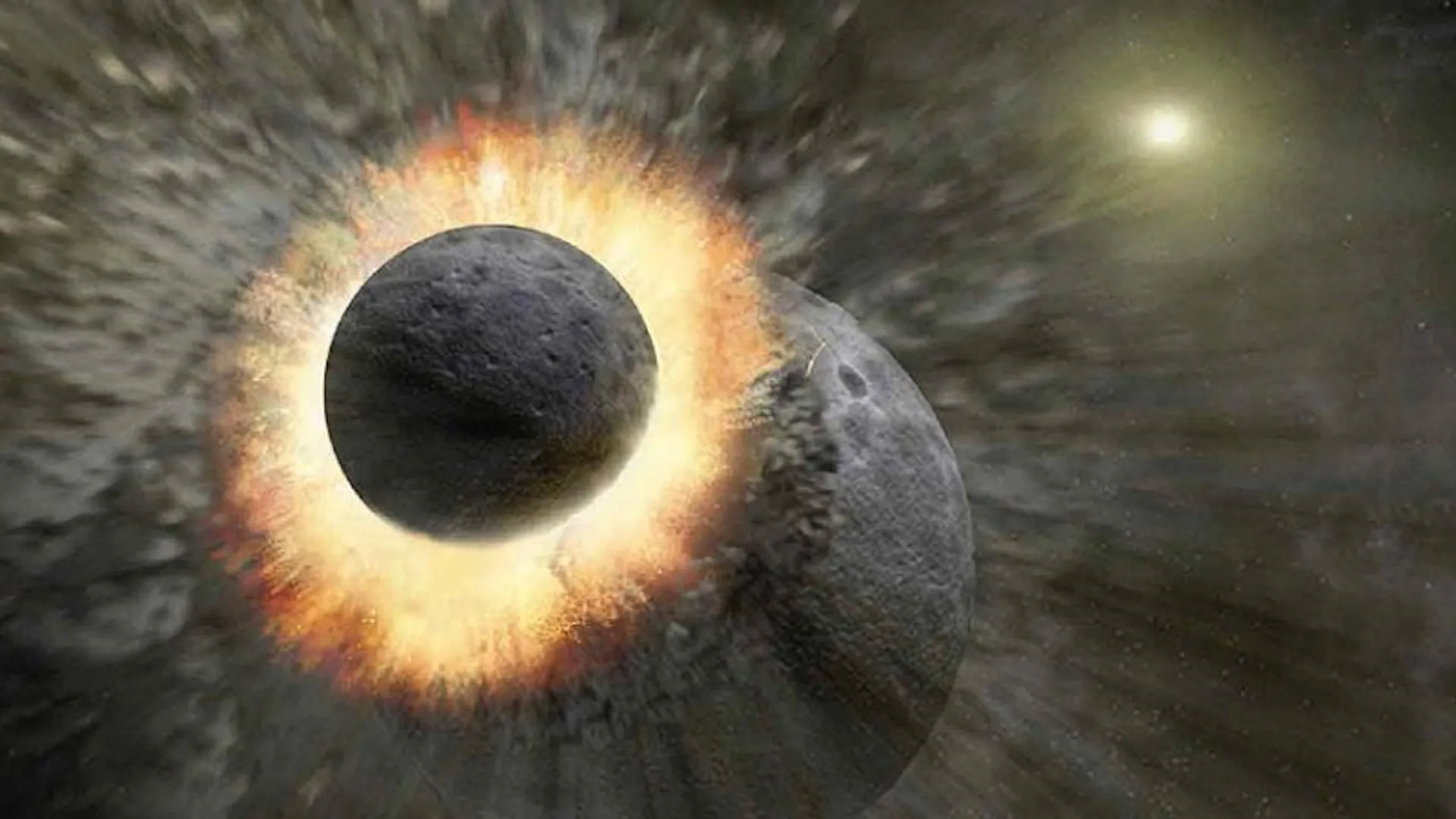
Earth has an unusually large moon compared with other rocky planets in the solar system, but scientists still do not fully understand how it formed. A new study from researchers at the Southwest Research Institute and the University of Arizona suggests that one long-overlooked factor may have played a major role in the Moon’s birth: the physical strength of the worlds that collided.



Using advanced computer simulations, the researchers examined the enormous impact thought to have occurred about 4.5 billion years ago between the young Earth and a Mars-sized object. Their results reveal strikingly different outcomes depending on the temperature and structural properties of the two bodies.
The findings were published in The Astrophysical Journal Letters. For the first time, the simulations account for the material strength of the two ancient worlds. That addition could reshape scientists’ understanding of the Moon-forming collision and may also help narrow down when it happened.
“We discovered that the preexisting geology of the Mars-sized proto-moon matters,” said Adeene Denton, a former postdoctoral researcher at Lunar and Planetary Laboratory who is now at SwRI. “When you simulate the Earth and the Moon as colliding bodies with geologic properties, it changes how the Moon forms out of that impact – that’s something we considered unnecessary before.”
Revisiting the Giant Impact Theory
One of the leading explanations for the Moon’s origin is the giant impact scenario. According to this idea, a Mars-sized body called Theia collided with the early Earth. The impact destroyed Theia and sent its remains into orbit around Earth, creating a disk of debris that eventually assembled into the Moon.
A foundational 2001 study of this scenario was led by Robin Canup, vice president of SwRI’s Solar System Science and Exploration Division in Boulder, Colorado, and Erik Asphaug, a professor at the Lunar and Planetary Laboratory and co-author of the new study.
Those early simulations, along with many later models, did not account for material strength. Scientists assumed that the collision was so energetic that the rocky bodies could effectively be treated like fluids.
Denton and her colleagues decided to test whether that assumption was justified. Using modern computational methods, they incorporated temperature-dependent geologic strength into Moon formation simulations for the first time.
“Because the collision was considered violent enough to melt and vaporize large portions of Earth and Theia, those previous papers assumed that it is okay to approximate them as fluids,” Asphaug said. “Based on our new results, however, we think that it is time to reconsider that.”
Adding Realistic Geology to the Collision
To revisit the giant impact, Denton used a more advanced form of smoothed particle hydrodynamics simulations, or SPH. These simulations account for the structural strength of the objects involved rather than treating them as entirely fluid.
“It turns out material strength is really important when you’re studying collisions between smaller bodies like asteroids, dwarf planets and moons,” said Denton, who got the idea of applying the concept to Earth’s moon while working on a previous paper about the formation of the Pluto-Charon system. “We weren’t sure if it would matter for our moon or not. When we did the simulations, we found it actually matters quite a bit.”
The version of SPH used in the study was developed at the U of A and the University of Bern in Switzerland. Its strength model allows simulated planetary material to resist deformation in ways more consistent with real geologic substances, including the rock and metals that likely made up Theia and the proto-Earth, or solid ice.
The Moon Could Form in Very Different Ways
Temperature turned out to be especially important. Hotter planetary bodies are mechanically weaker than colder ones, and the simulations showed that this difference can dramatically affect what happens after impact.
Under some conditions, the collision destroys Theia and creates a broad protolunar disk around Earth. Material in that disk then gradually comes together to form the Moon.
But other simulations produced a much more dramatic result. Instead of forming slowly from debris, a fully intact Moon appeared within only a few hours.
Because young protoplanets generally begin hot and gradually cool as they age, this result creates a potentially important link between the timing of the giant impact and the way the Moon initially formed.
“Depending on how hot the Earth and Moon are prior to the collision, the impact can destroy Theia and produce this massive disk of debris that eventually forms the Moon,” Denton said. “But when we used the same parameters as original impact modeling – down to the equal temperature structures inside both bodies – within around five hours, an intact moon emerged.”
Previous simulations have also produced intact moons, but the new work is the first to demonstrate that material strength and temperature can be central in determining whether the Moon forms largely intact or gradually assembles from processed debris in a protolunar disk.
New Clues to the Timing of the Moon’s Birth
The findings could potentially connect the Moon’s present-day properties with the physical state of Earth and Theia billions of years ago.
“These surprising and exciting new results imply a potential connection between the physical properties of the Moon today, including perhaps its volatile content, and the thermal state of the Earth and Theia at the time of the giant impact,” said Canup, who was not involved in the study. “This in turn might help scientists better constrain when the moon-forming event occurred.”
One major mystery, however, remains unresolved.
Earth and the Moon have remarkably similar compositions, something that giant impact models have long struggled to fully explain. The new simulations do not eliminate that problem.
“Because Earth and Mars formed in the same neighborhood of the solar system, they are like siblings,” Denton said. “The Moon and Earth are more like fraternal twins.”
One possibility is that Theia and the proto-Earth formed from material in the same region of the early solar system. Mars, whose composition differs from both Earth and the Moon, may have formed farther away.
A New Window Into the Moon’s Origin
By showing that the internal condition of Earth and Theia could strongly influence the aftermath of their collision, the study gives researchers another way to investigate one of planetary science’s biggest mysteries.
“We now know that the geophysical state of Earth and Theia play a fundamental role in shaping the outcome of the collision,” said study co-author Namya Baijal, a doctoral student in Asphaug’s group. “This gives us a new way to explore the conditions of the impact and what they might reveal about the Moon’s origin.”