
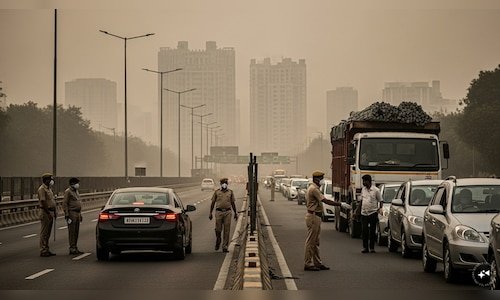
Delhi Environment Minister Manjinder Singh Sirsa said the decision is part of emergency measures to reduce vehicular emissions as pollution levels worsen.
प्रदूषण से निपटने के लिए भाजपा सरकार ने उठाए ठोस कदम
????गाड़ियों का PUCC नहीं तो पेट्रोल/डीजल नहीं
???? कंस्ट्रक्शन मटेरियल लेकर आने वाले ट्रकों पर पूर्ण बैन
???? दिल्ली से बाहर के BS6 केटेगरी से कम के निजी वाहनों की एंट्री पर रोकये कदम दिल्ली की हवा को साफ़ करने और प्रदूषण पर ठोस… pic.twitter.com/dLQ4b5CHr8
— BJP Delhi (@BJP4Delhi) December 16, 2025
No fuel without valid PUC
Petrol pumps in Delhi will stop supplying fuel to vehicles that do not have a valid Pollution Under Control (PUC) certificate from Thursday. Sirsa said vehicle owners were given one day to comply. “After tomorrow, vehicles that do not have a valid PUC certificate will not be provided fuel,” he said. Compliance will be checked using automatic number plate recognition systems and on-ground inspections.
GRAP-4 rules explained
The Commission for Air Quality Management has enforced Stage IV of the Graded Response Action Plan across the NCR after AQI levels moved close to or crossed the severe threshold. Under GRAP-4, the movement of BS-III petrol and BS-IV diesel vehicles is prohibited across Delhi-NCR, except for vehicles used for essential and emergency services. The restrictions apply to private as well as commercial vehicles entering Delhi.
BS-VI vehicles, along with CNG, LNG and electric vehicles, are allowed to operate. Commercial vehicles running on LNG, CNG or electricity, and BS-VI diesel vehicles, are also permitted.
Impact on NCR commuters
The ban affects large numbers of vehicles in NCR cities that depend on daily travel to Delhi.
- Gurugram: Around 2 lakh private vehicles are non-BS-VI, including about 1.5 lakh BS-III petrol cars and over 36,000 BS-IV diesel vehicles. In addition, over 47,000 BS-IV diesel commercial vehicles, more than 2,000 BS-III petrol commercial vehicles and around 2,200 buses will not be allowed to enter Delhi.
- Noida: Of nearly 10 lakh registered vehicles, only about 4.2 lakh meet BS-VI norms. Around 1.4 lakh BS-III vehicles and 2.8 lakh BS-IV vehicles are affected.
- Ghaziabad: More than 5.5 lakh vehicles do not meet BS-VI standards, including about 1.7 lakh BS-III and 3.7 lakh BS-IV vehicles.
Some residents said the restrictions would disrupt daily commuting, school travel and medical visits. A Gurugram resident described the order as “absurd and impractical,” saying Delhi and the NCR function as a single unit. Another resident called it “shortcut politics,” criticising the repeated reliance on temporary bans.
Petrol dealers raise concerns
The Delhi Petrol Dealers’ Association welcomed the “No PUC, No Fuel” rule but said enforcement would be difficult. The association said petrol pumps are not enforcement agencies and warned of possible law-and-order issues if staff are expected to implement the rule without official support. It asked the government to deploy enforcement personnel at fuel stations and said pollution control measures would be more effective if implemented uniformly across the NCR.
Other enforcement measures
Sirsa said action is being taken against multiple pollution sources. Over 8.66 lakh vehicles have been issued challans for PUC violations. More than 2,000 notices have been served on industrial units, with penalties of about Rs 9.21 crore imposed.
Around 3,200 diesel generator sets have been checked for compliance, and non-compliant units face closure. Online Emission Monitoring Systems have been installed in 280 industrial units.
The minister said Delhi currently has 3,427 electric buses in operation and plans to add around 7,000 more by December 2026.
Pollution situation remains critical
Delhi has experienced persistent smog over the past several weeks, with Air Quality Index (AQI) readings crossing 400 at several locations. Its average AQI stood at 328 on Wednesday morning, an improvement from 377 a day earlier, but still in the ‘very poor’ category.
At 9 am, 30 out of 40 monitoring stations recorded very poor air quality, with Bawana reporting the highest AQI at 376, according to the Central Pollution Control Board’s Sameer app. Several parts of the city remained covered in smog and fog, reducing visibility. Humidity was recorded at 100%, and the IMD forecast moderate fog for the day.
GRAP-4 has also led to restrictions on the movement of heavy vehicles, work-from-home advisories, hybrid or online classes for some school grades, and the suspension of outdoor activities.
Sirsa said pollution cannot be fixed quickly. “It is impossible for any elected government to reduce AQI in 9–10 months. I apologise for the pollution in Delhi,” he said, adding that daily enforcement and longer-term measures are being pursued.
(With input from agencies)
Discover more from News Link360
Subscribe to get the latest posts sent to your email.