

How Jharkhand rode on Ishan’s heroics and Dhoni’s guidance to end title jinx
While the families of the cricketers and officials watching the final from the president’s pavilion at the Maharashtra Cricket Association Stadium in Gahunje, on the outskirts of Pune, seemed overjoyed, two gentlemen sitting on the other side were still holding back their emotions.
As one of his friends urged him to celebrate, Saurabh Tiwary muttered, “ Arey, ruk jaao thoda… (wait a bit)”. Sitting beside him, Shahbaz Nadeem nodded in agreement before adding with a cheeky smile, “ Cricket hai bhai, last tak kuch keh nahi sakte (this is cricket, you can’t say anything till the end)”.
Not that they doubted the team’s prospects, but as former cricketers, Nadeem and Tiwary were unwilling to jump the gun. Over the course of their long careers, they had lived through several so-near-yet-so-far moments. This time, with history beckoning, they chose to wait.
In 2017, Jharkhand lost to Bengal in the semifinal of the Vijay Hazare Trophy. Three years ago, it went down to the same opponent in the quarterfinal of the Ranji Trophy.
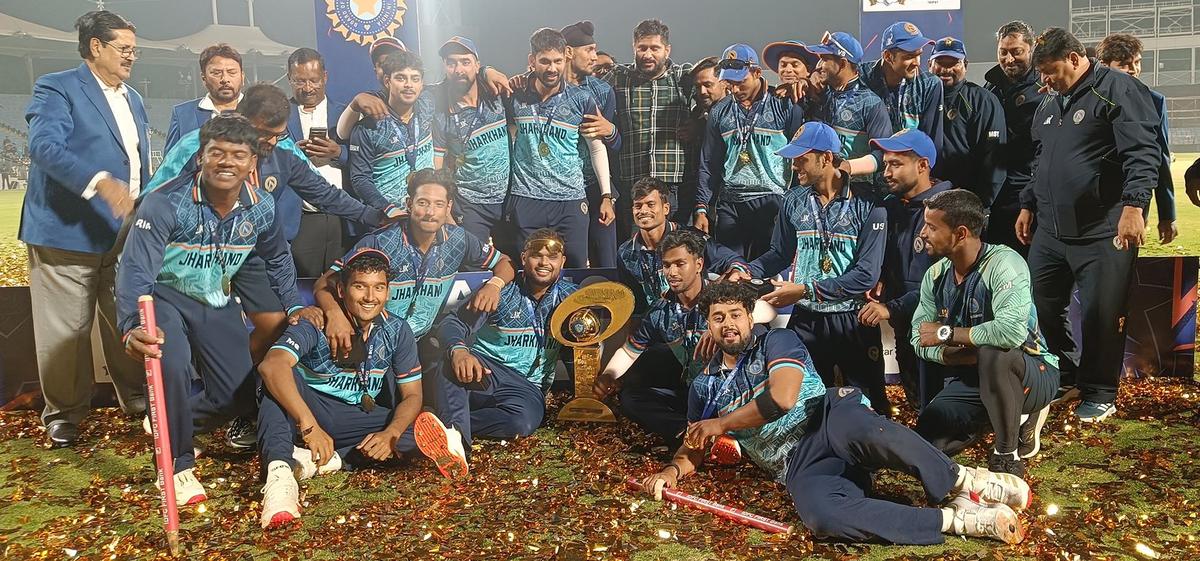
After years of heartbreak, Ishan Kishan’s men finally gave the State reason to celebrate. Jharkhand defeated Haryana convincingly in the final and won ten of its eleven matches in the tournament. Captain Ishan led from the front, finishing as the top-scorer with 517 runs in eleven outings.
| Photo Credit:
Shayan Acharya

Jharkhand’s players celebrate winning the Syed Mushtaq Ali Trophy, the first for the State, beating Haryana in the final.
| Photo Credit:
Shayan Acharya
While the players celebrated their biggest success in recent times, it was also a triumph of the Jharkhand model, rewired at the start of the season by Tiwary and Nadeem.
Now office-bearers — Tiwary is the secretary and Nadeem is the joint-secretary — at the Jharkhand State Cricket Association (JSCA), they worked under the guidance of a man who has seen Jharkhand cricket from its nascent years: Mahendra Singh Dhoni.
No cricket conversation in the State is complete without mentioning the former India captain. His impact on the sport and on younger generations is well documented, but his hands-on involvement leading into the season proved equally vital.
“When we started this season, and were selecting the coaches, Dhoni was very much involved in the process. His input was always important…,” Nadeem told Sportstar.
Dhoni advised the administrators not to chase big names and instead look for coaches who could be utilised better. Acting on his suggestion, Jharkhand appointed locals Ratan Kumar as head coach, Sunny Gupta as bowling coach, and the vastly experienced Madhusudan Tantubhai as fielding coach.
RELATED: Captain Kishan’s blistering century leads Jharkhand to maiden Syed Mushtaq Ali Trophy
“I remember Dhoni telling me that instead of looking for fancy, high-end coaches, our desi coaches should be preferred, because they understand the sentiments of our players, their feelings and hence, communication will be better,” Nadeem said.
“Most of our players come from humble backgrounds, so Dhoni felt that if we bring outsiders, communication will be a major barrier, and that could put the players in a cocoon. But with our local coaches, things were simple, and players could understand exactly what’s expected from them, in their local language…”
Dhoni also held regular conversations with the players ahead of the season, inviting them to ask him anything about the game. In one session with the senior team, he stressed the importance of mental toughness. As one of the players recalled, during the hour-long discussion, Dhoni referred to the Indian team and shared incidents to underline the value of staying strong in crunch moments.
“He was talking to all the players, in every format – whether it was the women’s team or men’s, Under-19 or senior, U-23. He was involved in everything. And he gave his input. He also had individual sessions with a lot of players, along with the team. He has given at least a couple of hours for each team,” Nadeem said, adding, “So, for all the success, we can give credit to him as well, because of his involvement, and giving his time throughout the day, despite such a busy schedule. He gave a patient hearing to all and also suggested developing the infrastructure, which we followed…”
One of Dhoni’s key suggestions was to rejig the State’s domestic cricket cycle.
For years, age-group cricket had largely revolved around day games, with players mostly exposed to white-ball formats. Keeping the evolving nature of the game in mind, Dhoni pushed for the introduction of multi-day cricket at the junior level. According to Tiwary and Nadeem, that proved to be a game-changer. “We changed the format in the domestic structure, especially at the junior level. Earlier, we used to have 50 overs and limited overs tournaments, but now, we have introduced two-day games at the U-16, U-19 level, which was earlier lacking,” Nadeem said, as Tiwary nodded in agreement.
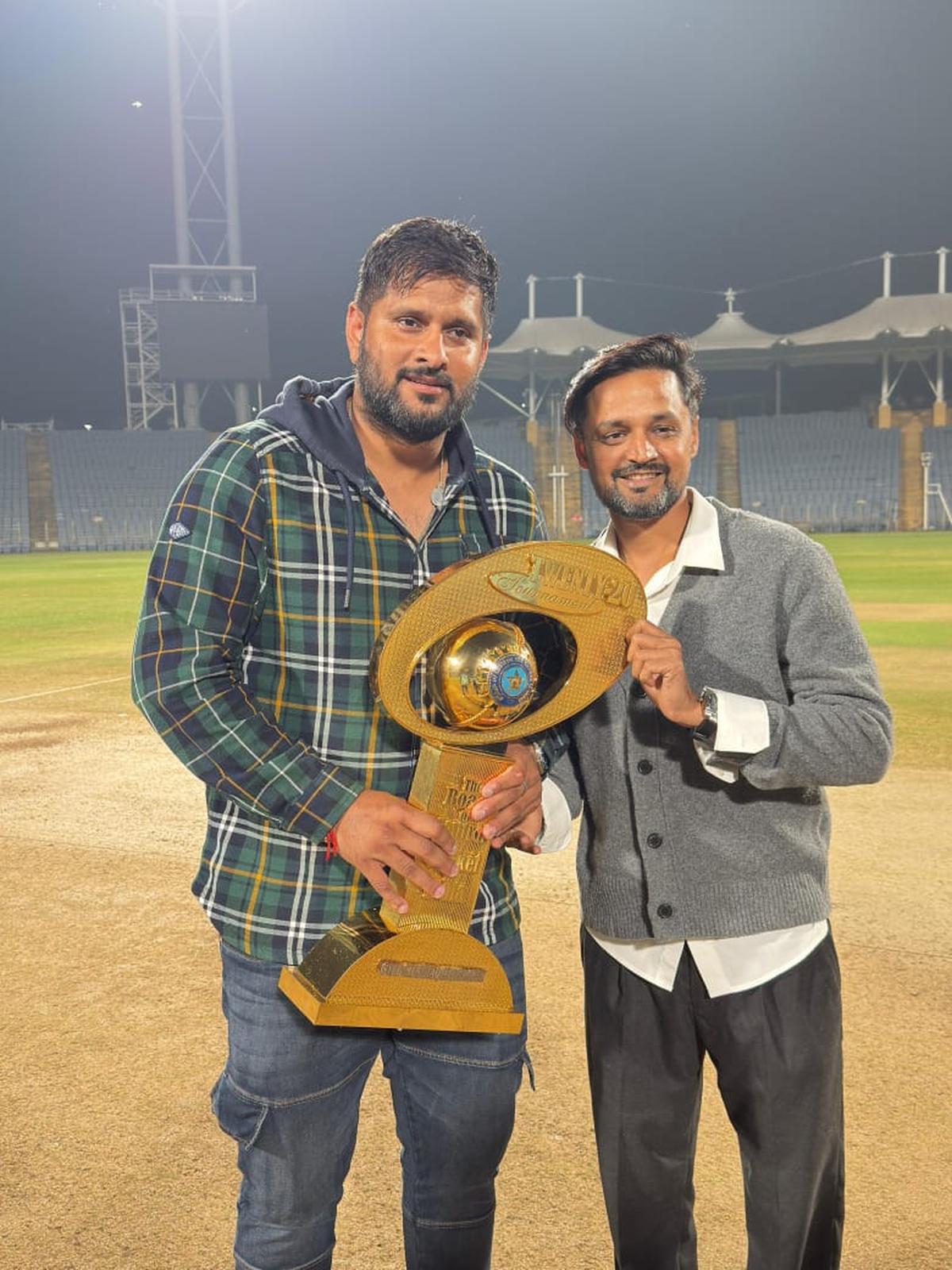
Saurabh Tiwary (left), the secretary, and Shahbaz Nadeem (right), the joint-secretary of Jharkhand State Cricket Association pose with the Syed Mushtaq Ali Trophy (SMAT) after their team beat Haryana in the final.
| Photo Credit:
Shayan Acharya
Saurabh Tiwary (left), the secretary, and Shahbaz Nadeem (right), the joint-secretary of Jharkhand State Cricket Association pose with the Syed Mushtaq Ali Trophy (SMAT) after their team beat Haryana in the final.
| Photo Credit:
Shayan Acharya
With facilities addressed, the real challenge lay in extracting the best from the players. With Ishan leading by example, things gradually fell into place. In team meetings before the SMAT, he assured the squad that they would be given a longer rope and not judged based on a couple of performances.
Kumar Kushagra, one of the architects of the campaign, admitted that the assurance from the captain and the management worked. Ahead of the group league in Ahmedabad, players were given clarity about their roles and what was expected of them. “As a team, we know that we will not only have to play our respective roles to perfection, but also step up for that player who may have had one bad day. So, by that, we complement each other and move forward as a team,” the young Kushagra, also the vice-captain, said.
A seasoned campaigner, Ishan knew how to bring the best out of his squad. He encouraged everyone, including those outside the playing eleven, to stay together and build bonhomie. At the same time, he took responsibility for tactical errors and rough patches. “Players knew that no matter what, he (Ishan) would back them, and being the leader, he would own up to the mistakes. With your captain leading by example, things get easy…” Kushagra added.
RELATED: ‘Happiest moment of my career,’ says Ishan Kishan after leading Jharkhand to SMAT 2025 triumph
Throughout the tournament, Ishan provided fiery starts at the top while Kushagra bolstered the order with consistent performances and stepped up for Virat Singh when the opener faltered in the final. “We were just playing game by game,” Ishan said, while Kushagra explained that the focus was on not losing the plot. “We all knew what to do, and we were not complicating matters, which was crucial,” he said.
That clarity allowed players like Robin Minz and Anukul Roy to bat lower down the order and still deliver impact innings. “As a unit, we never lost hope. Our message was clear that even if we are in a tough situation as a unit, we can always change the game and turn around,” Ishan said.
The balance showed on the field. When seamers struggled, the seasoned Anukul, Player of the Tournament with 303 runs and 18 wickets, rolled his arm over to find breakthroughs. On days the spinners went for runs, the fast bowlers stepped up. “It was all about the right balance and cutting out the noise,” Kushagra, Ishan’s deputy, said. When all units fired in sync, the team benefited.
An unbeaten group stage run boosted confidence and spoke volumes about the side’s character. By the time Jharkhand reached Pune for the Super League, it knew it was on course. All it needed was a bit of luck and for the momentum to continue.
There were a few tweaks. Calmness prevailed in the dressing room even during precarious moments, and Ishan instilled belief throughout the group. Taken together, it was a happy unit and a successful one.
That reflected in their cricket, as the players chased a long-held dream.
Published on Dec 20, 2025
Discover more from News Link360
Subscribe to get the latest posts sent to your email.