
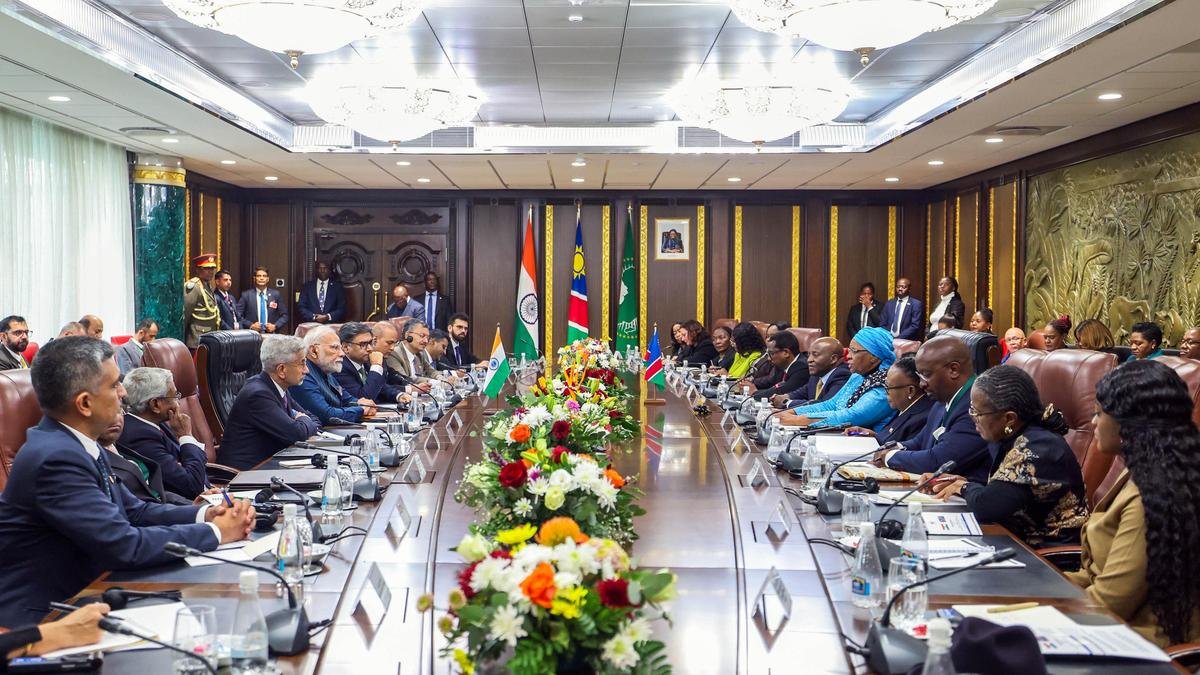
Editorial | Common goals: On India and a five-nation tour
Uncertainties in western markets
In FY24, India’s exports to the United States and the European Union constituted around 40% of its total exports. Given the rising unpredictability of these markets and the threat of a potential slowdown, it is essential that India looks to other markets, particularly African economies.
India is Africa’s fourth-largest trading partner, with bilateral trade reaching nearly $100 billion. In FY24, India exported goods worth $38.17 billion to African countries — the key destinations included Nigeria, South Africa and Tanzania. Petroleum products, engineering goods, pharmaceuticals, rice and textiles were some of the major goods exported. In 2024, Africa’s imports from India were around 6% of its total imports. To put this in perspective, in addition to being one of the largest investors, China is also Africa’s largest trading partner, with bilateral trade exceeding $200 billion. Around 21% of imports to Africa in 2024 came from China. Interestingly around 33% of imports from China fell under the HSN 84 and 85 product categories, demonstrating China’s industrial prowess. These product categories comprise machinery, boilers, electrical machinery, and semiconductor devices.
Recognising the need to catch up, India has already set a target of doubling its trade with Africa by 2030. Here is a five-point strategy that may enable India to fulfil its target.
The first strategic pillar should focus on removing trade barriers and engaging in negotiations for preferential trade agreements and comprehensive economic partnership agreements with regional economic communities and the major African economies.

The second pillar should aim to move from low-value commodity exports to two-way value-added and cross-border joint venture manufacturing. Currently, Indian firms lag in utilising the incentives offered by multiple African governments to enable firms to set up manufacturing units. For Indian enterprises, setting up manufacturing facilities across Africa presents a strategic dual advantage. It enables them to maintain preferential access to the U.S. market through favourable tariff regimes, while simultaneously capitalising on Africa’s growing consumer base and industrial demand. Moving beyond petroleum and traditional exports is critical in transitioning to a new phase of India’s ties with African economies. Deepening engagement with African regional groupings such as the African Continental Free Trade Area (AfCFTA) can open greater opportunities for Indian exporters.
An opportunity for MSMEs
The third pillar must prioritise the scaling-up of the Lines of Credit and improve accessibility to trade finance. The African market offers a great opportunity for the micro, small and medium enterprises (MSME) segment, unlike the European and American markets where MSMEs find it difficult to gain a foothold. There is a considerable lack of policy attention in enabling MSMEs to gain access to the African markets.
Ensuring easy access to trade finance is critical in achieving a sustainable trade relationship with the continent. Other measures may include adopting trade in local currencies, and forming a joint insurance pool to cover political and commercial risks for medium-term projects which may reduce the perceived risk for small and medium enterprises and banks.
The fourth strategic pillar should focus on lowering freight and logistics costs by investing in port modernisation, hinterland connectivity and in developing India-Africa maritime corridors.
The final strategic pillar involves the scaling up of services, digital trade, and people-to-people links. It is essential that India leverages its strength in Information Technology, health care, professional services and skill development to boost services exports and stimulate goods trade. Services enable high-value exports and facilitate greater two-way trade. Current policy measures fall short in enabling services trade with African economies. There needs to be a considerable improvement in this regard.

A role for the Indian public sector
Strengthening investments by Indian firms in African manufacturing, agro-processing, infrastructure, renewable energy and critical and emerging technologies may lend further strength to India’s relations with African economies. Currently, India’s investments in Africa are inflated by investments in Mauritius which are often done with an intent to evade taxes. Multiple factors, including bureaucratic hurdles, political instability and financing costs act as barriers for Indian firms to invest in Africa. Indian firms, particularly the public sector units must take the lead in investing in the African continent, particularly in mining and mineral exploration.
Ultimately, India’s engagement with Africa must go beyond transactional trade and move towards building long-term, sustainable partnerships. As global supply chains undergo restructuring and the world shifts towards a multipolar economic order, Africa will remain central to India’s aspirations of becoming a global economic power. The time is ripe for India to recalibrate, innovate, and deepen its economic footprint across the African continent.
Amal Krishnan is an Assistant Professor at Christ University, Bengaluru. Badri Narayanan is Fellow, NITI Aayog
Published – December 22, 2025 12:08 am IST
Discover more from News Link360
Subscribe to get the latest posts sent to your email.