



This student-led startup is revolutionising defence tech with agile kamikaze drones
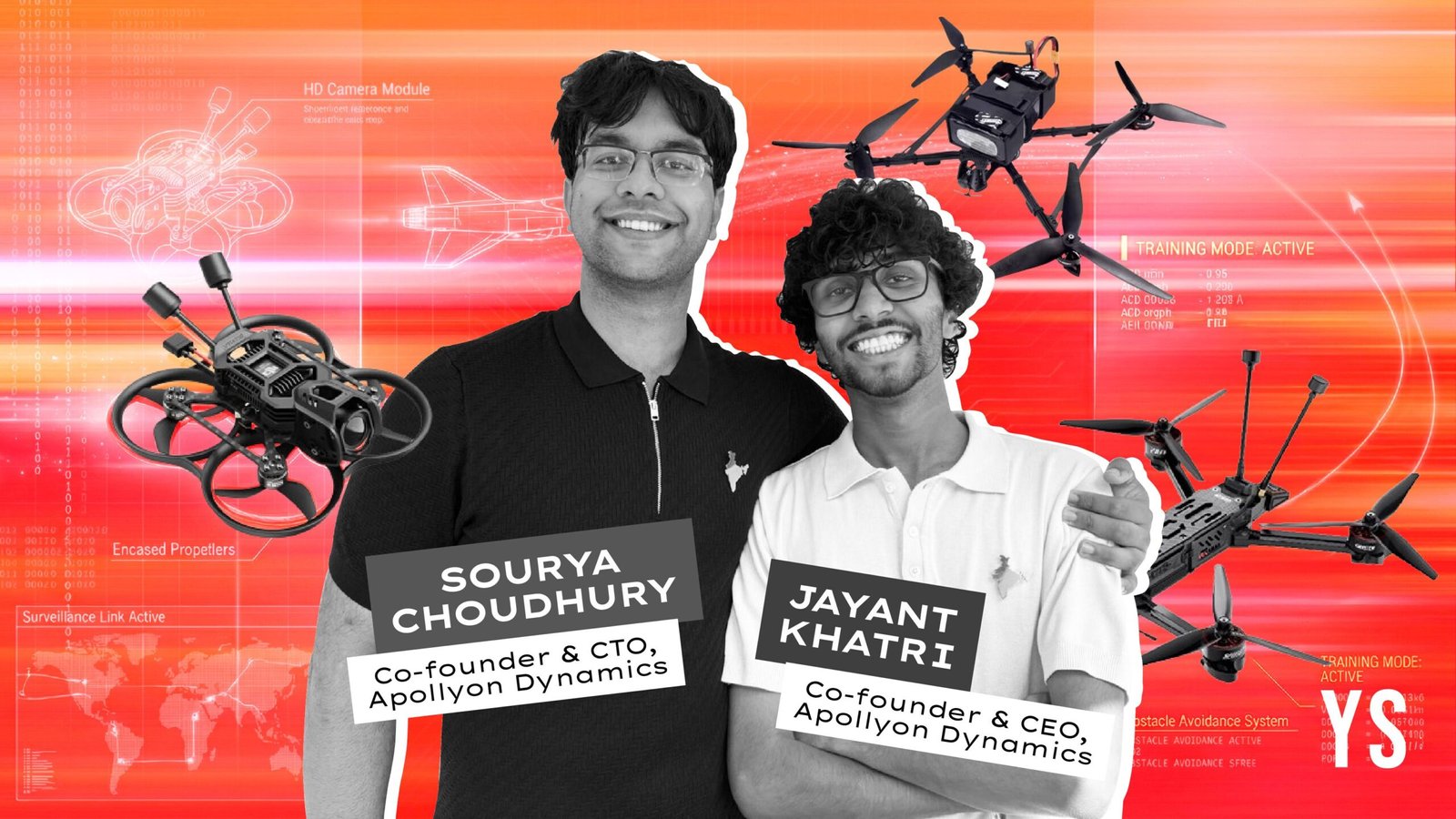
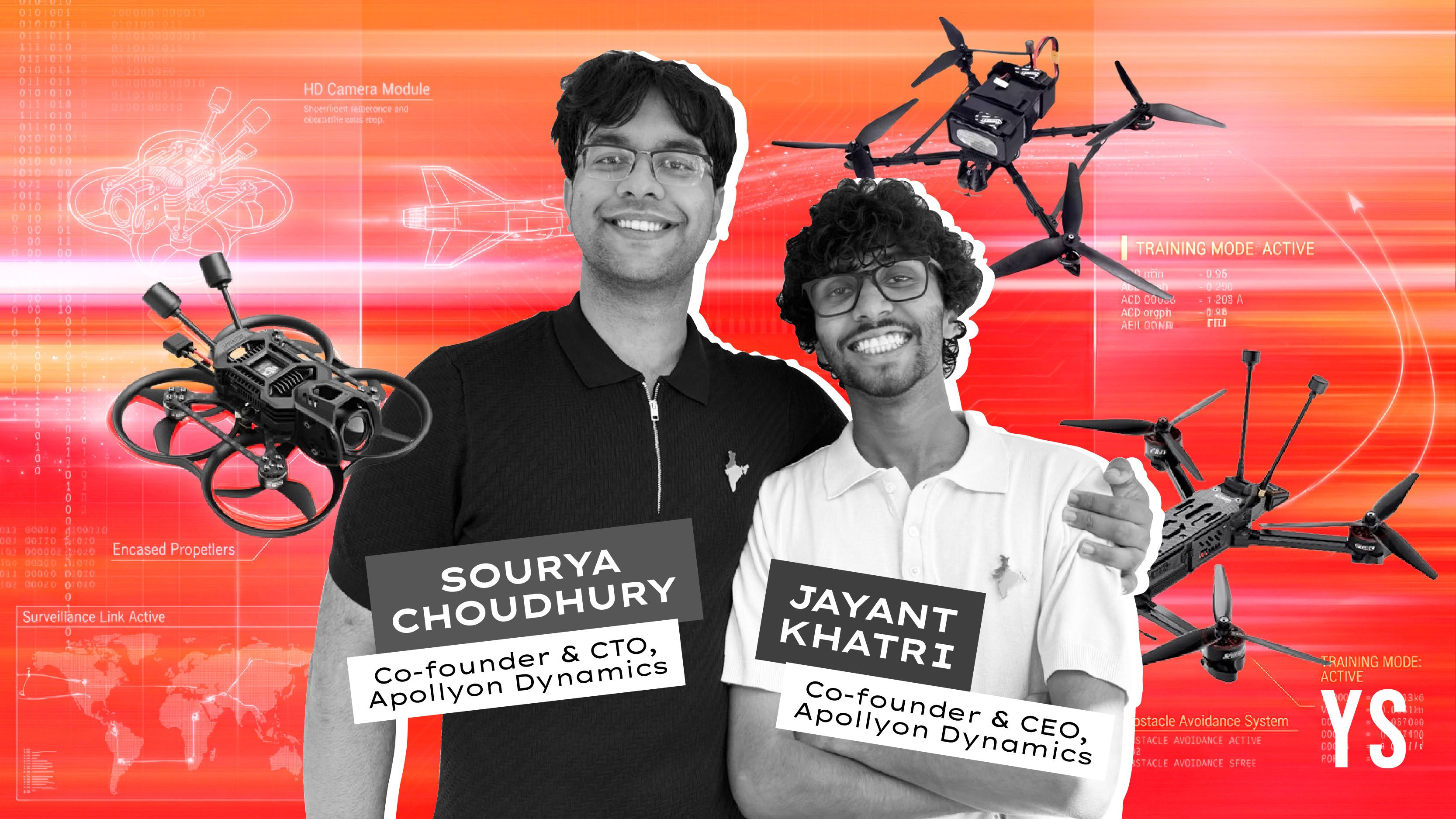

“We decided to build a business after successfully demonstrating the capabilities of the kamikaze drones to the [Indian] Army, which we had developed in our dorm rooms. This was part of a no-cost, no-commitment (NCNC) demonstration in Chandimandir, Ambala, Panagarh, and Babina, where they showed significant interest in the technology,” Khatri tells YourStory.
That demo led to the first order of Apollyon Dynamics, the defence tech startup founded in 2025. The name ‘Apollyon’, derived from the Greek word Abaddon—a biblical angel of destruction—felt like an appropriate identity for a defence tech venture.
Today, the 14-member startup is led by Co-founder and CEO Khatri, with Choudhury managing the tech operation as the CTO. Apollyon Dynamics is based on the BITS Hyderabad campus and incubated by Pilani Innovation and Entrepreneurship Development Society (PIEDS), with full in-house manufacturing.
Creating UAVs for modern warfare
In the early stages, the founders had the ideas, technical capability, and motivation, but lacked access to fabrication labs, high-power electronics facilities, and basic hardware tooling—critical for defence-grade R&D.
“Component sourcing added another layer of complexity. Many of the high-grade motors, sensors, avionics, batteries, and structural materials needed for defence-level UAV work are either expensive, imported, restricted, or simply unavailable in small prototype quantities,” Khatri says.
The defence tech startup spent its earliest months hunting for suppliers, negotiating with vendors, validating quality, and building a basic engineering setup that could support iterative prototyping.
“Without this foundation, development could not move forward. Despite the hurdles, we got our first order from the Indian Army’s Chandimandir base,” he adds.
.thumbnailWrapper{
width:6.62rem !important;
}
.alsoReadTitleImage{
min-width: 81px !important;
min-height: 81px !important;
}
.alsoReadMainTitleText{
font-size: 14px !important;
line-height: 20px !important;
}
.alsoReadHeadText{
font-size: 24px !important;
line-height: 20px !important;
}
}

The 20-year-old CEO says the team completed R&D for its first kamikaze drone in just two months. The company offers four primary product lines: trainer drones, long-range endurance platforms, autonomous multirole UAVs, and kamikaze systems.
“Our flagship product is the Ahuti, a high-velocity kamikaze drone capable of reaching a top speed of 300 km/h while carrying a sub-1 kg explosive payload with high precision. At Apollyon Dynamics, speed is our unfair advantage,” the CEO says, adding that in defence, speed and extended range are premium capabilities, and customers often pay five to ten times more for systems that deliver them.
Apollyon Dynamics now supplies drones to the Border Security Forces’ (BSF) School of Drone Warfare and works with several private defence partners as the manufacturing provider—positioning itself as a B2B and B2G startup.
Outside of UAV testing operations, the defence tech startup has worked on explosives testing with the Indian Army.
The startup is also developing jet-propelled systems, aiming for 650 km/h (approximately Mach 0.52) and offering a 3-5x speed advantage over electric propulsion systems, which typically cap out at 70-120 km/h for loitering munitions.
The industry at large
Apollyon Dynamics recently made a lot of noise at the BSF Raising Day 2025, becoming the first student-led startup to showcase a kamikaze drone at the event. Khatri says their experience with BSF was “eye-opening”.
“They opened doors to the Central Armed Police Forces and helped us understand operational doctrine,” he remarks.
According to the student entrepreneur, India’s geopolitical situation has dramatically accelerated the adoption of UAVs. “A few years ago, UAVs were nice-to-have. Today, they’re mission-critical, with every unit wanting reliable surveillance, strike capability, and faster reaction time—and drones are the only platforms that can deliver all three at scale,” explains Khatri.
“For companies like ours, this shift has opened up a very real opportunity. The demand isn’t just for ‘a drone’, it’s for specialised systems that solve actual operational problems. That pushes us to innovate faster and be extremely practical with our designs,” he says.
India’s UAV market—valued at $634 million in 2025—is forecasted to grow to $1.76 billion by 2034. However, Khatri believes that only serious engineering-led teams will survive.
Import dependency will become less acceptable, and most units want Indian companies that can deliver world-class systems quickly. In this environment, the founder believes that being a student entrepreneur is now an advantage.
“Today, if you can deliver working prototypes, people don’t care whether you’re 19 or 29. In our case, even as students, Army units trusted us with real projects because we showed them working systems, not PowerPoint presentations. That’s the difference,” Khatri says.
He adds that colleges are more supportive than ever, and investors are more open-minded, making this an ideal moment to build as a student.
.thumbnailWrapper{
width:6.62rem !important;
}
.alsoReadTitleImage{
min-width: 81px !important;
min-height: 81px !important;
}
.alsoReadMainTitleText{
font-size: 14px !important;
line-height: 20px !important;
}
.alsoReadHeadText{
font-size: 24px !important;
line-height: 20px !important;
}
}
Funding and the future
Apollyon Dynamics raised Rs 4 crore in a pre-seed round led by Naandi Ventures in 2025. The startup is using the funds for R&D and hiring. It plans to raise another round next year to expand its manufacturing capabilities.
Vikas Katragadda, Co-founder of Naandi Ventures, says the VC decided to invest in Apollyon Dynamics because the founders showed the courage to take on deeptech challenges from India for the world.
“We’ve seen them (the founders) evolve from first-year hobbyists to entrepreneurs creating sophisticated defence solutions. Their ability to learn fast, execute with discipline, and stay committed to a long-term vision is rare at this stage. Apollyon Dynamics reflects everything Naandi stands for—ambition, character, and technical excellence,” says Katragadda.
Competing with players like Kadet Defence Systems, Khatri says Apollyon Dynamics stands apart from the competition through unmatched drone agility and high-speed jet-propelled systems, which no other Indian startup is currently operating.
“Our UAVs have shown zero custom aero failures, and we’re one of the few Indian companies working on jet-propelled target drones. Our long-term vision is to establish Apollyon as a global defence exporter,” Khatri says.
Edited by Suman Singh
Discover more from News Link360
Subscribe to get the latest posts sent to your email.