



Deepinder Goyal on Jobs, Riders, and the Reality Behind 10-Minute Delivery
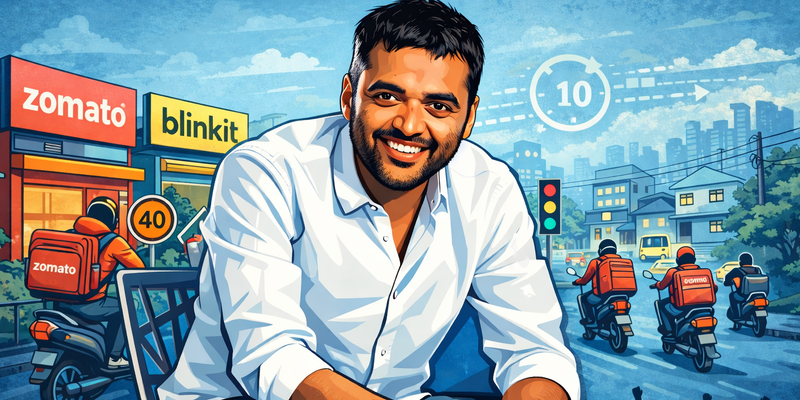
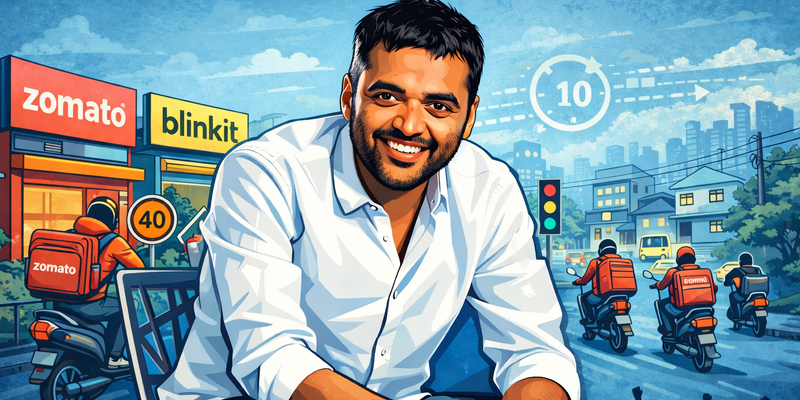

A series of posts on X by Deepinder Goyal, founder of Zomato and Blinkit, triggered a wide-ranging conversation on how gig work functions, how delivery timelines are achieved, and what fairness looks like in a country with chronic underemployment.
How Blinkit’s 10-Minute Delivery Works
According to Goyal, the promise of rapid delivery is enabled by a dense network of neighbourhood stores rather than by riders driving at unsafe speeds. He explained that orders are picked and packed within approximately 2.5 minutes, after which delivery partners typically travel under 2 kilometres in around eight minutes, translating to an average speed of roughly 15 kmph.
<div class="tweet embed" contenteditable="false" id="2006738218339766488" data-id="2006738218339766488" data-url="https://x.com/deepigoyal/status/2006738218339766488" data-html="
One more thing. Our 10 minute delivery promise is enabled by the density of stores around your homes. It’s not enabled by asking delivery partners to drive fast. Delivery partners don’t even have a timer on their app to indicate what was the original time promised to the…
— Deepinder Goyal (@deepigoyal) January 1, 2026
https://platform.twitter.com/widgets.js
” data-type=”tweet” align=”center”>
One more thing. Our 10 minute delivery promise is enabled by the density of stores around your homes. It’s not enabled by asking delivery partners to drive fast. Delivery partners don’t even have a timer on their app to indicate what was the original time promised to the…
— Deepinder Goyal (@deepigoyal) January 1, 2026
Importantly, Goyal stated that delivery partners are not shown countdown timers or original promised delivery times on their apps, countering the perception that riders are incentivised to rush.
“The complexity of the system design is often underestimated,” he noted, adding that concerns around risk stem from a lack of understanding of how hyperlocal logistics actually function.
Gig Work as a Safety Net in a Tight Job Market
The discussion broadened beyond delivery speeds to the larger role of gig work in India’s employment ecosystem. Several users highlighted that millions of Indians face limited formal employment opportunities, particularly at the entry level.
Supporters of platform work argued that companies like Zomato and Swiggy have ensured that individuals with basic assets such as a two-wheeler can access work without prolonged unemployment, even if earnings remain modest compared to long working hours.
Goyal echoed this sentiment, describing the gig economy as one of India’s largest organised job creation engines. He added that its long-term impact would be felt as workers’ families gain income stability and improved access to education.
New Year’s Eve, Strikes, and Scale
Goyal revealed that Zomato and Blinkit delivered over 75 lakh orders to more than 63 lakh customers on New Year’s Eve, supported by over 4.5 lakh delivery partners. The operations, he said, were unaffected by calls for strikes that circulated in the days leading up to the event.
He credited local law enforcement and on-ground teams for maintaining order and enabling uninterrupted operations, noting that no special incentives were offered beyond the usual New Year’s Eve surge pricing.
“If a system were fundamentally unfair, it would not consistently attract and retain so many people,” Goyal said, cautioning against what he described as narratives driven by vested interests.
Industry Leaders Weigh In
Several Indian business leaders supported the hyperlocal delivery model, saying speed comes from proximity, not pressure.
Sanjeev Bikhchandani, Founder of Info Edge, noted that Blinkit stores are often located just a few hundred metres from homes. In his case, the nearest store is around 400 metres away, making under-10-minute delivery possible without risky riding. He added that delivery partners often use slower vehicles and avoid main roads.
Vijay Shekhar Sharma, Founder and CEO of Paytm, likened quick commerce to booking a cab that is already nearby. He described it as a tech-enabled assembly line, where order packing and delivery happen in parallel, not by the same person.
Addressing Worker Welfare and Attrition
Questions around insurance, hiring practices, attrition, and career progression were also raised. Goyal clarified that all delivery partners are covered by medical and life insurance and undergo background checks before onboarding.
He acknowledged that attrition stands at around 65% annually, reinforcing that gig work is not designed as a long-term career but as short-duration, flexible employment. “Most people do this for a few months and move on to something more permanent,” he said.
On delivery delays, Goyal added that partners are not penalised for factors beyond their control, such as traffic congestion in dense neighbourhoods.
The Traffic Rule Debate
Addressing concerns about delivery partners breaking traffic rules, Goyal argued that the issue reflects a broader societal problem rather than platform-specific incentives. He suggested that uniformed riders are more visible and therefore more easily associated with violations, while similar behaviour by other road users often goes unnoticed.
“If our delivery partners were the only ones breaking traffic rules, I would take the blame,” he said, calling for a more balanced assessment of road behaviour in Indian cities.
As quick commerce continues to scale across urban India, the conversation around safety, worker welfare, and sustainable job creation is likely to intensify. While platforms emphasise system efficiency and flexibility, critics continue to call for stronger protections and clearer accountability.
Discover more from News Link360
Subscribe to get the latest posts sent to your email.