



According to the startup, the round is intended to support scale at a time when enterprise demand for AI adoption is accelerating, but execution capacity remains constrained. Aivar plans to deploy capital across four areas, such as international market expansion, senior talent hiring, continued development of its AI accelerators, and building sales, partnerships, and customer success teams.
“We did not raise capital because we needed it to survive. We raised it because the pace of enterprise demand is increasing faster than what a bootstrapped model can responsibly support. The risk today is not failure, it is missing the window where enterprises are ready to move from pilots to production,” says Kousik Rajendran, Co-Founder and CEO of Aivar Innovations.
An AI-first service built for production
Founded in 2024, Aivar Innovations is an AI-first technology services startup that works with startups, technology-led businesses, and large enterprises to operationalise artificial intelligence across core business workflows.
The Coimbatore-based startup operates through entities in India, the US, and Singapore, with a growing international customer base.
<figure class="image embed" contenteditable="false" data-id="587731" data-url="https://images.yourstory.com/cs/2/6c7d986093a511ec98ee9fbd8fa414a8/AivarFoundersGroupPhotos21-1767799060433.jpg" data-alt="Aivar" data-caption="
Co-founders: From top right (clock-wise) Kousik Rajendran, Aadarsh Ayyappan (sitting right), Ashwin Ram (sitting left) and Praveen Jayakumar (top left)
” style=”float: right; margin-left: 20px; width:50%; height:auto”> Co-founders: From top right (clock-wise) Kousik Rajendran, Aadarsh Ayyappan (sitting right), Ashwin Ram (sitting left) and Praveen Jayakumar (top left)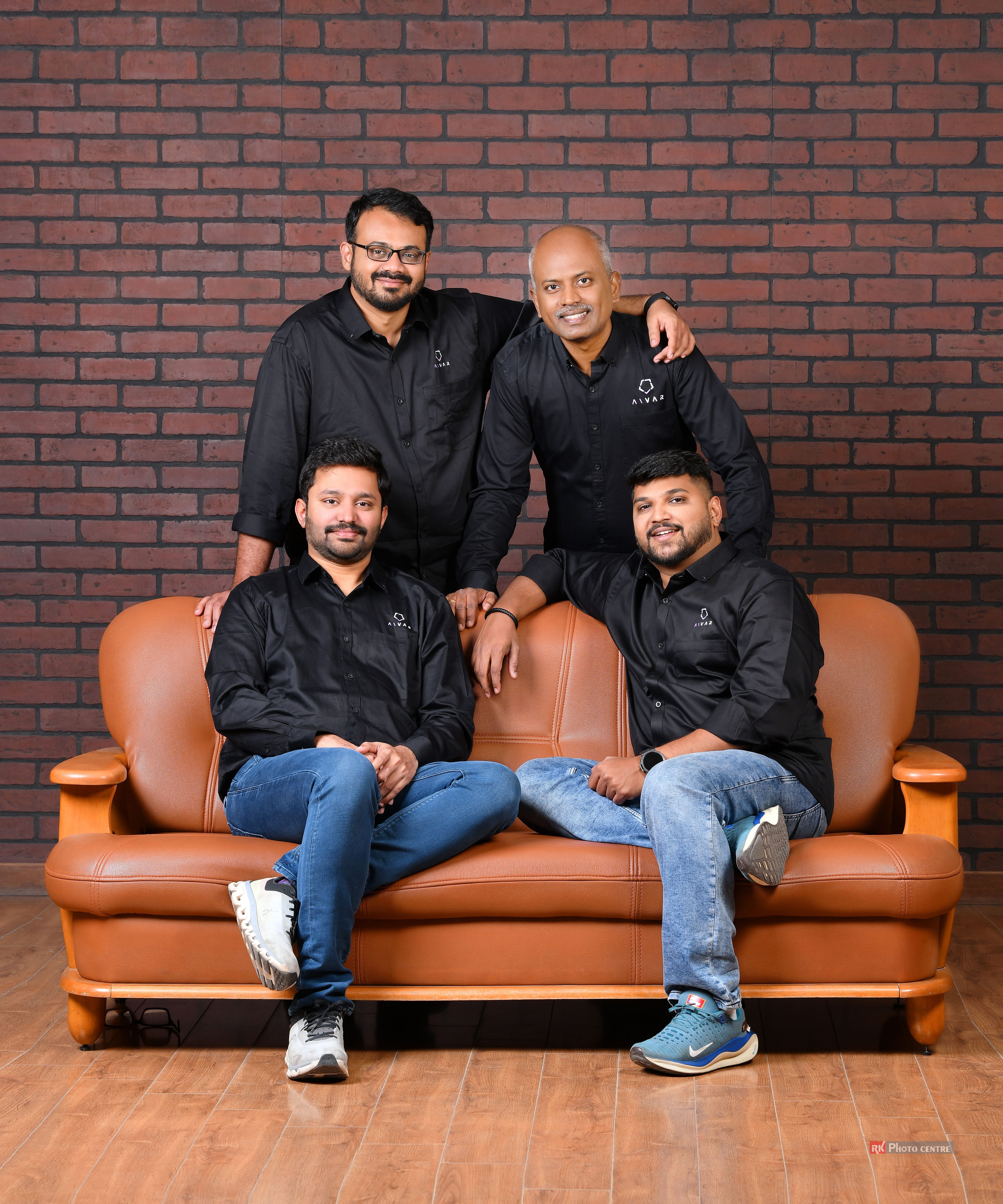
Since launch, Aivar has onboarded over 80 customers across fintech, healthcare and life sciences, logistics, retail, and D2C sectors. Around 80% of customers are currently based in India, with the remainder split between the US and the Middle East. Following the funding round, the startup has expanded its sales and pre-sales teams in international markets, gradually shifting this mix.
Rajendran says that in a year, the startup has proven that enterprises require more than AI tools; they need end-to-end execution partners. The startup is reshaping IT services by integrating AI with human expertise across strategy, development, and managed operations.
“Our studio- and accelerator-driven approach combines the best of services and software, delivering outcomes in weeks that traditionally took months. This funding allows us to scale this AI-native model globally while continuing to build the specialised AI and cloud talent that makes sustained client success possible,” he adds.
The startup reports about 2X quarter-on-quarter growth, and expects to cross 200 customers as it scales its accelerator portfolio and global delivery capacity. The team has grown to more than 100 employees, primarily based in Coimbatore, with additional operations in Bengaluru. It plans to expand to over 200 employees in the near term.
Internally, Aivar uses AI across its own workflows, from requirements analysis and solution design to testing and delivery management, allowing it to maintain delivery speed while controlling costs.
“If a services startup is not using AI to run itself, it cannot credibly help others do the same. Operational leverage is no longer optional; it’s fundamental,” Rajendran asserts.
The structural gaps in enterprise AI adoption
The startup was founded by four former Amazon Web Services (AWS) professionals, Kousik Rajendran, Praveen Jayakumar, Ashwin Ram Ravichandran, and Aadharsh Ayappan, whose combined experience spans enterprise architecture, engineering leadership, data platforms, sales, and strategy across Asia Pacific and global markets.
Rajendran previously spent over two decades in the technology industry and most recently served as a Principal Architect at AWS, working closely with enterprise customers across sectors.
“All of us had seen AI initiatives fail for the same reasons, regardless of startup size or industry. The technology was available, budgets were approved, but execution broke down when AI had to interact with real systems, real data, and real operational constraints. That gap is what we set out to address,” Rajendran tells.
The founders identified three systemic challenges limiting enterprise AI adoption. The first was a lack of clarity on where AI delivers measurable business value, beyond experimentation or isolated use cases. The second was the complexity of embedding AI into mission-critical workflows, particularly in regulated environments where governance, explainability, and reliability are non-negotiable. The third was a shortage of internal talent and execution bandwidth, which slowed or stalled production deployments.
“Many organisations were treating AI as an add-on. But the real value comes when AI is embedded into finance, operations, customer service, or compliance workflows. That requires multiple systems, approvals, and controls to work together, and most teams simply don’t have the capacity to build that internally,” Rajendran explains.
These observations shaped Aivar’s decision to operate as a full-stack execution partner rather than a model builder or advisory-only firm.
The AI studio model and end-to-end delivery
Aivar positions itself as an AI Studio, working across the full lifecycle from use-case prioritisation and system design to deployment and long-term management. Engagements are structured around defined outcomes and short delivery cycles, typically six to eight weeks, extending up to twelve weeks for complex implementations.
Rather than long, headcount-driven contracts, Aivar breaks work into modular phases that allow customers to validate value incrementally. Customers retain ownership of deployed code and can choose to continue with managed services based on internal capability.
“Enterprises want momentum, not multi-year roadmaps. Our focus is on helping teams see working systems quickly, learn from them, and then decide how far and how fast they want to scale,” he says.
Accelerators designed for real-world workflows
Aivar develops AI solutions using accelerators that combine reusable technology with custom features for each client. Convergent, the startup’s conversational AI platform, is built using an agentic architecture that allows multiple AI agents to operate within a single interaction.
The platform dynamically switches across languages, intents, and functional contexts, such as sales, support, HR, or policy queries, while routing requests across different model providers in the backend.
“In real enterprises, conversations don’t follow clean boundaries. Convergent is designed to reflect how organisations actually function, where interactions are handed off between specialists rather than forced into a single model or workflow,” Rajendran says.
Velogent, Aivar’s agentic process automation platform, is designed for regulated workflows such as invoice processing, contract reconciliation, and compliance-driven operations. Built on the startup’s proprietary REVACC (Reason, Validate, Act) framework, the platform ensures that AI-driven actions are explainable, validated before execution, and auditable after completion.
In a logistics deployment involving three-way invoice matching across contracts, purchase orders, and invoices, Velogent reduced manual effort by 80% and lowered operational costs by over 70% within six to eight weeks. Subsequent deployments were shortened to two to three weeks due to the reuse of the underlying IP.
.thumbnailWrapper{
width:6.62rem !important;
}
.alsoReadTitleImage{
min-width: 81px !important;
min-height: 81px !important;
}
.alsoReadMainTitleText{
font-size: 14px !important;
line-height: 20px !important;
}
.alsoReadHeadText{
font-size: 24px !important;
line-height: 20px !important;
}
}

The startup also offers Kubogent, a Kubernetes-based infrastructure accelerator for hosting AI workloads, providing pre-validated architectures with built-in security, observability, disaster recovery, and site reliability practices.
Business model
Aivar follows a service-first, hybrid software and services model, co-building AI solutions with customers and transferring full ownership of the deployed intellectual property. Pricing depends on factors such as infrastructure scale, traffic, supported languages, and customisation needs.
Engagements start with a one-time deployment fee, followed by optional managed services billed based on engineering effort, resource seniority, and engagement complexity, ranging from short-term handovers to subscriptions of eight to ten months or more. Solutions are delivered in modular components, allowing enterprises to adopt only what they need and scale over time across sectors, including fintech, healthcare, retail, and logistics.
“Our intent is alignment, not dependency. If we deliver value, customers continue working with us. If they choose to take things in-house, they should be able to do so without friction,” he says.
Looking ahead
The Indian AI market, valued at $9.51 billion in 2024, is projected to reach $130.63 billion by 2032, growing at a CAGR of 39%, according to Fortune Business Insight.
Looking ahead, Aivar sees AI evolving from discrete deployments into the operating layer of enterprise workflows, where processes are continuously optimised and outcomes measured in real time.
“This is not a tooling upgrade, it’s a redefinition of how work gets done. Our objective is to help enterprises navigate that transition pragmatically, with systems that work under real-world constraints,” he says.
The startup competes with AI-focused firms such as Fractal Analytics, Quantiphi, Tiger Analytics, LatentView Analytics, and select GenAI studios and advanced AWS partners, operating in enterprise AI delivery and analytics, while differentiating through faster execution, deeper integration into core workflows, and a service-led accelerator approach.
“Our differentiation is simple, we don’t treat AI as a pilot or a product; we embed it directly into core enterprise workflows and take responsibility for making it work in production,” Rajendran concludes.
Edited by Jyoti Narayan
Discover more from News Link360
Subscribe to get the latest posts sent to your email.