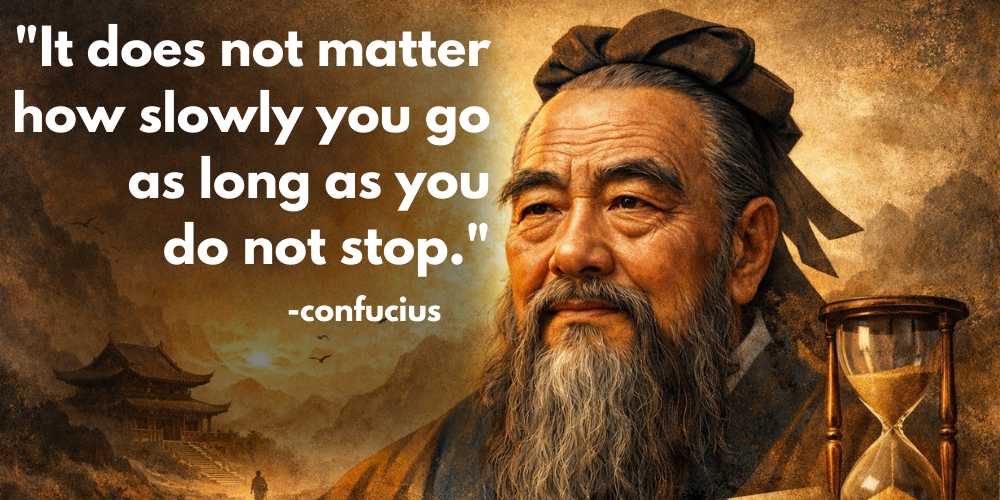
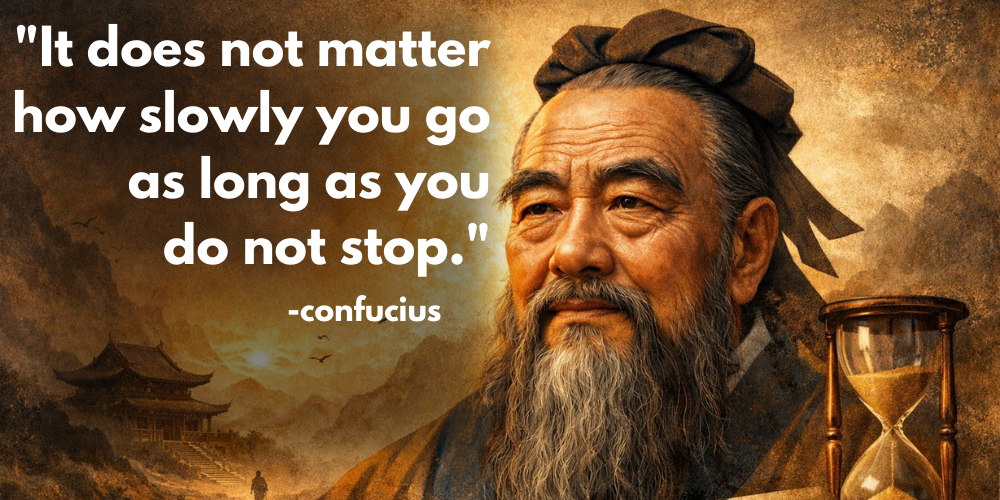

For professionals, entrepreneurs, and students alike, this philosophy cuts through the noise of comparison and competition. It shifts the focus from how fast we are moving to whether we are moving at all.
Who was Confucius?
Confucius (551–479 BCE) was a Chinese philosopher, teacher, and political thinker whose ideas shaped East Asian culture for over two millennia. His teachings, collectively known as Confucianism, emphasized ethics, discipline, respect for hierarchy, and lifelong learning.
Unlike abstract philosophers who speculated on distant ideals, Confucius focused on practical living. He believed that personal development, moral conduct, and consistent effort formed the foundation of a stable society. At the heart of his thought was a simple principle: self-cultivation requires patience.
Why this quote still matters
Modern culture rewards speed. Startups chase rapid scaling. Careers are measured by early milestones. Social media amplifies overnight success stories. In such an environment, slow progress can feel like failure.
Confucius challenges this narrative.
The quote does not celebrate slowness. It celebrates continuity. The emphasis is not on pace but on momentum. Moving slowly is acceptable. Stopping is not.
Consider long-term goals such as building a business, mastering a skill, writing a book, or recovering from setbacks. These pursuits rarely follow a straight, fast trajectory. They involve small daily improvements, repeated effort, and resilience during plateaus.
In practical terms, this idea reflects what modern productivity research suggests. Studies on habit formation show that consistency is more effective than occasional intense effort. Small actions carried out daily gradually build meaningful progress.
The psychology of not stopping
The greatest barrier to progress is rarely capability. It is discouragement. People abandon goals not because they are incapable, but because results are not immediate.
Confucius’ insight reframes the journey. Progress is not a race against others; it is a commitment to oneself. When speed is removed from the equation, pressure reduces. When comparison fades, focus returns.
This mindset is particularly relevant in professional environments where burnout is common. Sustainable growth, whether personal or organizational, depends on endurance. Companies that survive market cycles often prioritize steady iteration over reckless expansion. Individuals who build long careers understand the value of incremental mastery.
The quote also carries a deeper philosophical undertone. Life itself is a process. Growth is gradual. Wisdom accumulates slowly. Moral character is built through repeated choices, not dramatic gestures.
A lesson for modern ambition
For founders navigating funding winters, students preparing for competitive exams, or professionals switching careers, the message is clear: progress delayed is not progress denied.
The danger lies not in slow movement but in surrender.
In many ways, this is a radical antidote to modern impatience. It tells us that the journey does not need to be spectacular. It needs to be sustained.
Confucius’ words endure because they speak to a universal human struggle — the temptation to quit when results are invisible. Yet history consistently shows that endurance often outperforms brilliance.
You may move slowly. You may move quietly. But if you keep moving, you are already ahead of where you were yesterday.
And that, as Confucius reminds us, is enough.
Discover more from News Link360
Subscribe to get the latest posts sent to your email.