
Ajay Kumar first confronted this reality while he was studying engineering in Chandigarh. A female friend once arrived at their coaching centre, visibly shaken after a bike taxi ride: the driver had asked her to sit closer, made her place her hand on his waist, and used abrupt braking to force body contact. Feeling unsafe, she got off midway in a dark stretch and walked the rest of the way alone. The incident stayed with Kumar; it made him more aware of the everyday anxiety women face while commuting.
When Kumar met a batchmate, Vindhya Mehrotra, during his MBA course in 2021, they recognised this shared struggle, and one question emerged: “What if women didn’t have to choose between affordability and safety?”
To validate the idea of a “for women, by women” transport service, they began interviewing MBA, BBA, and BTech students on campus. Over six months, the duo spoke one-on-one to nearly 6,000 potential users, including more than 200 women at metro stations.
Their clear takeaway: 98% of women said they would feel more comfortable with a woman driver.
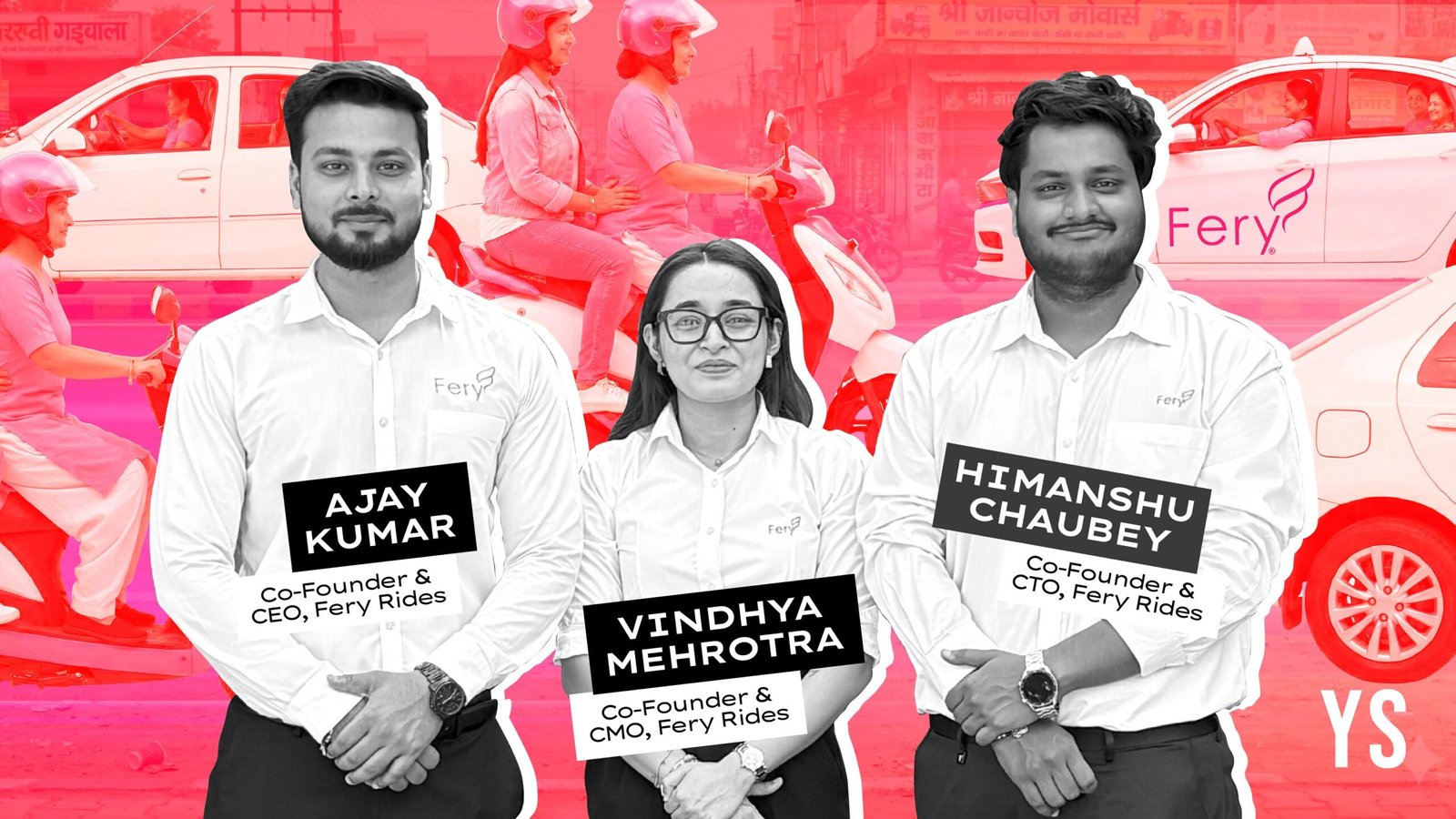
In 2023, the duo, along with Himanshu Chaubey, founded Fery Rides to tackle these gaps, especially the insecurity of sitting behind male drivers, overcrowding, accountability issues, and the near-total absence of female drivers in this male-driven space.
Inside Fery Rides’ zero-anxiety mobility model
Fery Rides positions itself as India’s first women-led, zero-anxiety mobility platform, built “for women, by women”, and operates with a fully electric fleet. “The name ‘Fery’ has dual meaning: it stands for ‘female rider’ and also references a ferry meant for short-distance travel,” Mehrotra says.
The platform offers on-demand rides, scheduled rides, and city rentals through bike taxis, and has expanded to cab services recently. Scheduled rides let users pre-book fixed time slots. “This works well for users who want predictable, no-hassle daily travel and can book the entire month in advance,” Kumar says.
A directed ride system and zero-cancellation policy underpin the service. “The ride gets assigned automatically to the nearest available partner who cannot cancel or refuse it,” Kumar adds. Partners get their next ride only after completing the current one, ensuring consistent fulfilment and shorter wait times.
Operations currently span a 10-km radius anchored by hubs at Millennium City Centre Gurugram metro station, where vehicles are stationed. Partners operate only within this zone to maintain steady availability and quicker pickups. The fleet comprises GPS-enabled electric vehicles supported by a battery-swapping network for uninterrupted usage. Pricing is flat with no surge charges implemented; they start at Rs 27–28 for the first 2 km and Rs 8–9 per km thereafter.
Partner onboarding and technology
To support its growing fleet and maintain service quality, Fery Rides recruits and trains its “sister partners” through referrals, Meta ad campaigns, and direct outreach.
The platform is open to all women, though preference is given to those who can ride a bicycle. A driver’s licence isn’t mandatory; Fery assists new partners in obtaining one during onboarding.
Training follows two pathways based on skill level. Women who already know how to ride receive structured on-ground guidance from in-house trainers, who are Fery’s most experienced sister partners. They go through supervised practice, safety orientation, and route familiarisation before going live. “New learners undergo an initial screening, then join batches of 8-10 women for formal riding and road safety training at Hero MotoCorp Safety Park,” Kumar says.
“This blended approach ensures every sister partner, whether a new learner or an experienced rider, becomes confident, safe, and professionally prepared for real-world mobility,” Mehrotra explains. The curriculum covers safe driving, customer interaction, and managing the day-to-day demands of the job.
Compensation is structured to offer stability with room for growth. Full-time partners start with a base salary of Rs 15,000, while part-time partners working four-hour shifts earn Rs 8,000–15,000 based on hours.
Incentives tied to ride volume, attendance, ride quality, and milestones such as completing 5,000 or 10,000 rides, can push full-time earnings up to Rs 30,000. Partners incur no costs for vehicles or maintenance.
Shifts are designed to be flexible. “We have mothers who adjust schedules around school drop-offs and pickups, taking one-to-three-hour breaks as needed between morning and evening shifts,” Mehrotra says. All partners receive medical insurance as part of their benefits.
Fery Rides’ app is built on Flutter for cross-platform use, with a backend powered by Node.js and Express.js. Razorpay handles payments, while Google Maps, Amazon Maps, and GCP provide navigation. The platform’s cloud infrastructure uses AWS and GCP to manage different functions efficiently.
Challenges and funding
The platform faced early challenges in building its partner fleet. “The concept was so new that no one believed it initially,” Kumar says. “Women were uncomfortable with the idea of being drivers since it was unprecedented in the market,” Mehrotra adds. High demand combined with limited supply created operational pressures.
To address these challenges and stabilise operations, Fery secured Rs 50 lakh from the Startup India Seed Fund and grant support from HDFC Parivartan. In October 2025, it raised Rs 2.075 crore in a seed round led by Indian Angel Network (IAN) Group.
The funds are being deployed to strengthen the team, build technology capable of handling millions of rides, and establish solid unit economics. “Once the team, technology, and unit economics are stabilised, we will be ready for multi-city scaling,” Kumar says.
Growth and future plans
Fery Rides has executed 80,000+ rides in Gurugram since its inception in 2023. In the short term, Fery aims to execute around 10,000 rides per month. The immediate plan is to scale aggressively in Gurugram, increasing the partner base from 30 to 230, and begin testing operations in Noida and Delhi.
Over the next two years, the startup plans to expand to 10 cities, including Bengaluru, Hyderabad, Chandigarh, and Chennai, with a partner network of 5,000+ sister partners and 10 million safe rides for women, targeting an ARR of Rs 100 crore. “The expansion strategy is deliberately focused, not 100 or 1,000 cities, but thoughtful growth to 10 well-served cities by 2027,” Mehrotra says.
Fery’s expansion plans are backed by substantial demand from other cities. “From Bangalore alone, we have 30,000+ written queries from women asking when Fery will launch there. The demand validates that this isn’t just needed in Gurugram; women across India are waiting for a safe, reliable mobility option,” Kumar tells YourStory.
Discover more from News Link360
Subscribe to get the latest posts sent to your email.