
Launched in mid-2022, Valmo is neither a conventional third-party logistics (3PL) player nor a fully captive delivery arm like Amazon Transportation Services or Flipkart’s Ekart. Instead, it is an “asset-light orchestration layer”, designed to compress Meesho’s fulfilment costs rather than optimise for speed or service control. And that distinction has come in handy.
In just three years, Valmo has scaled from handling less than 2% of Meesho’s shipments in FY23 to 66–67% by Q2 FY26, according to brokerage firm JM Financial. In absolute terms, Valmo shipped ~400 million orders in Q2 FY26, making it the largest logistics platform in India by shipment volumes—all this without owning trucks, warehouses, or delivery fleets, surging ahead of Delhivery and others.
This scale has turned Meesho into a systemically important shipper, accounting for roughly 30% of India’s total ecommerce shipments (excluding hyperlocal). This volume density is the foundation of Valmo’s cost advantage, say analysts, highlighting that the in-house logistics engine has been “structurally cheaper”, in fact, than traditional 3PLs since FY25.
Valmo as a cost optimiser
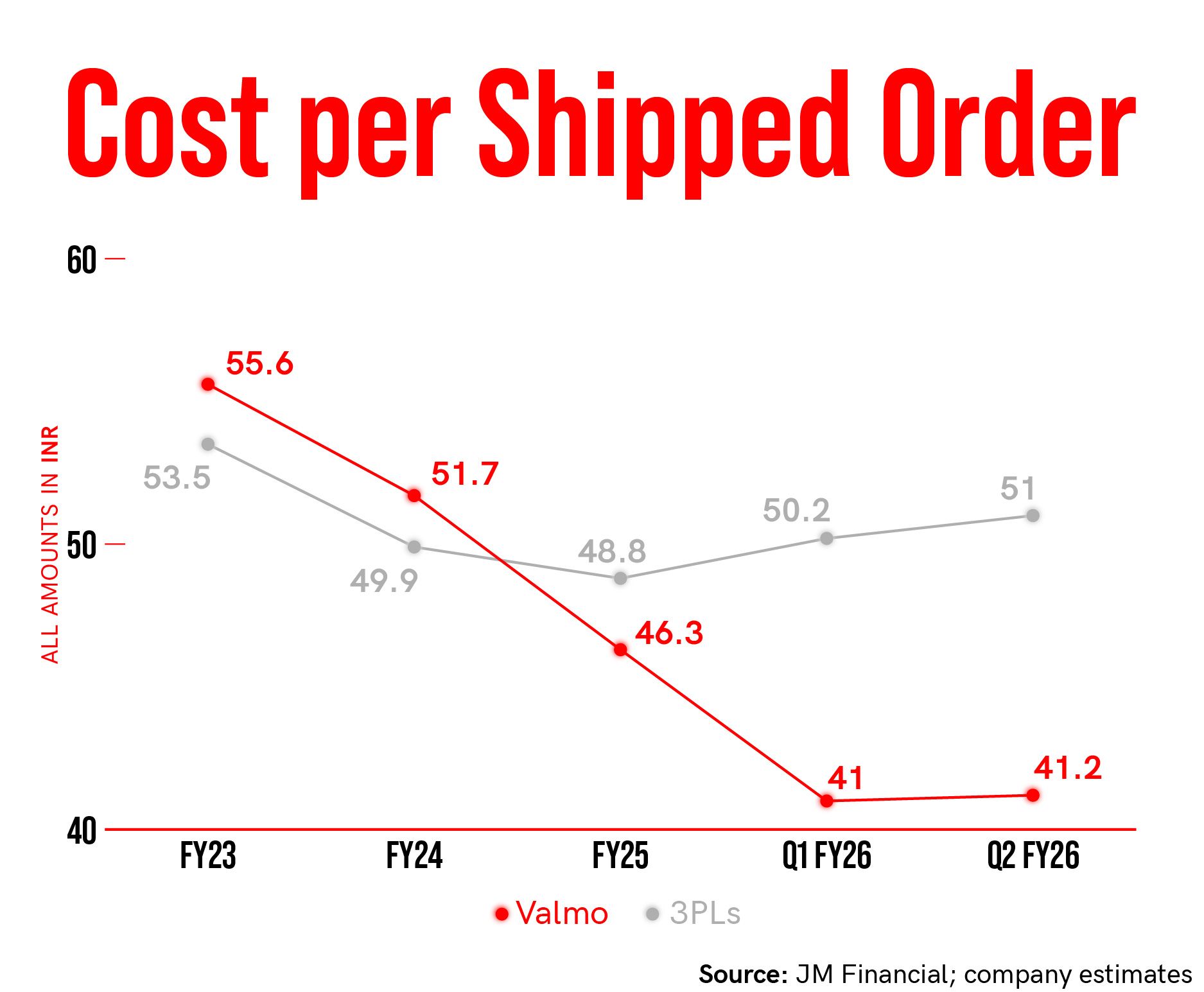
While 3PL costs have remained in the Rs 48-51 range, Valmo’s per-order costs dipped into the low Rs 40s in FY26, with the gap widening as volumes scaled, JM Financial stated. In fact, Meesho’s blended logistics and fulfilment cost per shipped order has steadily fallen from Rs 55.6 in FY23 to Rs 46.3 in FY25, even as volumes more than tripled.
JM Financial expects this figure to drop further to Rs 37-38 per order by FY30, a level that would make selling sub-Rs 200 products economically viable at scale for the company.
Valmo’s advantage is most pronounced in Tier II, Tier II and long-tail pin codes, where Meesho’s order density is disproportionately high. “The rise of Valmo has resulted in multiple 3PL players seeing volume impact and was one of the key reasons for industry consolidation that resulted in Delhivery acquiring Ecom Express in 2025,” JM Financial noted.
Add to that, “Valmo does not need to earn a standalone margin,” according to the broking firm. “Traditional 3PLs require 15-20% service EBITDA margins to sustain their businesses. Valmo, by contrast, operates with just ~291 full-time employees, minimal capex (manual sortation), and exists purely to lower Meesho’s ecosystem costs,” it explained in its analyst note.
Valmo does not replace logistics partners; it stitches them together. It integrates more than 18,000 logistics partners, allocating different legs of a shipment—first mile, sorting, line haul, last mile—to whichever provider is cheapest and available at that moment. As a result, its average order now involves 4-4.5 handovers, higher than traditional 3PL models, but a lot cheaper.
In essence, Valmo’s real significance lies in what it enables. By compressing logistics costs, it expands the universe of products that can be sold online, thereby pulling India’s vast unbranded, offline economy into the ambit of ecommerce.
3PL partnerships will continue
But, despite being Meesho’s trump card, or “cheat code” as analysts call it, Valmo will not be the end of the value ecommerce firm’s relationship with other logistics players. Meesho still relies on third-party logistics for peak demand, reverse logistics, heavier parcels, and operational redundancy.
And as Meesho expands in heavy-item categories (up to ~3 kg) like home & kitchen, “the dependence on established 3PL networks with higher weight-handling capabilities becomes unavoidable,” JM Financial stated.
While Amazon and Flipkart have built deeply captive logistics networks, insourcing 85–90%+ of shipments on an average, Meesho is unlikely to go fully in-house.
“Meesho is likely to continue increasing the share of shipments handled by Valmo, but we expect this to plateau at a significantly lower level than seen at Amazon or Flipkart. Insourcing is likely to stabilise at ~75-80% vs 88-92% for Amazon and 85-90% for Flipkart,” the broking house added.
Edited by Swetha Kannan
Discover more from News Link360
Subscribe to get the latest posts sent to your email.