


Ashes 2025 Review: When belief met reality Down Under

Pat Cummins was expected to play just one Test. Josh Hazlewood was ruled out altogether. Nathan Lyon’s involvement would be limited. Had England been offered that scenario in advance, it would have taken it without hesitation and perhaps imagined an opening.
Instead, it left Australia having lost 4–1, its campaign ending with a five-wicket defeat in Sydney that merely confirmed what had been clear long before. The solitary victory, a two-day shootout on a grassy Melbourne pitch, stood apart from the rest of the series, an outlier rather than a corrective.
While Australia adapted quickly to its reduced resources and found authority elsewhere, England failed to exploit the absences in front of it. The series was decided not by what the host lacked, but by what it still possessed and deployed with certainty.
That is where Mitchell Starc came to define the Ashes. Not as a convenient stand-in for missing stars, but as the enforcer of a structure England could neither destabilise nor escape. He struck early, sustained pressure, and ensured England was constantly reacting rather than shaping contests.
Starc set the tone immediately. His wicket in the first over in Perth denied England the one luxury touring sides crave in Australia: time. His pace, angle and bounce forced England into survival mode before any rhythm had been established. The career-best seven-wicket haul was the consequence rather than the cause.
There was also a deeper tactical deterrent at play. Starc’s left-arm angle discouraged England’s preferred scoring areas. Batters, hesitant on the drive, were caught between committing fully and playing late.
Brisbane reinforced the pattern. An opening-day six-for on a pitch offering movement again left England chasing the game. By the time Australia reached Adelaide with a 2–0 lead, Starc already had 22 wickets and the Ashes were effectively decided within 11 days. England had not been allowed to grow into the series.

| Photo Credit:
Getty Images

Pressure point: Mitchell Starc struck early, sustained pressure, and ensured England was constantly reacting rather than shaping contests.
| Photo Credit:
Getty Images
Starc’s influence extended beyond the ball. His scores of 77 in Brisbane and 54 in Adelaide, the first back-to-back Test fifties of his career, carried particular weight. Lower-order runs do not just inflate totals. They drain belief. England’s bowlers, already struggling for durability, were forced to bowl longer spells with diminishing threat.
Underlying all this was a stark contrast in fast-bowling resources. Starc, 35, played all five Tests. His speeds held. His role remained clear. Australia trusted him to carry a heavy workload and built its plans around that certainty. England’s relationship with pace was far more tentative. Mark Wood’s speed was treated as a decisive weapon, but Perth was his first First-Class game in 15 months. Eleven overs later, he was injured and ruled out.
The pattern repeated. Jofra Archer lasted three Tests. Gus Atkinson broke down. By Sydney, England was selecting Matthew Potts, scarcely in the picture earlier in the year. His figures of 141 for none from 25 overs told their own tale, but they reflected a deeper problem. England was improvising while Australia was executing.
What further exposed England’s lack of incisiveness was not merely the fragility of its pace resources, but the near irrelevance of spin across the series. This Ashes was decided almost entirely by fast bowling, and that too worked decisively in Australia’s favour.
Spin barely featured from either side. Nathan Lyon’s 53 overs in Adelaide were the exception. Australia went to the extraordinary length of selecting no frontline spinner at the SCG, the first time it had done so in 138 years of Test cricket at the venue. On the two pitches that offered turn, at Adelaide and Sydney, Shoaib Bashir, the spinner England has backed of late, was nowhere to be seen.
The numbers underline how skewed the series was. Across five Tests, 1,279.3 overs were bowled. Only 191 of them came from spin.
Australia’s spinners bowled 95 overs for eight wickets at an average of 41.25. England’s bowled 96 overs for seven wickets at an average of 62.71. The 1,146 balls of spin in this series were the fewest in any Ashes series since 1910 and the third fewest in any Test series of five or more matches.
Australia bowled 657.2 overs in total, taking 96 wickets at an average of 26.69. England bowled 622.1 overs, took 79 wickets and conceded at 33.53. The gap was not marginal. It was decisive.
In a contest so dominated by pace, the imbalance in fast-bowling resources became even more damaging for England. When spin offers control or respite, fast bowlers can be rotated and protected. Here, there was no such cushion. Seamers carried the burden almost entirely. Australia was equipped for that reality. England was not.

Mercurial: Travis Head’s impact worked on a different axis but was no less decisive. His promotion to open after tea on day two in Perth, prompted by Usman Khawaja’s injury, proved a turning point.
| Photo Credit:
AP
Mercurial: Travis Head’s impact worked on a different axis but was no less decisive. His promotion to open after tea on day two in Perth, prompted by Usman Khawaja’s injury, proved a turning point.
| Photo Credit:
AP
Travis Head’s impact worked on a different axis but was no less decisive. His promotion to open after tea on day two in Perth, prompted by Usman Khawaja’s injury, proved a turning point. Until then, openers had failed. Not a single run had been scored for the first wicket across three innings. Head changed that instantly. His 69-ball hundred did more than accelerate the scoring. It altered the psychology of the contest. England had been well-placed at one point. After lunch on day two at Perth, it led by 99 runs with one wicket down. Suddenly, it was chasing.
That innings exposed England’s lack of readiness. Its bowlers, undercooked and lightly loaded, could not sustain pace or pressure. Plans shifted ball by ball. While Starc and Scott Boland bowled at the stumps, England resorted to short-pitched bowling, which Head fed off, playing hooks and cuts with abandon.
The hundreds in Adelaide and Sydney confirmed this was no one-off. In Adelaide, as England began to question its own attacking instincts, Head exploited hesitation ruthlessly. In Sydney, his 163 completed the picture.
Alex Carey’s work behind the stumps was one of the quieter but more decisive factors in Australia’s early control of the Ashes. In a series where pace dictated terms and margins were narrow, his keeping did not merely support Australia’s bowlers, It amplified them.
Standing up to fast-medium bowling is not new in itself, but Carey’s execution was immaculate and consistent. At the Gabba, where Australia established a 2–0 lead, he spent long periods standing up to Boland and Michael Neser, a deliberate tactic designed to pin England’s batters to the crease. England’s batting under McCullum and Stokes relies on freedom of movement, on advancing down the pitch or rocking back to disrupt length. Carey removed that option.
The effect was immediate. Carey’s reflex catch to dismiss Stokes off Neser in the second innings was outstanding, taken without flinch off a thick edge. It followed a superb running catch in the first innings and set the tone for a second innings in which four of Neser’s five wickets came with Carey standing up. Stokes and Will Jacks, both inclined to counter-attack, were forced into static positions, playing from the crease rather than dictating terms.
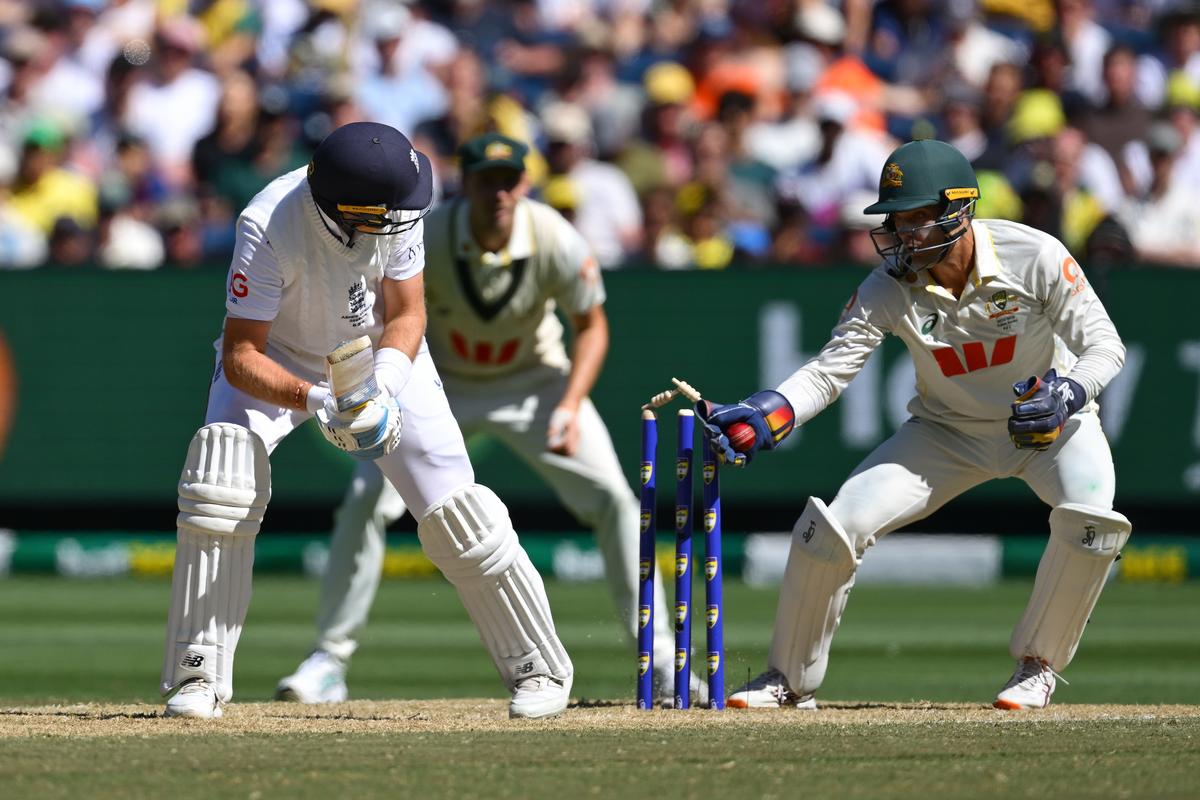
Safe hands: Alex Carey’s work behind the stumps was one of the quieter but more decisive factors in Australia’s early control of the Ashes.
| Photo Credit:
Getty Images
Safe hands: Alex Carey’s work behind the stumps was one of the quieter but more decisive factors in Australia’s early control of the Ashes.
| Photo Credit:
Getty Images
Carey’s influence extended beyond Brisbane. He stood up to Boland for much of England’s second innings in Adelaide, taking a sharp bat-pad catch off Jacks and helping create the conditions that led to Brydon Carse being bowled while rooted to the crease.
If England’s Ashes failure had a recurring fault line, it was at No. 3, a position that has long functioned as the spine of a Test batting order. Traditionally, it is where technique meets temperament, where the ability to absorb pressure matters as much as the capacity to score. England’s history at the position reflects that importance. Ken Barrington’s certainty, David Gower’s authority and Jonathan Trott’s refusal to yield once defined it. In this series, that lineage felt distant.
Ollie Pope’s numbers are stark. Across eight Ashes Tests, 16 innings have produced 282 runs at an average of 17.62, with a highest score of 46. At No. 3 in Australia, survival is currency. Pope rarely accumulated enough of it to allow England’s innings to settle.
The damage went beyond individual returns. England’s top order struggled to impose itself collectively. Zak Crawley’s 273 runs at 27.3 hinted at promise without authority. Jamie Smith’s 211 at 23.44 reflected a batter still finding his feet in alien conditions. Joe Root and Harry Brook carried much of the burden, scoring 400 and 358 runs, respectively, but even their efforts were often made in recovery rather than control. Jacob Bethell’s standout average of 51.25 came from just four innings and felt more like an outlier than a foundation.
Australia, by contrast, found production where it mattered most. Head’s dominance set the tone, but the depth beneath him was telling. Steve Smith averaged 57.2. Carey, batting lower, outscored most of England’s top order. Australia did not rely on one pillar. England, without solidity at No. 3, was repeatedly exposed early.
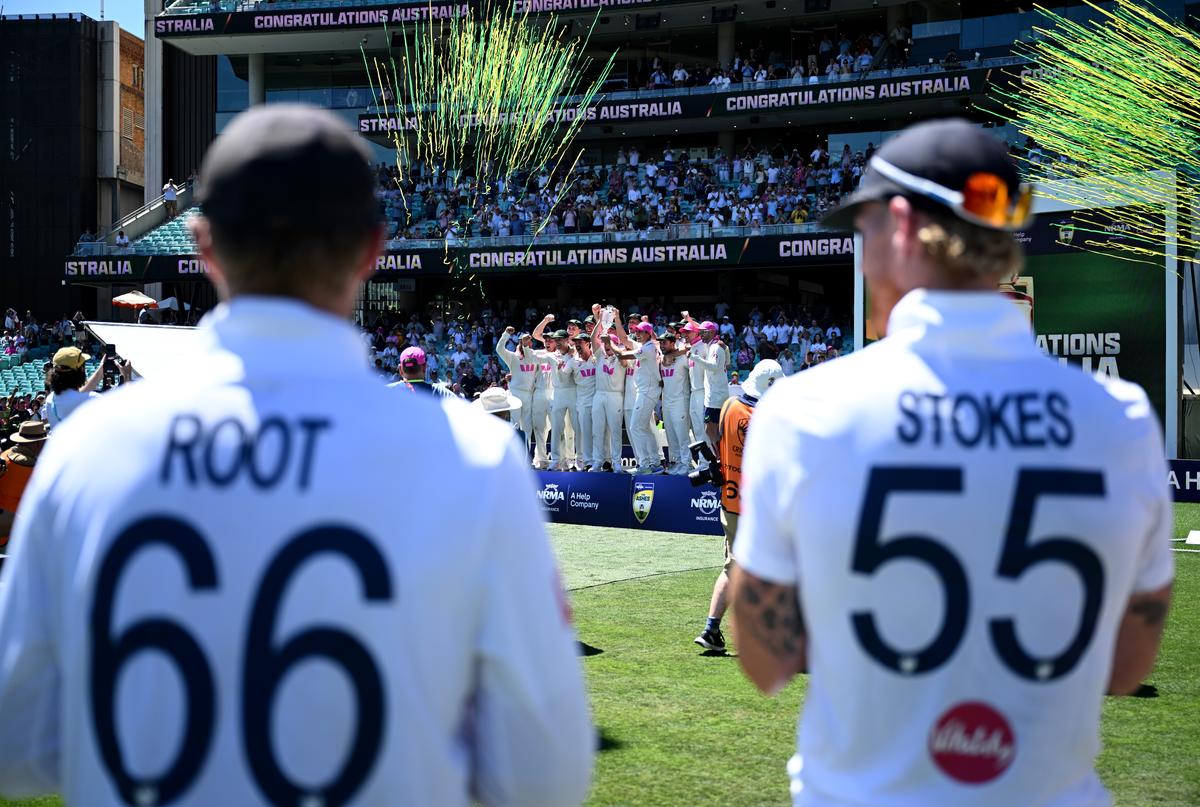
A lesson in failure: England’s top order failed to make a telling impact, leaving Joe Root and Harry Brook, along with Jacob Bethell (right) — one of its standout players — to shoulder most of the burden.
| Photo Credit:
Getty Images
A lesson in failure: England’s top order failed to make a telling impact, leaving Joe Root and Harry Brook, along with Jacob Bethell (right) — one of its standout players — to shoulder most of the burden.
| Photo Credit:
Getty Images
In the end, this Ashes did not turn on moments of drama or fortune, but on fundamentals exposed over time. Australia stripped the contest back to its essentials and found it still held the advantage. England arrived with belief, but belief proved insufficient when not reinforced by preparation, durability and clarity of role.
Stats inputs by Sahil Mathur
Published on Jan 14, 2026
Discover more from News Link360
Subscribe to get the latest posts sent to your email.