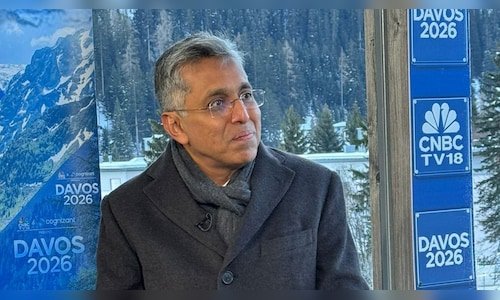
These are edited excerpts of the interview.
Q: What are the themes that you are picking up on? What are the conversations that your investors are having with you, and your clients are having with you today?A: The theme I’ve picked up so far is resilience. We’ve gone through a year with many challenges, and across the world, the sense I’ve got from our conversations is a higher degree of optimism than I would have expected, and a very high level of resilience in terms of companies looking at doing what is in their control and tackling issues as they come up. And that augurs well for us.
Q: Speaking of resilience, we, of course, have a big event coming up back home in India — the budget. What’s the expectation? What is the industry going into this budget hoping for? Because many of the big-ticket items — GST cuts — have happened. That was not a budget item. Income tax cuts happened in the previous budget. Many other measures have been taken. So, what’s the hope, the ask that industry is going into this budget with?
A: The ask we have is to stay on track. The budgets over the last few years have been very good. They were focused on infrastructure build, on capex, on longer-term structural changes, as well as on fiscal discipline, and that is good for India. So, continuing on that same path is positive.
As you said, we have seen a lot of positives in terms of reforms, in terms of GST, etc., and that is playing out very well for the economy. So, we’re seeing the economy in very good shape right now. We’re seeing a very high level of demand. Our plants are full. While we quadrupled capacity in the auto business, we still cannot meet the demand that is out there, and we’re putting in more capacity as well. So, on balance, we’re very positive on India and the Indian economy.
Q: You said it’s hard to meet demand at this point in time, even though you’ve added capacity. So, let me bring up the point about fiscal discipline as well as capital allocation, both themes that you’ve been very focused on. What can we expect now for 2026, both in terms of capital deployment as well as where you intend to prioritise your investments?
A: So, we are also staying on track. We have not just been disciplined, but we also have been bold in many actions we’ve taken across our companies. And as you saw at Invest Today, at the Round Table you conducted with our leaders, all our leaders are talking about multiples of growth, not percentages of growth. And that has come from doing less, focusing on what we are good at, and doing that very well, and that’s exactly what we will continue to do as we go forward.
We are not going to be shy about investing. We have been investing in many of our businesses that are now growing. You heard Vinod Sahay talk about aerostructures growing literally 12 to 15 times this decade. You heard Amit Sinha talk about Lifespaces growing many multiples again. And all our leaders today are looking at significant growth that essentially complements our large businesses.
So, our auto team has done remarkably well. The products that you’ve seen and the consumer responses we’ve got have been just amazing. The farm team continues to deliver well, aided by very strong sentiment in rural areas, so the farm industry has grown, but we continue to grow market share from a high level. Our Mahindra Finance business is on a very good track. It has gone through a stabilisation phase, come out of it, and we’re now pivoting to growth there. Tech Mahindra is on a good track as well.
So, as we said at that point, our businesses are firing on all cylinders. So, for us, it is to stay on track and continue to deliver growth.
Q: Since you’re talking about cylinders, let me ask you about what’s likely to happen as far as the electric vehicle (EV) and Internal Combustion Engine (ICE) mix is concerned for the auto business going forward. You just had a bunch of launches, and in your words, they have done very well for you. What can we expect over the next few years in terms of the changes in your portfolio between ICE and EV?
A: We will continue to see EV grow. EV today is about 7% or so of our sales, and we expect that to grow to 20%, then 30%. The key is going to be around infrastructure, and this is where government policy of focusing on EVs has helped tremendously, because that is starting to result in infrastructure growth.
The product is a wonderful product, from everything our customers tell us, and it’s a wow. Even compared to any of the ICE vehicles, EV vehicles are lots of fun to drive, and that will result in a lot more sales for EV. Charging at home and office is sufficient for any city driving, because the real-life range is 500 kilometres. Our customers need to charge once a week.
Charging on highways is not as easy right now. It’s there, but that needs to get much better. As that does, we will see EV taking off.
Also Read | Cognizant plots big bets with AI, outcome-based pricing and possible India IPO
Q: With all the subsidies in place, the push being made by the Centre as well as many state governments, as well as, of course, companies like yours, it’s still, as you pointed out, 7% of sales for you. So, this ambition of 20% and 30% doesn’t seem far-fetched today.
A: It’s not, and I think with the path that we are on, we feel that we should be able to get there. And we just need to ensure we stay the course from a policy standpoint as well, because building charging infrastructure will take a little bit of time, and we need to allow for that time for that infrastructure.
Q: It’s also been a year, as you pointed out, during which many of your businesses have seen significant investments but are now targeting significant growth plans. So, what can we expect realistically? Are we likely to see any listings from the Mahindra Group in 2026 or perhaps in the near term?
A: Not in 2026, but in 2027, we will look at listing our last-mile mobility business, which is electric three-wheelers. A business that has also done phenomenally well, a space where we were literally a non-player in three-wheelers, and we were the leader in electric, today having a 40% to 45% market share, depending on what month or quarter you look at it. Number one in that space.
EV penetration in that space has gone up dramatically. So, we are at about 35% EV penetration overall. Some cities are at 50%, 60%, 70% as well. And the large metros are at 5%. So, as you get charging infrastructure in large metros, that will take off. So, we’ve got a great business in an industry that is a very strong industry.
Q: IPO-ing the last-mile mobility business in 2027 — what’s the rationale for that? What will you use the funds for?
A: For further growth of that business and for going international, because we’ve got a great set of products.
Q: How aggressively are you going to tap the international markets, the export markets, for the three-wheeler business?A: As you know, we’ve always done things in phases and ensure that every phase is done well. So, at this point, it is a very sharp focus on the domestic market. It is a highly competitive market, and our business has done very well with that competition. And we will start looking at global plans, pick certain countries, and look at becoming large players in those countries.
Q: There’s a lot of interest in India. We’ve already seen a lot of deals being done, specifically in the financial sector in 2025, and many outside of that as well. Anything on the anvil in terms of partnerships or investments into any of your group companies?
A: We are always open to that where our partners can bring value beyond just capital. And there again, we’ve had some marquee investors come into many of our businesses, and that has helped us with the expertise that they have brought. We typically don’t go out seeking funds from anyone, but we have some very good partners that we discuss potential partnerships with, and as that fructifies, you’ll be the first to know.
Q: We talked about many of the opportunities, and you said resilience clearly seems to be the theme in spite of all the volatility and uncertainty of the headlines that we are faced with. So, the key risk that you would be watchful of, and how do you intend to mitigate those risks as we move forward?
A: Realistically, the key risk today is what we don’t know, because everything we know, we’ve got a plan for, and that’s what we’ve seen through the past year. Rare earths came up from nowhere. We had no clue that something that goes into permanent magnets, that goes into motors for a vehicle, is what we should be concerned about.
And therefore, our teams today are just prepared for eventualities. We have a supply chain that has gone from just-in-time to just-in-case. But given the world where it is today, there will be challenges that come up, and we just have to have the mindset to be ready to face the challenges.
Q: Interest in the government’s product-linked incentive (PLI) scheme for rare earths?
A: For us, we are going to be a big consumer of rare earths with our vehicles. And it’s not an area that is core for us from an investment standpoint. But we have mentioned to potential players who are interested that we can always come in with a small investment, but more importantly, give the assurance that we will take the supply.
Q: Who are you talking to for that?
A: There are a few players who are interested in that. I’m not sure of the level of interest. More companies outside that have the capabilities to build this. And as they want to come in, we are open to partnering.
Maybe this is something India needs, and this is something where manufacturers have to be ready to pay a slightly higher price than is available globally as well to have certainty of supply chain. So, we are stepping in there to say we will pay a slightly higher price to ensure the certainty of sthe upply chain. And that’s beneficial for us, and that’s beneficial for the country.
Q: So, the capex number for the year?
A: We have talked about a ₹26,000 crore capex for a three-year period. We are still exactly on that same number.
Q: And the one thing that you believe Indian manufacturing needs at this point in time?
A: To be bolder, to have more research and development that goes into making higher-quality products, a much greater focus on quality, to create world-class products, and to prepare ourselves to be the manufacturing power of the world.
Q: Will mergers and acquisitions (M&A) be a path to both research and development (R&D) as well as export markets?
A: We’ve got a fantastic team for R&D. We’ve got 4,000 engineers at our Mahindra Research Valley, so we don’t need M&A for that. We have great pride in our team, and they’ve done an amazing job.
Q: But are you looking at M&A to look at new geographies, new categories, new markets?
A: Not really. Our businesses are growing at a very rapid pace. Where we need to do it, like SML, and we find the right fit, we will. So, there will be some areas where, as things come up, we’re still looking at them, but it’s in line with the growth plans we have and in line with where the businesses can play and can win.
Q: This is a Trump Davos, Anish, as I pointed out, and you’re going to be at the reception that the World Economic Forum is hosting for President Trump as he meets business leaders. What’s the expectation?
A: The basic expectation is for me to at least understand a little more of what’s happening around the world. I must admit that not all of it is fully understood as yet, and hopefully we get to a path of much stability from a geopolitical standpoint.
For the full interview, watch the accompanying video
Catch all the latest updates from the stock market here
Catch the latest Budget 2026 expectations updates here
Catch all the latest updates from the Q3 earnings here
Discover more from News Link360
Subscribe to get the latest posts sent to your email.