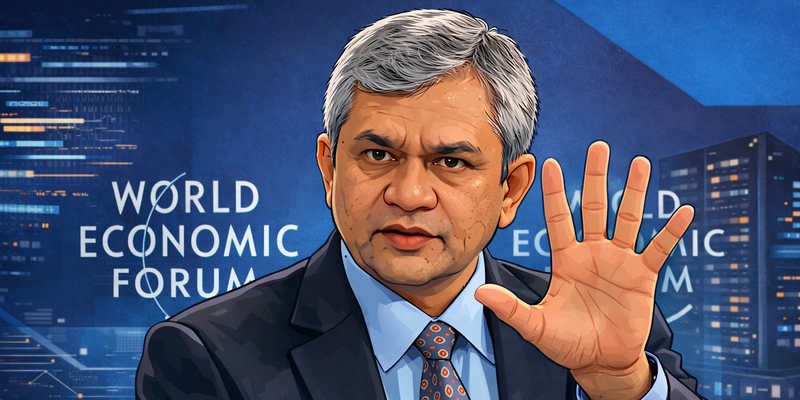
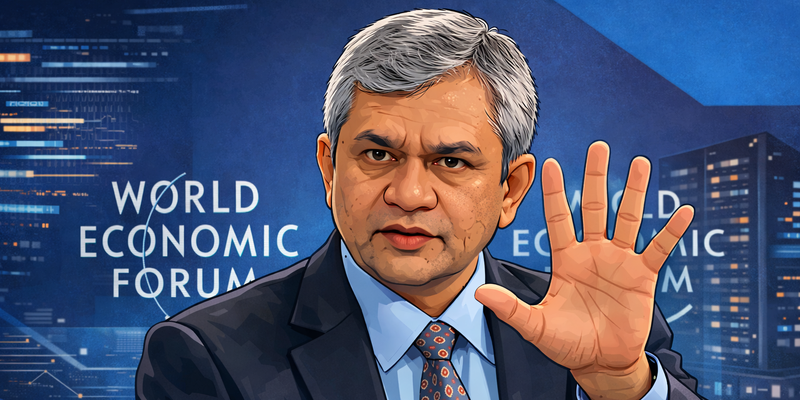

Vaishnaw’s argument rested on a clear, systems-level view of AI, broken into five interconnected layers, each designed to maximise real-world value rather than symbolic technological dominance.
AI value begins at the application layer
India’s AI strategy starts where citizens and enterprises feel impact most directly, the application layer. Vaishnaw emphasised that the true return on investment in AI does not come from building the largest possible models, but from deploying AI into businesses, public services, and everyday workflows.
India’s strength, he argued, lies in its ability to understand enterprise processes and deliver AI-powered solutions at scale. From agriculture and healthcare to education, manufacturing, and governance, the focus is on rapid diffusion of AI tools across the economy. This wide adoption is where productivity gains, efficiency improvements, and measurable outcomes emerge.
Models built for localisation, not spectacle
At the model layer, Vaishnaw pushed back against the assumption that geopolitical power flows from owning the biggest frontier models. He noted that nearly 95 per cent of practical AI use cases can be addressed using mid-sized models in the 20 to 50 billion parameter range.
India is developing a bouquet of such models, optimised for Indian languages, sector-specific needs, and regulatory contexts. These sovereign models enhance data security, cultural relevance, and strategic autonomy, while avoiding the heavy capital and energy costs associated with ultra-large systems.
In this framework, AI capability is defined less by scale and more by economic viability and adaptability.
Democratising compute through public-private partnership
Compute availability is widely seen as one of AI’s biggest bottlenecks. To address this, India has adopted a public-private partnership model that has empanelled over 38,000 GPUs as a shared national compute facility.
Unlike markets where access to GPUs is dominated by a handful of large technology firms, India’s model makes compute resources accessible to students, researchers, startups, and enterprises at roughly one-third of prevailing global costs. This democratisation of compute lowers entry barriers and accelerates innovation across the ecosystem.
Parallel to this, India is investing in domestic semiconductor capability through fabrication and ATMP units, laying the groundwork for long-term resilience in chip development.
Data centres as strategic infrastructure
The data centre layer forms the backbone of India’s AI infrastructure. With more than $70 billion already invested by global players such as Google, Microsoft, and Amazon, India is rapidly expanding domestic data centre capacity.
These facilities not only host AI models and datasets but also strengthen digital sovereignty and create high-value employment. Innovations in cooling, water efficiency, and energy optimisation are being prioritised to make large-scale AI infrastructure sustainable over the long term.
Energy security and the SHANTI Act
AI at scale demands continuous, reliable power, a challenge that renewables alone cannot fully address due to intermittency. Vaishnaw highlighted the energy layer as a strategic pillar of India’s AI vision.
Under the proposed SHANTI framework, India is exploring nuclear-led AI infrastructure using small modular and micro reactors. These systems can provide clean, stable baseload power for data centres and AI workloads through public-private partnerships and foreign investment, ensuring energy security while meeting climate commitments.
Rethinking AI geopolitics
A recurring theme in the Davos discussion was whether AI dominance translates into geopolitical leverage. Vaishnaw questioned this assumption directly. He argued that dependence on a single country’s large models creates vulnerability, not strength.
The minister said India wants to reduce dependence on any single geography or technology provider by backing cost-efficient AI models, supporting diverse compute choices such as CPUs and custom chips, and investing in distributed infrastructure. In his view, the real advantage in the fifth industrial revolution will come from models that are affordable and deployable, not just larger in size.
Governing AI through a techno-legal lens
On regulation, Vaishnaw stressed that AI governance cannot rely on legislation alone. India is adopting a techno-legal approach, pairing policy with technical safeguards.
This includes tools to mitigate bias, systems capable of detecting deepfakes with court-admissible accuracy, and mechanisms for model unlearning before enterprise deployment. By embedding governance into technology itself, India aims to address AI risks proactively rather than reactively.
At Davos, Vaishnaw’s message was clear: India’s AI ambition is not to outbuild others in scale, but to outdeploy AI in ways that deliver measurable value across society and the economy, while remaining strategically autonomous in a rapidly shifting global landscape.
Discover more from News Link360
Subscribe to get the latest posts sent to your email.