
Bajaj Auto sees export run-rate holding above 2 lakh units a month
For 2026-27 (FY27), export growth will depend on global demand and market conditions. Sharma said the company will respond to market trends quarter by quarter, adding that international business is influenced by multiple factors including global economics and geopolitical trends.
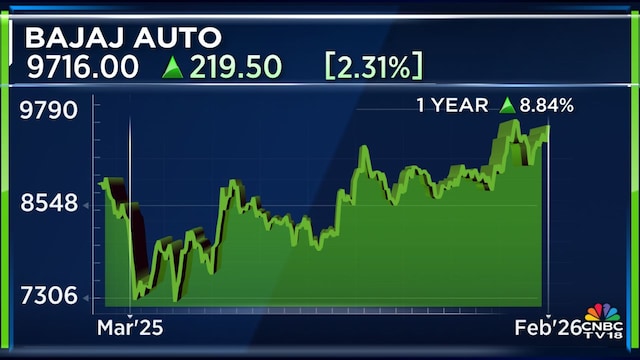 Bajaj Auto recently reported results for the October-December 2025 quarter, supported by growth across domestic, export and electric vehicle segments. Profit was slightly below market expectations during the quarter.
The company currently has a market capitalisation of ₹2.71 lakh crore, and its shares have gained more than 8% over the past one year.
These are edited excerpts of the interview.
Q: Give us your overarching view on the India-US trade deal. I know predominantly you cater more to Latin America and Africa, so your exports to North America are fairly limited. But how does it change the industry? And as it is under Section 232, broadly, what have you picked up?
A: It’s certainly welcome news. Quantitatively for Bajaj Auto exports to the US, which we do under the Triumph and KTM brands accounts for about a percentage of our total exports. So even when the tariffs went up, we were, on an overall basis, not impacted by it. So now, when the tariffs are down, the same sort of holds.
Also Read | US-India trade deal removes tariff overhang, clears air for investors: Nisha Biswal
However, having said that, as we build up our business with KTM Austria, and through them, accessing markets like the US, we do foresee more and more production shifting into India, and therefore, we will be making more US-relevant products in the future. And having these tariffs will certainly be very helpful from that point of view.
And beyond that, the signal, which goes out from a sentiment point of view with the US and India aligning, there are so many other things, we trade in US dollars there, and so it’s good to have this positive sentiment all around. It’s good for trade.
Q: Monthly exports on the whole, you’re crossing the two-lakh mark. So, this quarter, it’s been in excess of six lakh. And you’ve also said that the company expects exports to deliver the highest-ever top-line performance in dollar terms in FY26. How do you see the export momentum, particularly for Q4? Does the two-lakh momentum get stronger per month? And for FY27, do you have a number in mind?
A: I think Q4 will sustain at the levels which we have been doing. We’ve been growing at about 15 to 18%. Q4 tends to be a bit shorter, because we tend to complete our exports by March 20 or so. So, you have, in that respect, fewer days. But the tempo should be maintained, and we are hoping to, on average, still clock over 200,000 units per month as an average in Q4.
Going beyond that, we are going to be responding to the market quarter by quarter. At this point as things are now, it looks as if we will be sort of trying to inch up above this number in FY27, but international businesses have several moving parts, microeconomics, geopolitics, etc., so it’s very difficult to crystal-ball gaze. But at this point in time, we would be looking forward to maintaining this kind of tempo, even in FY27.
Q: What about margins? If you could talk about the commodity inflation that you have seen in Q3, expectations for Q4, and even in terms of offsetting measures via price hikes.
A: So the margin story is not a very difficult one at this point in time. Yes, there has been an increase in the noble metals package, quite substantial increases, but they have been offset by flattish performance of steel and rubber and some natural products. So, on balance, from the commodity side, there has been a little bit of inflation, which we have taken action on early January to plough those back.
Now, as we move forward, the softness in the Indian rupee has been very helpful, and with the rupee trading at 90 plus to the dollar, that is a very significant tailwind. So, we’re not under any kind of great pressure to manage the margin story, given these things. So, we will always be looking at competition and the impact on demand, etc., and responding to those factors, rather than the cost side factors.
Also Read | India–US trade deal: Auto stocks gain up to 20% led by Balkrishna Industries
Q: Baseline margins of 20% plus should sustain.
A: Hopefully.
Q: And the EV markets— you have pulled back a good amount of market share, close to around 500 basis points. Do you believe you can go even higher from here? And your earlier competitor, Ola, is struggling out there. Have you had a look at their business?
A: All the time. Because you know that we had a major supply chain dislocation in two-wheelers and three-wheelers, and therefore, quarter three, clawing back five percentage points of market share and getting back to a firm number two after having slipped down the league table is welcome. And almost in the closing period of quarter three, we also launched a new edition, which sort of opens up a new segment for the Chetak scooter.
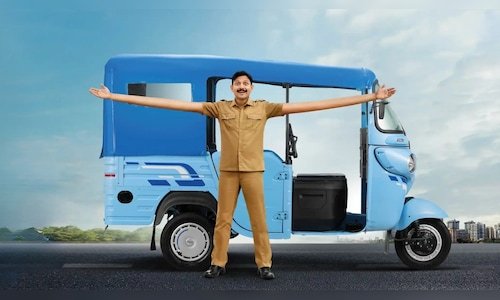
The Chetak C 25 is targeted specifically at youth and women. And that should open up opportunities, so the Chetak portfolio has been bolstered, and we will therefore obviously be looking forward to improving our market share in quarter four. Electric three wheelers also — we had slipped out, but there, the return has been quite rapid, and we are, for the last two months now, at the number one position. I think in January, we’ve exited at about 38% market share in the E-auto segment.
For the full interview, watch the accompanying video
Catch all the latest updates from the stock market here
Discover more from News Link360
Subscribe to get the latest posts sent to your email.