

How AI developers are rewriting their playbooks, insights from the Codecraft webinar
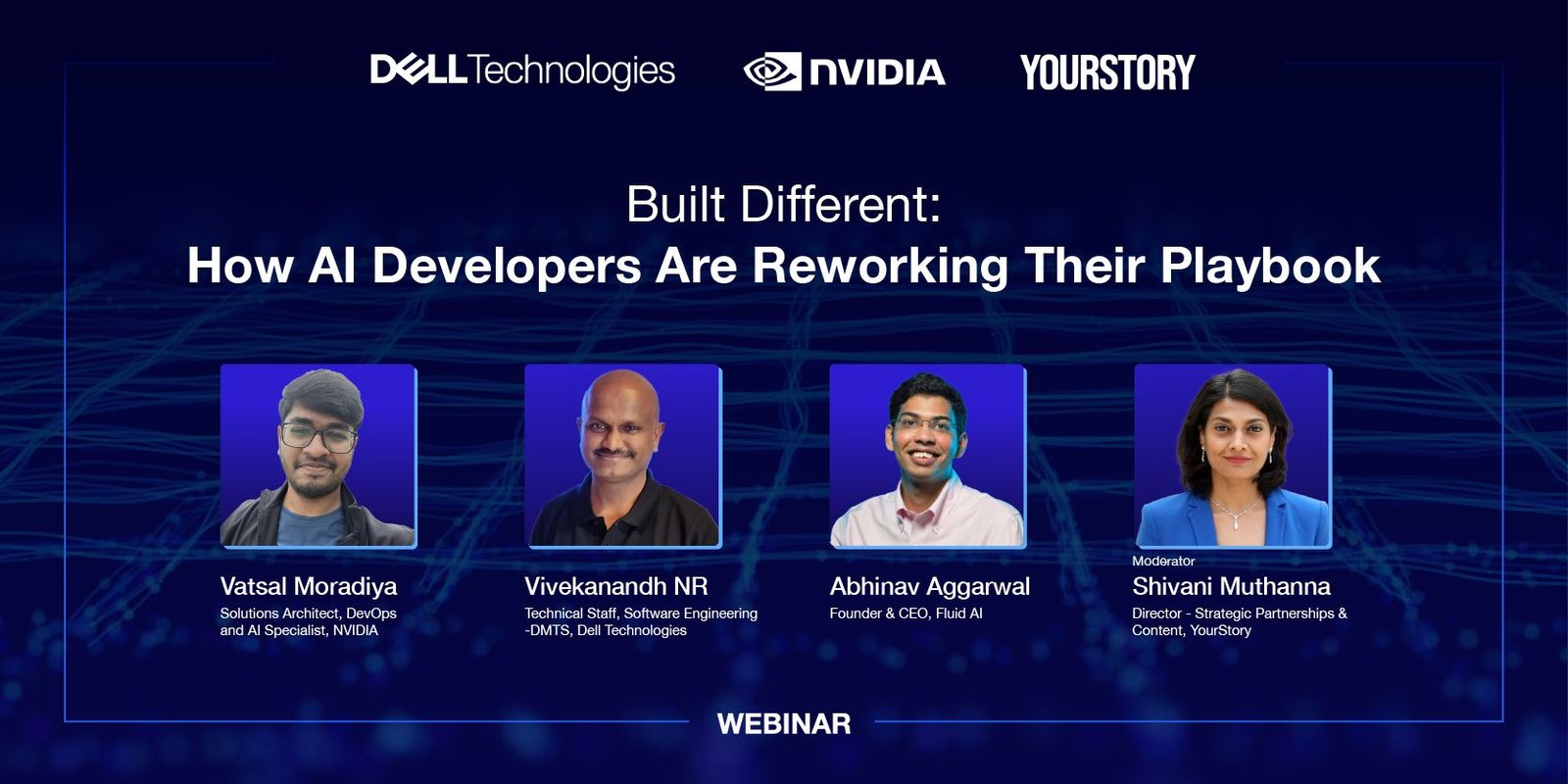
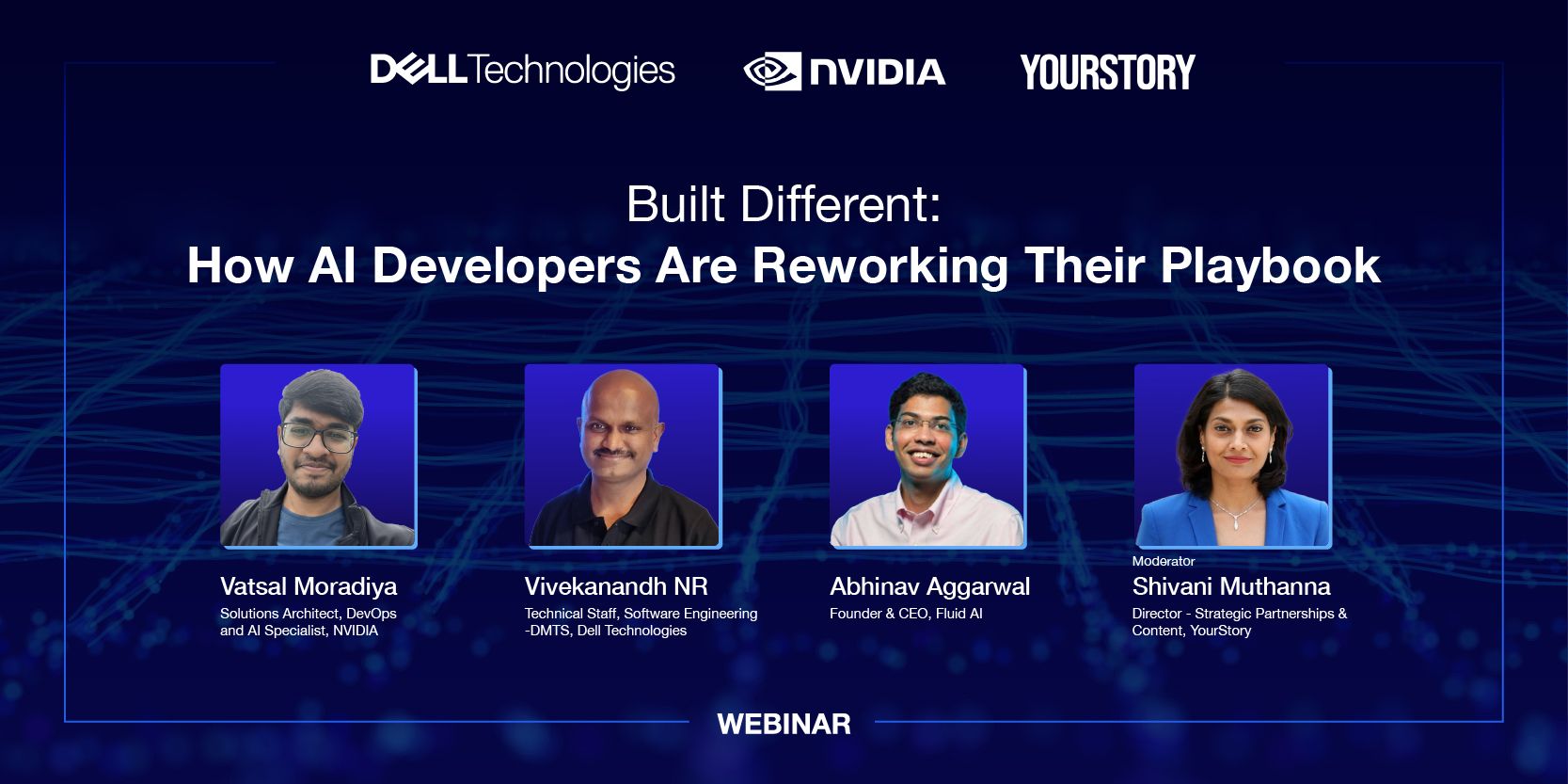

It was against this backdrop that Dell Technologies, in association with YourStory, hosted the inaugural webinar of CodeCraft: The Dev Masterclass Series themed ‘Built Different: How AI Developers Are Reworking the Build Cycle’ on January 16. The webinar, attended by more than 500 participants from the SMB AI builder community, brought together Vivekanandh NR, Technical Staff Software Engineering – DMTS, CSG CTO Software Architecture Team, Dell Technologies, Vatsal Moradiya, Solutions Architect at NVIDIA, and Abhinav Aggarwal, Co‑founder and CEO of Fluid AI. Moderated by Shivani Muthanna, Director – Strategic Content, YourStory, the panel offered a candid look at the realities of AI development in 2026 and how builders are adjusting their playbooks.
The enterprise adoption gap
Aggarwal set the stage by contrasting consumer enthusiasm with enterprise hesitation. While everyday users are already drawing value from generative AI tools, only a small fraction of enterprises are seeing meaningful returns. He pointed to three recurring barriers: security approvals that slow deployment, finance teams wary of unpredictable cloud bills, and the difficulty of managing probabilistic outputs in production.
Local experimentation secures sensitive data and allows teams to plan around fixed infrastructure costs rather than variable subscription models. Hardware advances, he added, are beginning to unblock many of these hurdles.
From Dell Technologies’ vantage point, Vivekanandh NR emphasized the importance of memory‑rich, low‑latency, locally controllable systems. Sensitive data often cannot be uploaded to the cloud, he explained, so developers need environments where they can run inference and fine‑tune models securely, without waiting for compute slots. Unified memory is critical for orchestration and retrieval, allowing context to remain within the same environment. Quick iteration cycles, he added, are now a baseline requirement.
Local vs cloud: A nuanced equation
The panel explored how teams decide what runs locally and what goes to the cloud. Vivekanandh argued that the decision is always a mix of cost, privacy, speed, and control, with the weightage shifting depending on the industry. In healthcare, for example, speed takes precedence because decisions are life‑critical. In compliance‑heavy industries, privacy dominates.
Aggarwal pointed to the rise of open‑weight models that are outperforming cloud‑hosted ones. Developers, he said, can fine‑tune locally, experiment freely, and avoid the trap of prompt engineering workarounds. With platforms like Dell’s Pro Max accelerated by NVIDIA GB10 Grace Blackwell Superchip, each developer has a box that can host 200‑billion parameter models.
The conversation turned to what datacenter‑class performance at the desk unlocks. Vivekanandh framed the shift as a fundamental change in mindset. Before NVIDIA GB10 Grace Blackwell Superchip, startups relied on cloud‑hosted models even for small experiments. Now, with datacenter‑class performance available locally, developers can run workloads without waiting in queues. “It’s an AI companion on the desk—free to experiment without subscription costs or connectivity concerns,” he said.
Demonstrations in practice
The panel moved from discussion to demonstration, showing how these ideas translate into everyday workflows. Vivekanandh presented a personalized newsletter agent built on DELL Pro Max accelerated by NVIDIA GB10 Grace Blackwell Superchip that automatically generated content based on user interests. He then showcased a podcast generation pipeline that produced audio locally using a multi-model setup.
Together, the demos illustrated how agentic workflows, content pipelines, and validation loops can be executed at the edge, shortening feedback cycles during early development and giving teams more control over experimentation.
The Q&A segment reflected the concerns of practitioners. Developers and engineering leaders raised questions around cost predictability, data control, and how smaller teams can make smarter infrastructure choices. Aggarwal summed up the mood: “Teams aren’t blocked by ideas, but by infrastructure. The next wave of AI innovation will be defined by how builders manage speed, reliability, and data stewardship.”
Shaping the next playbook
The session highlighted that the future of AI development will be defined not only by the sophistication of models but by the environments in which they are built and tested. With datacenter‑class performance now available locally, and hybrid workflows becoming the norm, developers are reworking their playbooks to prioritize speed, control, and security.
For the attendees who tuned in, the takeaway was clear: infrastructure decisions made today will determine how fast teams can ship tomorrow.
Discover more from News Link360
Subscribe to get the latest posts sent to your email.