


Ather moves closer to breakeven as volumes rise and software revenue grows

The market capitalisation of Ather Energy, which is based in Bengaluru, stands at about ₹27,284.46 crore, and its shares have gained close to 136% over the past one year.
The company manufactures electric vehicles and develops smart, connected and high-performance electric scooters.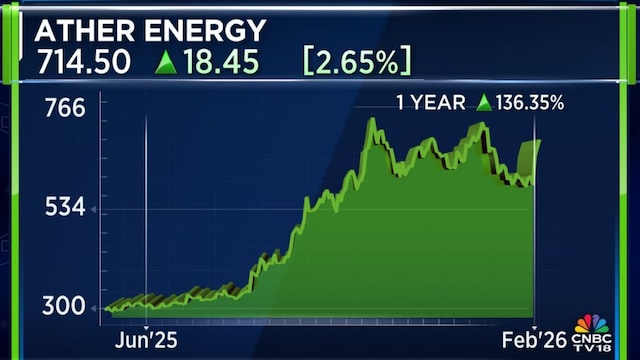
These are edited excerpts of the interview.
Q: You have delivered a sharp improvement in operating performance, with losses narrowing and reported EBITDA margins improving to just -3%, an improvement of around 1,500–1,600 basis points. This has been driven by higher volumes, market share gains and productivity improvements. However, with the risk of higher commodity prices potentially impacting operations, how are you balancing these two factors? When do you expect to turn EBITDA positive, and are you taking any price hikes?
A: The third quarter was great for us. We saw 50% growth in volumes. We saw a 1,500–1,600 basis points improvement in EBITDA. We also saw a good improvement in unit economics by almost 300 basis points. This was firing on all cylinders. Unit economics improved because we were able to improve our ASPs, because we were able to drive costs down, and operating leverage was there. We have roughly 4x volume in the last six quarters. So that’s kind of played out beautifully in the EBITDA journey.
Also Read: Copper to lead the next base metals cycle as electric vehicle demand rises: Dhan founder
We have cautioned that there are some potential headwinds from commodities in the coming few quarters, and we have kept a lot of our engineering bandwidth focused towards cost reductions, while also keeping a tight control over our fixed costs. We want to fast-track our journey towards breakeven as much as possible, so that even if we absorb all these blows, we end up at a better place and stay on a good path.
Q: By when do you break even?A: Always difficult to say, and we don’t give guidance there, but we have gotten pretty close, and we intend to stay there.
Q: Anytime in the next three or four quarters, is there visibility for you to break even?
A: We have got a few growth levers ahead of us. First, on price hikes, we took a ₹3,000 price hike just at the start of the January-March quarter of 2026 (Q4FY26) itself. That’s with the intention of absorbing some of the potential commodity hits. I think that will go a long way. We have further cost reductions coming our way. The biggest one ahead of us this year is coming from a transition to the low-cost scooter platform, the EL scooter platform. So, between both of these, we expect a lot of gains ahead of us. So, we think we should be well-positioned to absorb these hits. Third, our software contribution and non-vehicle revenues have been on a tear. So, we had almost 14% of our revenue coming from non-vehicle sources, a large majority of that coming from software sales. So that’s continuing to support our profit and loss (P&L) massively. And we think this trend will likely continue, given what we have seen in newer markets, particularly the northern markets, where the trends have been very encouraging.
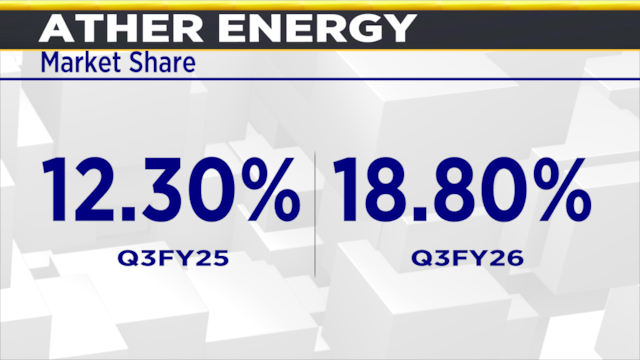
Q: Two-part question. You can give us numbers. One, your market share by the end of this year — where does it stand? It’s about 18.8% right now. What’s your target there? And by the end of 2026-27 (FY27), and non-vehicle revenues, which are about 13%, you said directionally that is increasing. So, from about 13%, where does that go — on your market share and your non-vehicle revenues? If you could give us three quick numbers.
A: Market share, think of this as two different parts of the country. In the South, we have been consolidating a 25% market share now for several quarters, and with the current portfolio, we are pretty confident of this. In the rest of the geographies, we believe our fair market share lies around 20%, and we have been moving towards that every quarter. So, our 20%-plus kind of market share is our near-term expectation.
To your other question on non-vehicle revenue – that is compounding well. So, there are two parts — software sales: we have been able to hike prices of the software also consecutively every year. But service revenues are compounding in nature. Given the fleet size, we believe that in steady state, there is a 3%–4% potential improvement from this source. So, the current 14% could compound to 17%–18% over the next few years, driving a lot of margin gains for the business.
Watch the interview in the accompanying video
Catch all the latest updates from the stock market here
Discover more from News Link360
Subscribe to get the latest posts sent to your email.