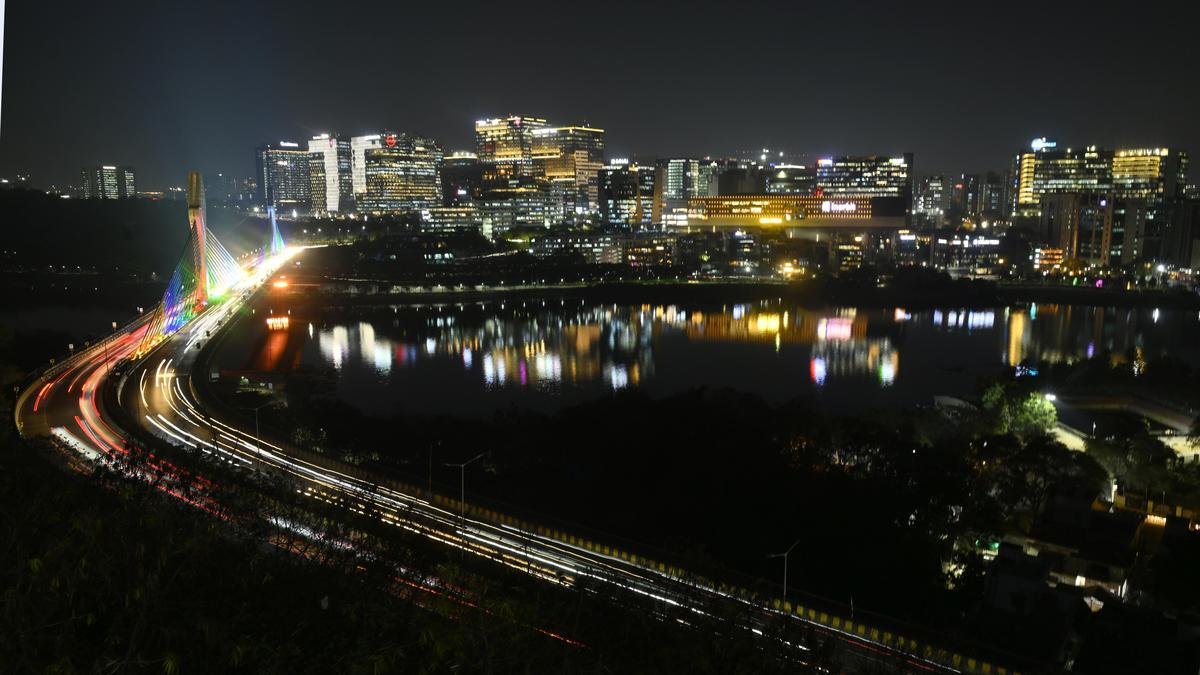
“Within 10 minutes, the smell fades from the mind and the sight becomes enthralling. Then we get lost in conversation,” says a second-time visitor to the restaurant-cum-bar.
On the other side, at the boating point, visitors queue up for a speedboat ride — ₹500 for 25 minutes — zipping through waters studded with floating patches of gurrapudekka (water hyacinth). The pilot steers the boat with practiced ease, but the stench of rotting organic matter is overpowering.
“We resumed boating only a week ago. We had to halt boating operations as visitors were complaining about the foul smell and the water had become unnavigable. It took us 20 days to clear the gurrapudekka,” says an official of Telangana Tourism.
Between the curated spectacle of leisure, built around upscale restaurants and a carefully staged stunning view of the lake, and the nausea-inducing reality of decay lies the paradox of Durgam Cheruvu. One of the larger water bodies to have survived decades of pressure from builders and official interventions, it is still being quietly altered: its water level has been lowered and its edges reshaped to free up land.
The mechanics of that damage become visible at the southern edge of the lake. Descending a flight of steps towards the sluice gate, an Irrigation Department official recalls a moment from last monsoon which, he suggests, changed the lake’s behaviour.
“Last monsoon, the lake bund was dug up to lay a fresh pipe to release water. It was dug up after the water level increased. Earlier, it used to rise up to this level,” he says, pointing to a mark roughly two metres above the present waterline. The figure aligns closely with readings from a cellphone altimeter and elevation maps of the area. On the Deccan Plateau, a two-metre drop in water level does not merely lower a shoreline; it exposes acres of land around a lake. Land that has already been encroached upon with the construction of a raised bund to create a fait accompli.
For a lake of Durgam Cheruvu’s scale and history, the implications are profound. Once a source of drinking water and the reservoir that filled the moat surrounding Golconda Fort, its full tank level has been repeatedly altered to free up land. Historical records, anecdotal accounts and old photographs trace a steady manipulation of the lake’s level over the decades, cumulatively lowering it by nearly two metres. The old sluice gate on the southern side bears physical testimony to this shift. The lake’s original full tank level of 560.1 metres above sea level matched that of the water tank in the upper reaches of Golconda Fort, allowing water to flow by gravity. After the 2015 intervention by the water board, the sluice gate now sits at 558 metres.
“Some very powerful people built houses around the lake. When the lake waters entered their homes during monsoon, they forced the officials to release water. Then there is the issue of disappearance of natural inflow channels for rain and stormwater. Now only sewage enters it regularly,” says Hyderabad chronicler and engineer Sajjad Shahid. His account is corroborated by the Irrigation Department official.
“I close and open the valve whenever I receive instructions to do so. Earlier, the water was allowed to reach up to this place before I opened the valve. The excess water used to flow out of the channel beside the masjid and flow towards Malkam Cheruvu. Now, all the water is released through this sluice gate and there are two other pipelines where the water drains automatically,” says the official, who has worked in the Irrigation department for the past 40 years.
Construction frenzy
Shahid recalls a very different lake from the one that exists today. In the early 1980s, he says, the water was pristine blue and the surrounding area largely empty. “It would be difficult to believe that the area was just plots of land. The few people who built houses there reported frequent burglaries. Then the Jubilee Hills Housing Society issued a threat to open plot owners to build houses, failing which the land would be taken back. That triggered frenzied construction activity,” he says.
Most housing colonies multiplied between 1995 and 2020, driven by the IT boom radiating out of Hitec City, Cyber Towers and the formation of the Cyberabad Development Authority (CDA) on January 20, 2001. The expansion spilled far beyond the zoned areas of the CDA, morphing into a regulatory free-for-all marked by illegal settlements. The lake’s water level, Shahid argues, is now kept deliberately low to ensure that wealthy residents who live along its edge are not put to inconvenience.
Recently, the Hyderabad Disaster Response and Asset Protection Agency (HYDRAA) announced that it had evicted squatters who had converted a portion of the lake into a parking lot. But even before the signage put up by the enforcement agency could dry, the fencing erected at the site was moved aside using earthmovers — to allow the removal of water hyacinth with a de-weeder and bucket excavator. “We charge ₹2.5 lakh per month and ₹10,000 a day for removing the weed. The weed will again fully cover the lake in a matter of 20 days if we don’t clean it regularly,” says the contractor executing the clean-up operation.
The contamination feeding the lake’s decline has a measurable source. The 7 MLD (million litres per day) sewage treatment plant on the northern side of Durgam Cheruvu releases about 10 lakh cubic metres of treated water into the lake every 10 days (data for the older 5 MLD plant is not available).
Visualised differently, the discharge is equivalent to a 100-metre-square tower of water carrying a coliform count of 430 MPN (most probable number) per 100 ml. The numbers tell a paradoxical story: the water meets certain clean-water benchmarks with a Chemical Oxygen Demand of 40 mg/L, while its Biological Oxygen Demand stands at 3 mg/L, levels that render it unfit for even wildlife and marine life. It is this organically loaded water, released continuously into the lake, that fuels the runaway growth of water hyacinth.
The engineering solution to arrest this flow has been known for over a decade. Thirteen years ago, the first proposal and approval were granted for constructing interception and diversion structures at the Madhapur and Silent Valley nalas, along with the formation of a ring bund and the laying of a ring main at Durgam Cheruvu. The first phase for diversion of sewage entering the lake was estimated to cost ₹35 crore. Since then, funds have been sanctioned under different schemes, but the outcome has been the opposite of what was intended: the lake has shrunk from 160.6 acres, and its water quality continues to deteriorate.
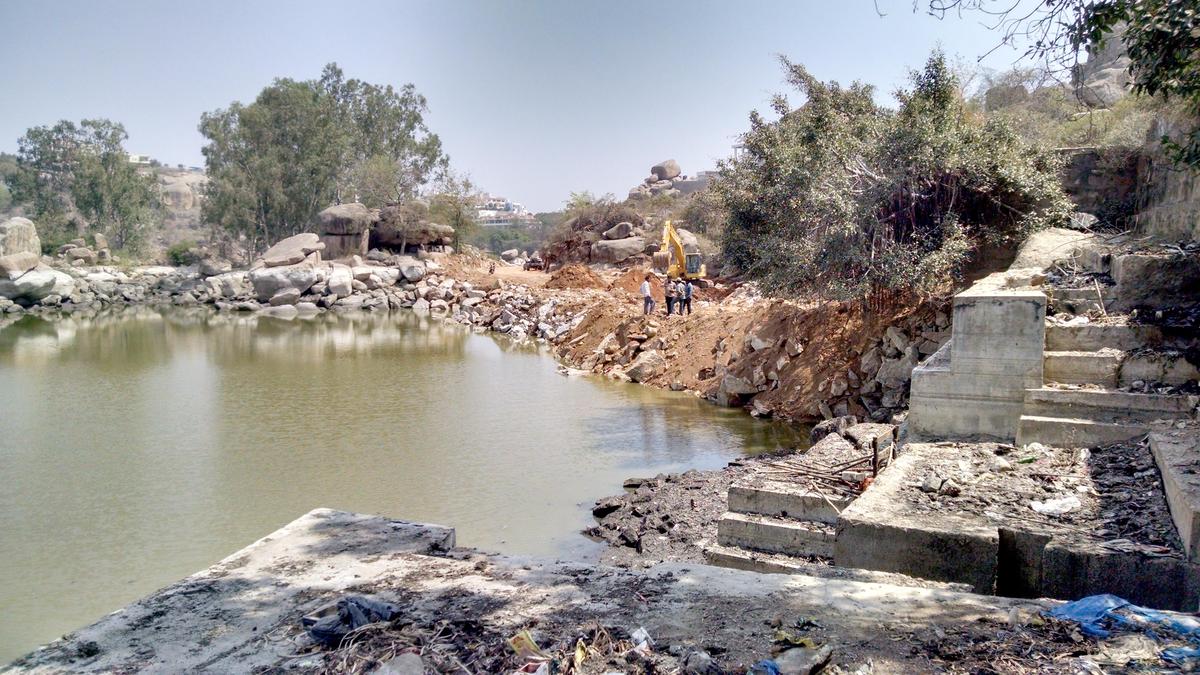
In February 2015, a channel was created at Durgam Cheruvu to enable outflow, marking one of the earliest major interventions to lower the lake’s water level.
| Photo Credit:
Serish Nanisetti
One thing, however, has changed in the past year: the fear. In the colonies that fringe the lake, the anxiety that once accompanied official markings has largely vanished. “Most of the residents have erased the markers made by officials. Only a faint marker remains,” says Srinivasulu, who has worked as a watchman at a villa overlooking the lake for 11 years.
The contrast with the past is stark. “In the gardens attached to the palaces, canals zigzagged at intervals, and fountains and pools teemed the precincts. The palaces were erected on a plateau and were laid out in a harmonious fashion with streams and waterfalls huddling the main structure. Fountains were devised at beautious spots all around,” wrote William Methwold after visiting Hyderabad in 1622.
Nearly 400 years later, residents around Durgam Cheruvu sit behind mosquito netting, light joss sticks to keep insects at bay and shut windows when the wind turns. Inside the Last House Coffee Shop, mosquitoes the size of small coins buzz and bite diners.
Power games
In August 2024, the tehsildar of Serilingampally Municipality issued notices to 240 home and property owners around Durgam Cheruvu, invoking Section 23 of the Water, Land and Trees (WALTA) Act. Overnight, houses in Amar Society were marked with a red ‘F, signifying full tank level (FTL) of the lake and sending a wave of panic through affluent residents who said they were unaware that they were violating the law.
Besides those from Amar Society, residents of Nectar Garden and Doctors Colony, along with a few house owners in Kavuri Hills, were directed to remove illegal structures within the FTL and buffer zone of the water body.
The buzz about demolitions gained momentum as the notices coincided with HYDRAA’s demolition of a portion of N-Convention, owned by actor Akkineni Nagarjuna.
Among those served notices was Tirupathi Reddy, brother of Telangana Chief Minister A. Revanth Reddy, whose sprawling office and residence marked by giant posters of the politician stand out as landmarks. For a brief moment, it appeared that the days of tony cafés and homes with manicured, walled gardens along the lake were numbered.
That moment passed. The High Court directed Greater Hyderabad Municipal Corporation officials to consider the 2022 recommendations of a five-member committee, which held that Durgam Cheruvu was no longer an irrigation tank but a tourist spot, and to settle FTL encroachment issues pragmatically, blotting out yet another sliver of hope for the lake’s recovery.
Activist Lubna Sarwath of Save Our Urban Lakes says the damage is now visible even to a casual visitor. “I visited the lake about a month ago and found that the outflow had increased, with more froth than before. Rocks had been demolished to make way for a pipeline,” she says. What is being erased, she adds, is a landscape once identified by a technical report as a triangular rocky enclave linking Durgam Cheruvu, the downstream Malkam Cheruvu and Khajaguda Pedda Cheruvu — a natural system that allowed water to move, settle and sustain life.
The unravelling of Durgam Cheruvu as an ecosystem is not accidental but incremental, an ongoing project shaped by the cumulative actions of all civic bodies in Hyderabad. During the 2025 monsoon, the Irrigation department dug up a channel to release more water. At the same time, the Hyderabad Metropolitan Water Supply and Sewerage Board has been discharging large volumes of sewage downstream as it tries to reconnect a 1,200-mm-diameter pipeline meant to divert sewage from the upstream areas surrounding Durgam Cheruvu.
Each intervention is projected as a technical necessity. Taken together, they have steadily accelerated the degradation of a historic lake into a tightly controlled water body, its fate dictated less by natural inflows and contours and more by pipelines, valves and expedient real estate compulsions.
Discover more from News Link360
Subscribe to get the latest posts sent to your email.