
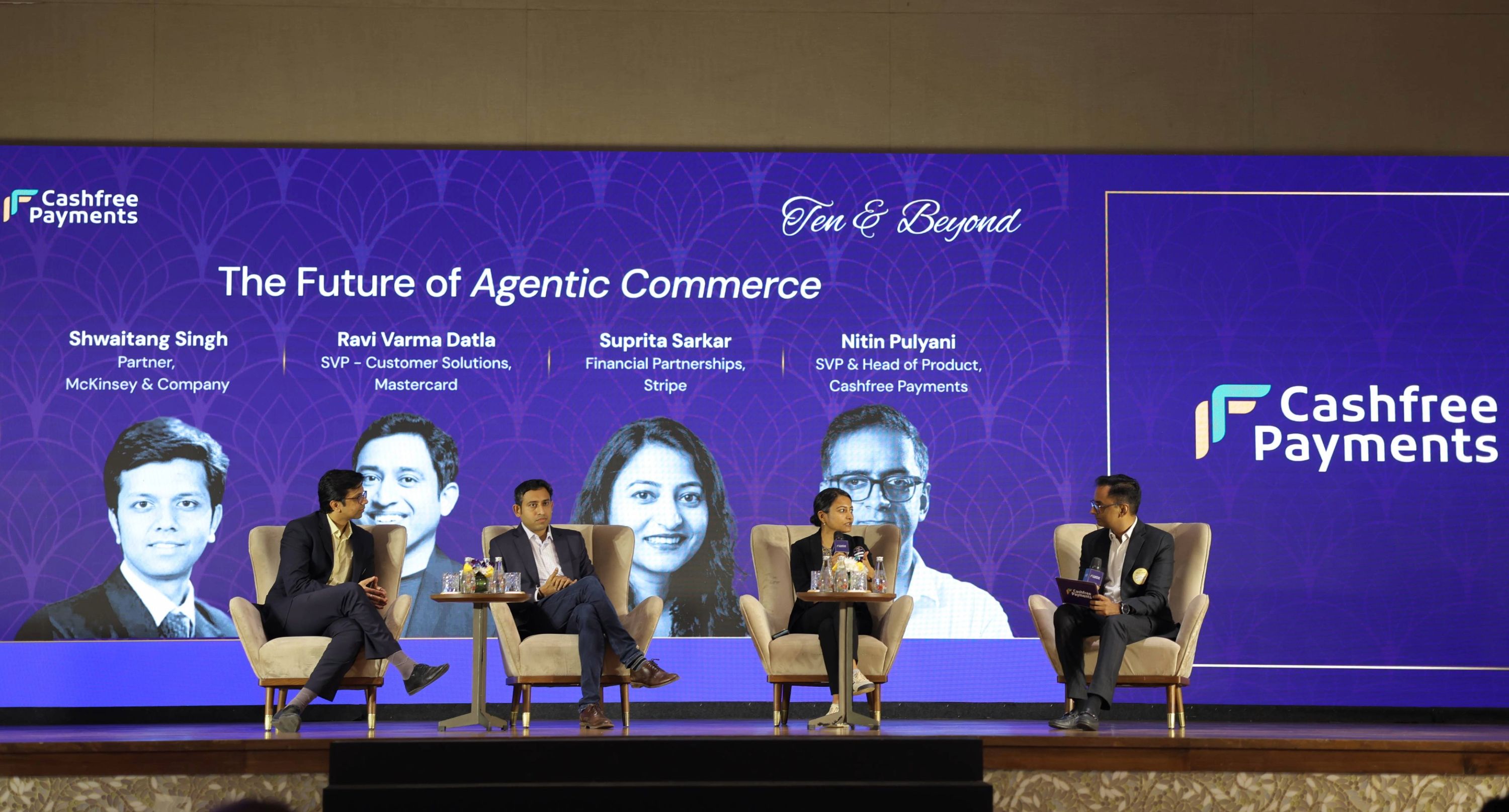

This formed the core of the dialogue at Cashfree Payments’ ‘Ten and Beyond’ event in Mumbai, where the company marked 10 years of building payments and fintech infrastructure for India and global markets. The event was designed not as a retrospective celebration, but as a forward-looking conversation on the future of commerce, payments, and trust in an AI-first world.
The event brought together more than 150 senior leaders and CXOs from across fintech, payments, platforms, banks, card networks, and policymakers, reflecting the belief that the next phase of commerce will be shaped through collaboration across the ecosystem.
A key highlight of the evening was a panel discussion titled ‘The Future of Agentic Commerce’, featuring Shwaitang Singh, Partner, McKinsey & Company; Ravi Datla, SVP, Customer Solutions, Mastercard; and Suprita Sarkar, Financial Partnerships, Stripe, moderated by Nitin Pulyani, SVP and Head of Product, Cashfree Payments.
One theme stood out clearly: agentic commerce is less about automating payments and more about re-architecting commerce around intent, with trust being rebuilt across platforms, networks, and infrastructure layers.
Commerce is becoming intent-led, not checkout-led
Suprita Sarkar, of Stripe, highlighted how consumer behaviour is already evolving globally, noting that a growing share of consumers now begin their purchase journeys within generative AI applications, using them to research, compare, and evaluate products.
“If this is where consumers are starting their journeys, it makes sense for businesses to meet them there,” she said. According to Sarkar, early adoption of agentic commerce is already visible across retail, marketplaces, SaaS platforms, and commerce infrastructure providers. Readiness, she explained, is being driven by consumer comfort, trust, and the ability of merchants to make their products discoverable within AI-led interfaces.
Her perspective reinforced a clear shift. Agentic commerce is moving from experimentation to early adoption, requiring ecosystems to align around trust, safety, and intent fulfillment rather than transactions alone.
Why agent-led commerce needs new trust and identity layers
Building on this, Ravi Datla from Mastercard traced the evolution of commerce from physical catalogues to web and app-based journeys, and now towards agent-led experiences. While the core steps of commerce, discovery, cataloguing, checkout, and payment, remain unchanged, the participants executing these steps are rapidly shifting.
“Search is the first signal,” noted Datla, highlighting that a significant share of search traffic in India has already moved from traditional search engines to AI-driven discovery. This shift requires payment networks to rethink and evolve their trust and security models, he explained.
Traditional identifiers, such as customer ID, order ID, and transaction ID, are no longer sufficient in an agentic ecosystem. Instead, networks are working to introduce agent-level and intent-level identifiers, while adding new layers of security and authentication to existing rails.
Datla emphasised that tokenization, already implemented at scale in India, provides a strong foundation for this next phase. Just as the ecosystem previously collaborated to define tokenization and authentication frameworks, similar collective efforts will be critical to enabling agentic payments safely and at scale.
Who will win in an agentic world? Those closest to intent
Offering a broader ecosystem view, Shwaitang Singh, of McKinsey & Company, spoke about how agentic commerce is unfolding across markets. While agents are increasingly influencing discovery and decision-making, Singh emphasized the importance of deliberately building robust trust and governance frameworks as adoption expands.
“Every new commerce paradigm needs strong foundations of trust,” said Singh, noting that the industry is actively working towards strengthening fraud prevention, authentication, and regulatory alignment to support agent-led interactions. In this context, predictable and recurring payment use cases such as subscriptions, bill payments, and repayments are likely to play a meaningful role in early adoption.
Singh also highlighted a defining theme for the agentic era: proximity to commercial intent. Platforms that understand and act on intent, whether across conversational interfaces, social platforms, messaging ecosystems, or B2B workflows, will be best positioned to shape the next phase of commerce.
Towards invisible, intent-led payments
As the discussion turned to the future, the panel converged on a shared vision of commerce becoming more intuitive and less transactional.
Summing up the sentiment, Nitin Pulyani, of Cashfree Payments, noted that the best payment experience is often no experience at all, where trust is so seamlessly built into the ecosystem that payments simply happen in the background.
The conversation at Cashfree’s Ten and Beyond event underscored a clear takeaway. The future of agentic commerce will not be built in silos. It will be shaped through shared responsibility, ecosystem-wide collaboration, and continuous dialogue across platforms, networks, banks, and technology providers.
By convening these voices, Cashfree reinforced its role not just as a payments infrastructure company, but as an active participant in shaping how India and the world reimagine commerce in the age of AI.
Discover more from News Link360
Subscribe to get the latest posts sent to your email.