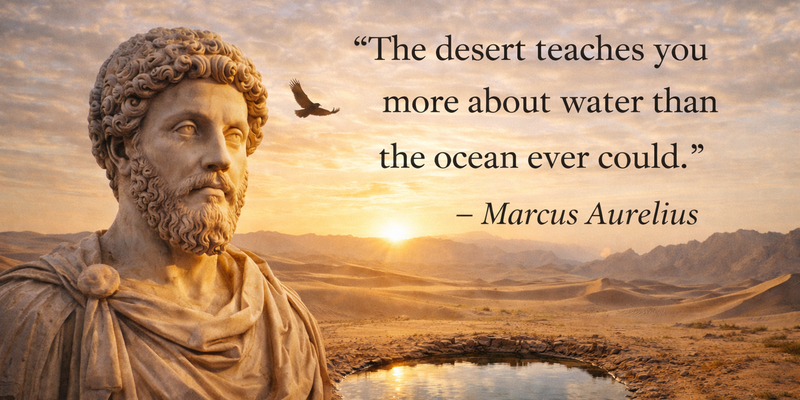

This is not merely a poetic contrast. It is a principle deeply aligned with the philosophy of Stoicism, particularly the reflections found in Meditations by Marcus Aurelius. The Stoics believed that hardship, limitation, and discomfort are not obstacles to wisdom but its teachers. The desert, in this sense, is a classroom.
Scarcity reveals true value
The Stoics consistently emphasized voluntary discomfort. They advised practicing moments of simplicity — eating modest meals, wearing plain clothes, sleeping without luxury — not to punish oneself, but to cultivate perspective. When abundance becomes constant, gratitude fades. When comfort is uninterrupted, resilience weakens.
In Meditations, Marcus Aurelius repeatedly reminds himself not to complain about circumstances beyond his control. Instead, he urges reflection: What is truly necessary? What is within my power? The desert answers these questions with ruthless clarity. In extreme conditions, survival depends on essentials. Water is no longer a casual commodity; it is life itself.
Likewise, Stoicism teaches that when external distractions are stripped away, we confront what truly matters: character, judgment, discipline. Just as thirst teaches the value of water, adversity teaches the value of inner strength.
Hardship refines character
The ocean symbolizes abundance and excess. It is overwhelming and constant. In such environments, one may forget how much is enough. The desert, by contrast, imposes limits. It forces intentionality.
Stoic thinkers such as Epictetus and Seneca argued that we suffer more from our reactions than from events themselves. The desert does not apologize for its harshness. It does not negotiate. It simply exists. What changes is the traveller— their preparation, patience, and endurance.
In this way, scarcity becomes transformative. When comforts are removed, we learn which desires are superficial and which needs are genuine. We discover the difference between craving and necessity. We recognize that resilience is not built in times of ease, but in moments of constraint.
Modern life, dominated by convenience and constant stimulation, resembles the ocean more than the desert. Information, entertainment, and consumer choices flood our senses. Yet many still feel restless.
Stoicism suggests that abundance without reflection creates dissatisfaction, while limitation with awareness creates wisdom.
The wisdom of enough
The desert does not merely deprive; it teaches sufficiency. One cup of water can be enough. One shelter can be enough. One steady mind can be enough.
This idea echoes throughout Meditations: external abundance does not guarantee inner peace. Peace emerges from understanding what we truly require and letting go of excess expectation. When we practice mental “deserts” — periods of stillness, restraint, and voluntary simplicity — we rediscover appreciation.
The lesson is enduring. Comfort numbs. Scarcity awakens. The desert sharpens our senses, disciplines our desires, and reminds us that value is most visible when it is rare.
In a world overflowing like the ocean, perhaps wisdom lies in occasionally walking through the desert — not to suffer needlessly, but to remember what truly sustains us.
Discover more from News Link360
Subscribe to get the latest posts sent to your email.