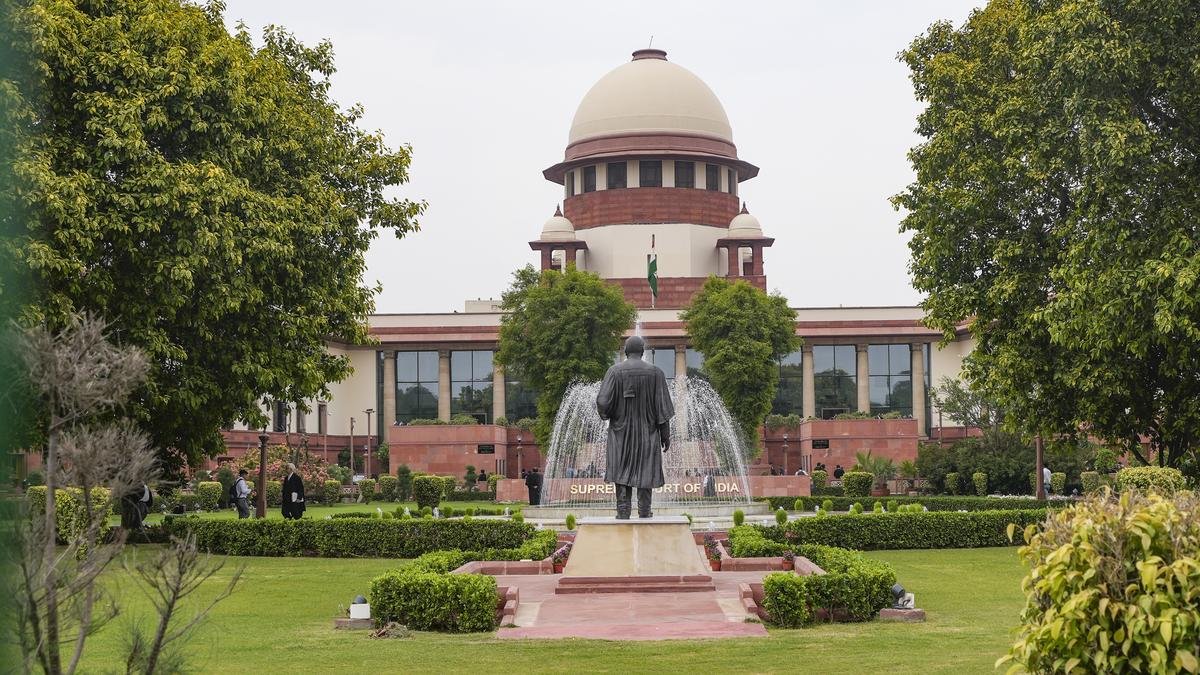

A view of the Supreme Court of India, in New Delhi. File
| Photo Credit: PTI
The Waqf (Amendment) Act, 2025 had amended Section 14 of the Unified Waqf Management Empowerment, Efficiency and Development (UMEED) Act, 1995 to mandate that two of the total members in Waqf Boards be non-Muslim.
Appearing before a Bench headed by Chief Justice of India Surya Kant, senior advocate P. Wilson, for the Waqf Board, submitted that the January 8 interim order of the High Court had “virtually paralysed” its functioning.
“Eight members have been appointed. Only three are remaining. But the High Court said the board cannot function,” Mr. Wilson submitted.
The Chief Justice said the High Court was “of course wrong”.
“The Madras High Court order rendering the Board defunct is stayed. Doctrine of necessity has to function,” the court observed.
It asked Mr. Wilson to provide details of the remaining three members.
The Waqf Board submitted that the High Court order proceeded on the erroneous premise that the Board, as presently constituted, was prime facie illegal solely on the ground that two non-Muslim members were not yet nominated, despite the existence of statutory vacancies.
The Waqf Board said High Court had breached Section 22 of the UMEED Act which categorically declared that no act or proceeding of the Board should be invalid merely by reason of any vacancy or defect in its constitution.
“In the teeth of Section 22 of the Act, the High Court could not have restrained the functioning of the Board on the sole ground of non-appointment-of certain members,” the petition said.
It said the High Court’s approach has rendered the legislative protection under Section 22 completely nugatory and defeated the express intent of Parliament.
“The High Court has nullified a statutory Board by judicial order, without striking down the Government Order constituting the Board, without considering statutory saving clauses, and without appreciating that appointments to statutory bodies are often made in a phased manner,” the Waqf Board submitted.
Published – February 19, 2026 03:05 pm IST
Discover more from News Link360
Subscribe to get the latest posts sent to your email.