

By the time Vijay Shekhar Sharma was preparing to take his mobile-services company public in 2010, he already knew his business was dying.
One97 Communications, the parent company of what would later become Paytm, was then one of India’s most successful purveyors of mobile value-added services — ringtones, ringback tones, cricket scores, astrology readings, jokes delivered by SMS, exam results pinged to feature phones across the country. It was a thriving business. It was also, Sharma had concluded, a business with a clock ticking above it.
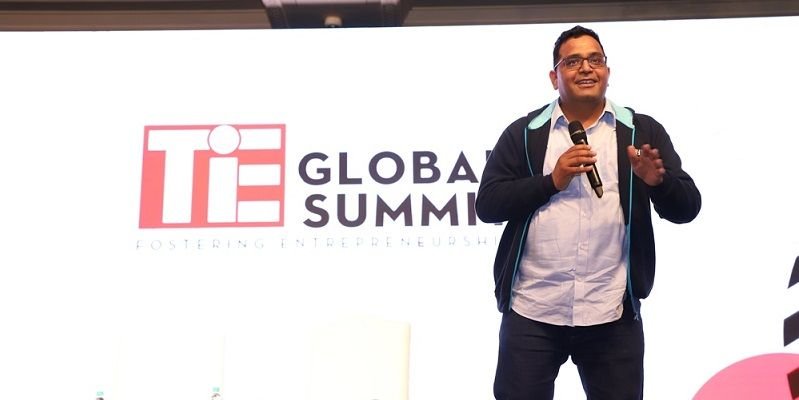
“I was going for an IPO in 2010, and the challenge was, what will happen to the future?” Sharma told the audience at the India AI Impact Summit 2025. “I had seen the smartphone in the US, and I was uncomfortable that we should do an IPO at that point in time because I was like, the business model is going to change.”
The world had not yet seen it coming. He had. “The ringtone will no longer be a business model,” he said. And it wasn’t. “No one will pay Rs 15 for a ringtone anymore; they can stream songs directly on their phones.” He recalled telling himself this at the time.
“The world had not seen, but I knew it,” he said. The power of the smartphone, he added, was not incremental. “The power of a smartphone was not that PCO, STD will be over. It was over.”
Instead, the smartphone became the gateway to India’s financial system. “As you know, the smartphone gave access to the financial system to every nook and corner of the country,” Sharma said. That shift eventually enabled Paytm’s pivot into digital payments and financial services.
That detail set the tone for everything that followed. Sharma was not speaking as a theorist. He was speaking as someone who had once stood at exactly the kind of inflection point many Indian builders are standing at today: artificial intelligence is the smartphone. And India, he said, is once again at the moment of choice.
“2026 begins with a commitment and confidence that AI will bring the capability in the business and the work and the problem that we typically would not have assumed would be solved,” he said.
Sharma framed AI not merely as a productivity tool but as infrastructure for financial inclusion. Coming from financial services, he said, “I fundamentally believe access to credit creates wealth.” Yet access to credit requires assessing risk across millions of small and complex cases.
“By the capability of AI, we will be able to take care of corner cases where it should not go, or it should go,” he said. That, he added, could make people more financially inclusive than ever before.
.thumbnailWrapper{
width:6.62rem !important;
}
.alsoReadTitleImage{
min-width: 81px !important;
min-height: 81px !important;
}
.alsoReadMainTitleText{
font-size: 14px !important;
line-height: 20px !important;
}
.alsoReadHeadText{
font-size: 24px !important;
line-height: 20px !important;
}
}

On foundational models
During the speech, Sharma also cautioned against viewing the AI race solely through the lens of foundation models. “A foundation model is a horizontal capable model,” he said. While India “must and for sure have a foundation model,” the focus, he argued, should be on applied systems.
“It’s like asking, will you build vehicles or will you make engines?” he said. Foundation models, in his telling, are the engine. The agents, the sector-specific models, the domain applications built on top — those are the vehicles. And the vehicles are what the world actually needs. “That requirement will go metaphorically ten times and many more fold than ever before imagined.”
“The point is not about just building a foundation model,” he said. “The point is about building the models that solve for us. Solve for global health. Solve for global problems.”
He was not dismissive of the foundation model question — he offered an endorsement of Sarvam AI, the Indian startup building a homegrown large language model — but he insisted the more consequential frontier lay elsewhere. “The fight is not about just a foundation model,” he said. “The fight is about AI that works for a sector, works for a segment, and solves the problem via agents.”
Edited by Jyoti Narayan
Discover more from News Link360
Subscribe to get the latest posts sent to your email.