The chance went down. Ashraf capitalised. Twenty-nine runs came off the final two overs, and victory was snatched from the jaws of defeat.
“I want to be very clear: Pakistan didn’t win the game today, we lost the game ourselves,” the Netherlands pacer Paul van Meekeren said afterwards.
Closing gaps
That match set the tone for what followed from the Associate nations in the league stage: fightbacks, sustained pressure on Full-Member sides and long spells of dominance. It is unfortunate that none ultimately crossed the line against the very top teams.
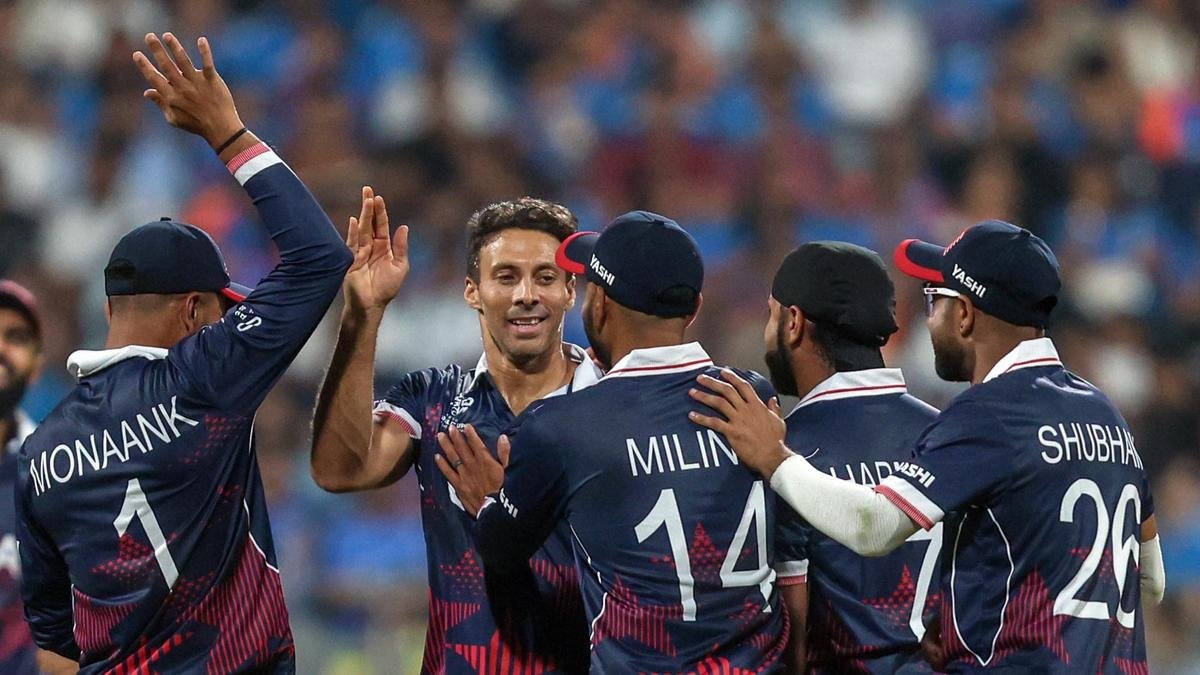
Later that day, the USA reduced defending champion India to 77 for six before Suryakumar Yadav steadied the innings and took his side to a competitive total, eventually sealing a 29-run win. The next day, Nepal came agonisingly close to beating England, losing by four runs despite needing only 13 off the final nine balls with five wickets in hand.
“More matches against top teams help you handle pressure moments better. Experience comes from repeatedly being in those situations,” USA’s Shayan Jahangir said.
This World Cup made one thing clear: Associate nations are no longer content to participate; they expect to compete. The closely fought matches, resilience under pressure and individual skill on display showed they belong at this level.
Italy, making its T20 World Cup debut, defeated Nepal and stayed competitive against England until the end.
“We came here wanting to win games, so I wouldn’t say we exceeded expectations. We gave it a proper go. That’s what we demanded of ourselves,” Italy captain Wayne Madsen reflected.
There has clearly been a shift in mindset. These teams are more competitive and tactically sharper. Yet most of their exposure still comes within the Associate circuit. ICC qualifiers, regional tournaments and domestic leagues remain their primary platforms for growth.
“The Nepal Premier League (NPL) is very important for Nepali players. It is one of the best T20 tournaments in the country,” captain Rohit Paudel said. “Many local players who don’t often get national team opportunities gain exposure there. They share dressing rooms with experienced international players and learn from them. That experience is invaluable.”
Limited exposure
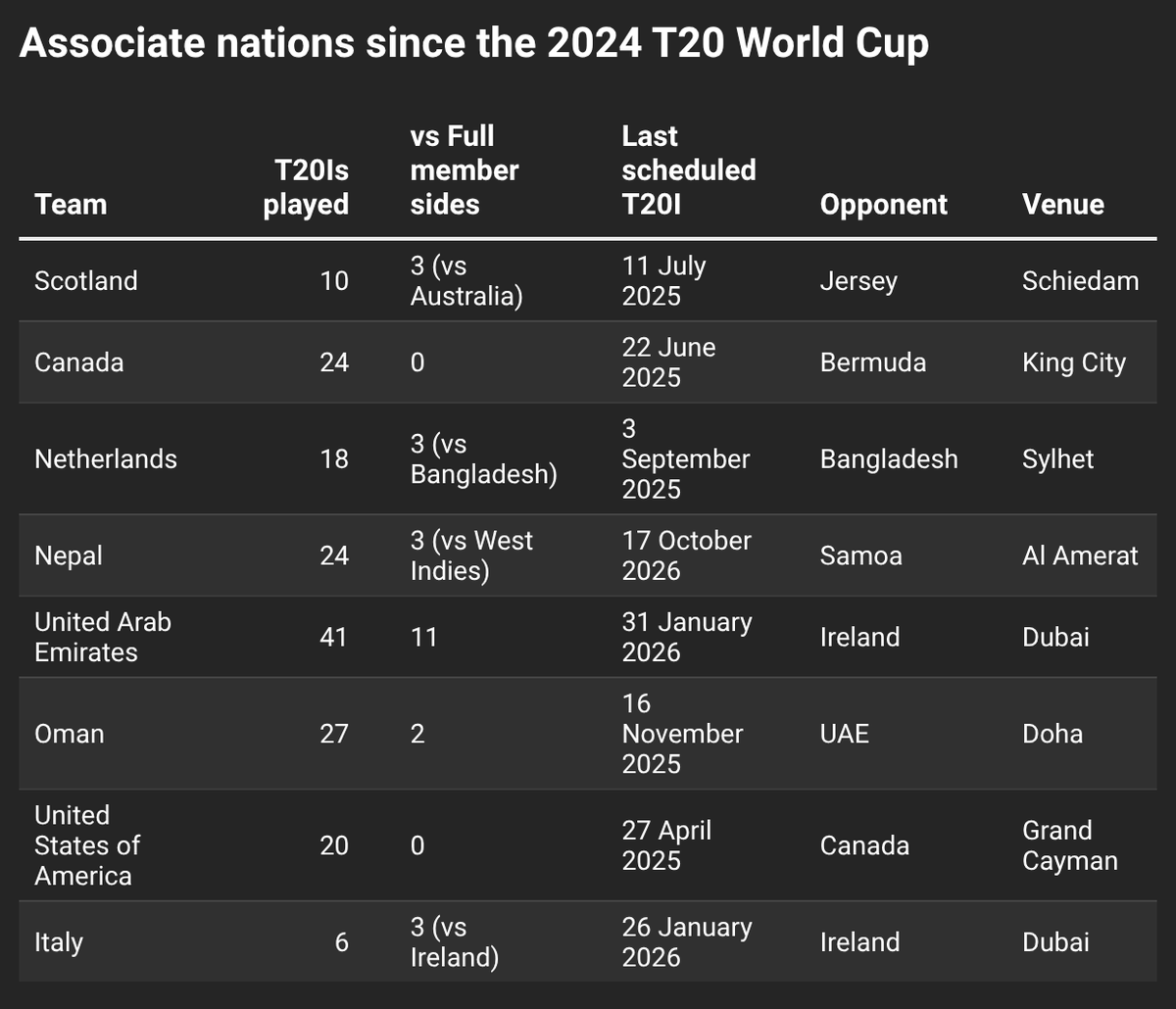
In September 2025, Nepal played its first and only bilateral series against a Full Member, West Indies. It won the three-match series 2-1. In the 2024 T20 World Cup, it fell one run short of beating South Africa in the group stage.
“After that World Cup game against South Africa, we only played one series against a Test-playing nation, the West Indies. In the last two years, we didn’t receive the exposure and experience we expected after that performance,” Paudel said.
| Photo Credit:
PTI

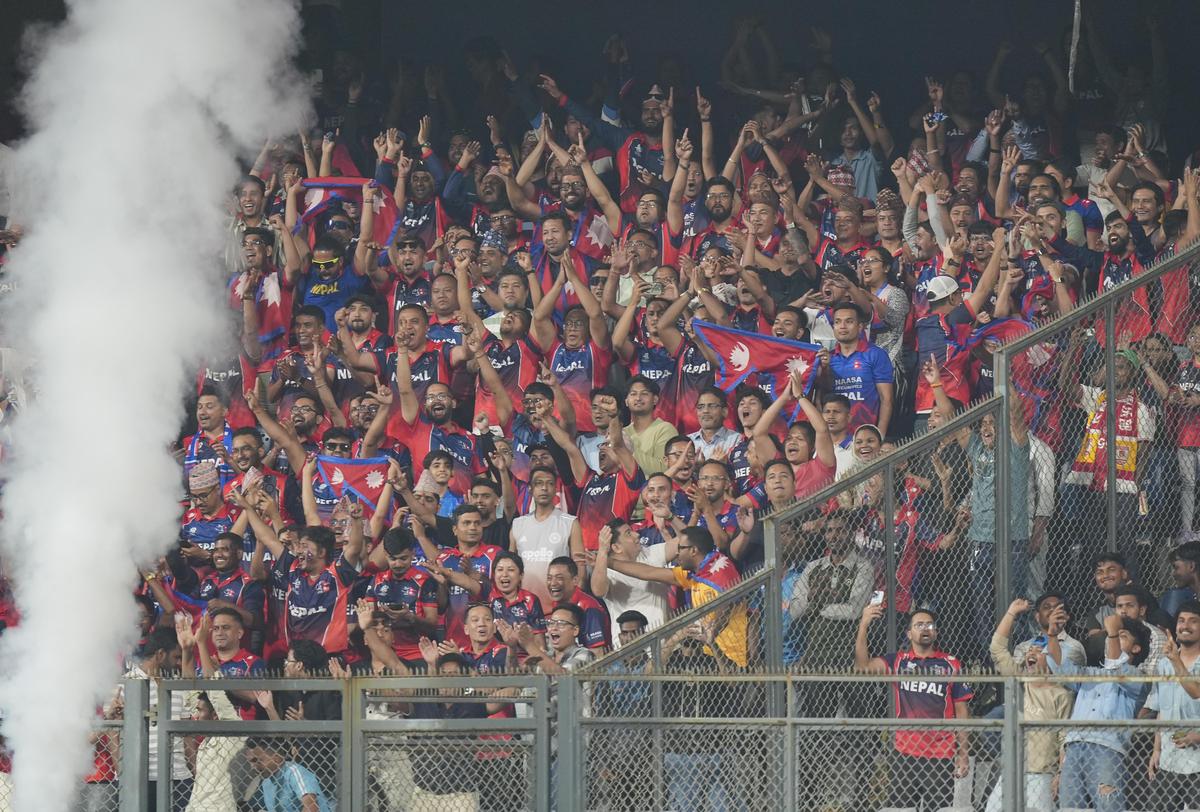
Here to stay: Nepal ended a 12-year wait for a third T20 World Cup win by beating Scotland in Mumbai, having earlier pushed England close, backed by rapturous fans who transformed every match into a celebration.
| Photo Credit:
PTI
“We’ve been playing matches, but not regularly against top teams. I’m not asking for six or seven series a year. Even one or two series annually against strong teams would help us test ourselves at that level.”
It is a similar story for other Associate nations at this World Cup. The USA reached the Super Eights in its maiden T20 World Cup appearance in 2024 but did not face a Full-Member side in a bilateral series afterwards.
In preparation for this tournament, the USA team, embroiled in a governance crisis, held a one-month camp in Sri Lanka, playing Sri Lanka A, Oman and two warm-up matches.
“If you look at our preparation for the World Cup, the reality is we hadn’t played a T20 International since February last year,” USA coach Pubudu Dassanayake said. “From that point onward, we didn’t get any international T20 matches.”
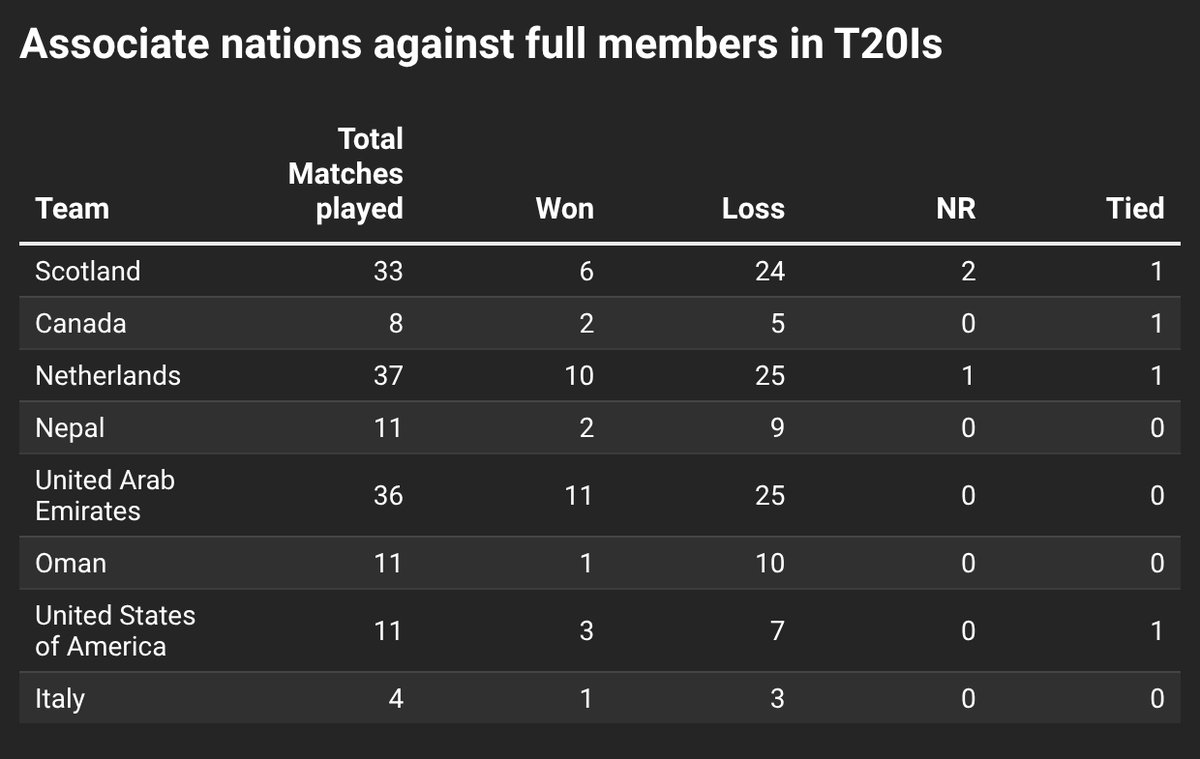
For most Associate nations, fixtures against Test-playing countries remain sporadic and, for teams like Canada and Oman, virtually non-existent outside multi-team events. The Netherlands was the only Associate side to travel outside its continent for a bilateral series against a Full Member, touring Bangladesh in September 2025 for three T20Is.
“We’ve probably punched above our weight over the years,” the Netherlands captain Scott Edwards said. “But to get to the next level, we need more opportunities against Test-playing nations. As Associates, you often only face them at World Cups. That’s the reality. The better we perform at these events, the stronger our voice becomes and, hopefully, that leads to more fixtures outside tournaments.”
Preparation divide
Full-Member teams sharpened themselves through bilateral series. Associate nations, by contrast, were left to stitch together preparation as best they could, often relying on short training camps and limited windows of competition.
Italy played three matches against Ireland and one against Namibia in Dubai in January 2026 before travelling to India. Several Dutch players arrived early in Mumbai for individual preparation before the full squad trained at Chennai’s Super Kings Academy.
For each opponent, these teams leaned heavily on data and video analysis to compensate for limited match exposure. For USA all-rounder Mohammad Mohsin, that dynamic can even tilt slightly in their favour.
“Not playing regularly against Full-Member nations can work both ways. We study them throughout the year on TV, through video and analysis. But they don’t always have much data on us. That can be an advantage,” Mohsin said.
The margins at this World Cup have shown that the gap is narrowing, but it also requires greater exposure, infrastructure and funding.
Under the ICC’s 2024-2027 revenue cycle, India will receive roughly 40 per cent of the global body’s earnings, about $231 million annually. Of the ICC’s estimated $600 million annual revenue during this period, nearly $533 million will be distributed among the 12 Full Members, while Associate nations will share approximately $67 million.
The gulf is huge. But, as Italy head coach John Davison pointed out, it is not only about the money. In a football-dominated nation, the dream of reaching the sports pages and expanding coverage beyond the Winter Olympics fuels these players.
No wonder players squeeze time out of their day jobs to follow their passion. Some hope to catch the attention of franchise owners and break into major leagues, but they know it is not easy given the limited exposure to high-level competitive cricket.
Structural reform
That is something that needs immediate attention. In previous ICC events, teams like the Netherlands, Scotland, UAE and Oman have proved their mettle, but back home there has been little change in terms of exposure. For several teams, the domestic structure is not streamlined.
That made this edition of the T20 World Cup crucial. Each time smaller teams caught the attention of stakeholders, they hoped it would translate into structural change. They at least allowed themselves to dream of more equitable treatment.
But it is easier said than done.
As Davison, a former Canada international, suggested, Associate nations expect structural changes. Teams like Italy would “love to play more cricket” and develop turf facilities back home, but funding and programming depend on administrators and ICC support.
That is where unity comes in. Cricket Scotland CEO Trudy Lindblade revealed that when not competing, Associate nations help each other stay afloat and keep the game going.
“We (the Associate members) meet, and one of the things that we used to have was someone within the ICC who could help bring us together. That would be something that, if we could look at having again, would make sure that we are working together to build the game and grow the game,” Lindblade said.
“We compete on the field, but off the field we should be helping each other as well. We all have our own individual targets and metrics for what we want to achieve. I think we have all been consistent in what we want: more cricket on a more regular basis, playing against the top teams. You don’t always have to play the Englands and Australias of the world. We want to play a mix of teams because that will help improve our cricket,” she said, adding that the ICC should eventually introduce a system in which teams performing consistently well in lower divisions are rewarded with series or matches against the bigger sides.
For now, that appears to be wishful thinking.
One ICC board member conceded that a packed international calendar leaves little room for regular bilateral series with Associate members. “But then we try to play a tri-series or something ahead of those big tours, so that the smaller teams get a chance to watch the players in action,” the board member said.
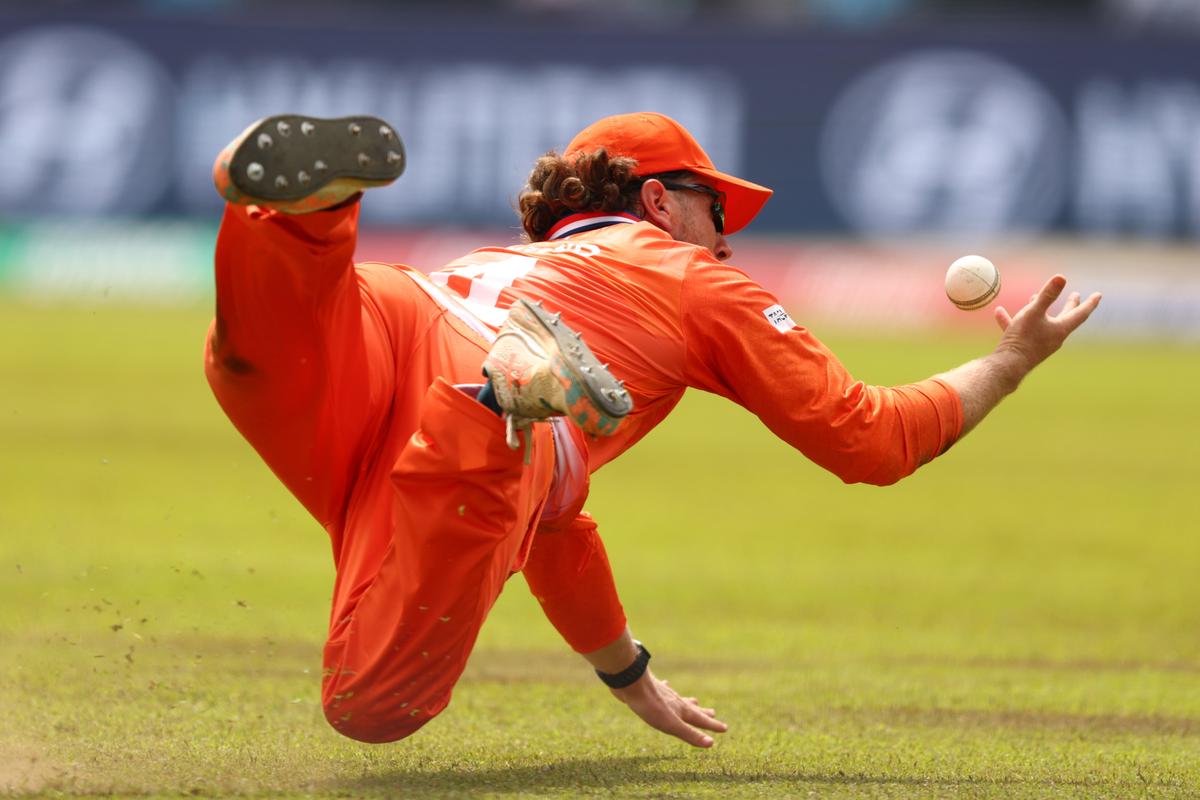
Cruel margin: Max O’Dowd put down Faheem Ashraf at long-off, a moment that slipped through the Netherlands’ fingers as Pakistan escaped with the match.
| Photo Credit:
Getty Images
Cruel margin: Max O’Dowd put down Faheem Ashraf at long-off, a moment that slipped through the Netherlands’ fingers as Pakistan escaped with the match.
| Photo Credit:
Getty Images
Ground realities
Back in 2022, the Netherlands hogged the limelight after knocking South Africa out of the T20 World Cup. Former Netherlands coach Ryan Campbell hoped that things would improve, both in terms of exposure and funding, for the Men in Orange. Six years on, most Associate nations are still chasing the same elusive goal: proper infrastructure.
Nepal, for instance, plays its home games in Kirtipur, where fans turn up in impressive numbers, but it lacks indoor facilities. The team frequently travels to India to train at the BCCI’s Centre of Excellence in Bengaluru or at private residential academies.
Players from the Netherlands have limited experience of night games because there are no such facilities at home, and much of their training is conducted indoors. It is a similar story for Namibia. Mumbai-born Harmeet Singh, now a key member of the USA side, did not mince words. “We do have a few stadiums in the USA, but infrastructure isn’t in the players’ control. What we need are more facilities and stronger development systems,” he said.
“Back in the 1990s, even India faced infrastructure challenges. But once academies like the National Cricket Academy were established and quality coaching systems were put in place, Indian cricket changed completely,” he added. “The difference between us becoming a top nation and where we are right now is infrastructure.
This team has immense potential. We just need more international games, more series against top sides, and the confidence that comes from finishing games against them.”
That sentiment echoes across dressing rooms.
“I think it’s not rocket science. If you play more cricket, you’re going to get better. And especially if you play more competitive cricket. So I think all the Associate nations are calling out for the same thing,” Namibia coach Craig Williams said.
The T20 World Cup has become the ICC’s chosen instrument of expansion. Since the 2024 edition, the tournament has grown from 16 to 20 teams, underlining T20’s role as the format through which the game hopes to widen its footprint. But expansion cannot end with adding names to a draw sheet every two years.
Associate nations need sustained exposure against Full Members through regular bilateral opportunities, high-quality competition and meaningful calendar space.
The appetite exists. The potential is evident. If that broader pathway begins to take shape, the upsets that once felt fleeting could become part of a more competitive global game.
Published on Feb 25, 2026
Discover more from News Link360
Subscribe to get the latest posts sent to your email.