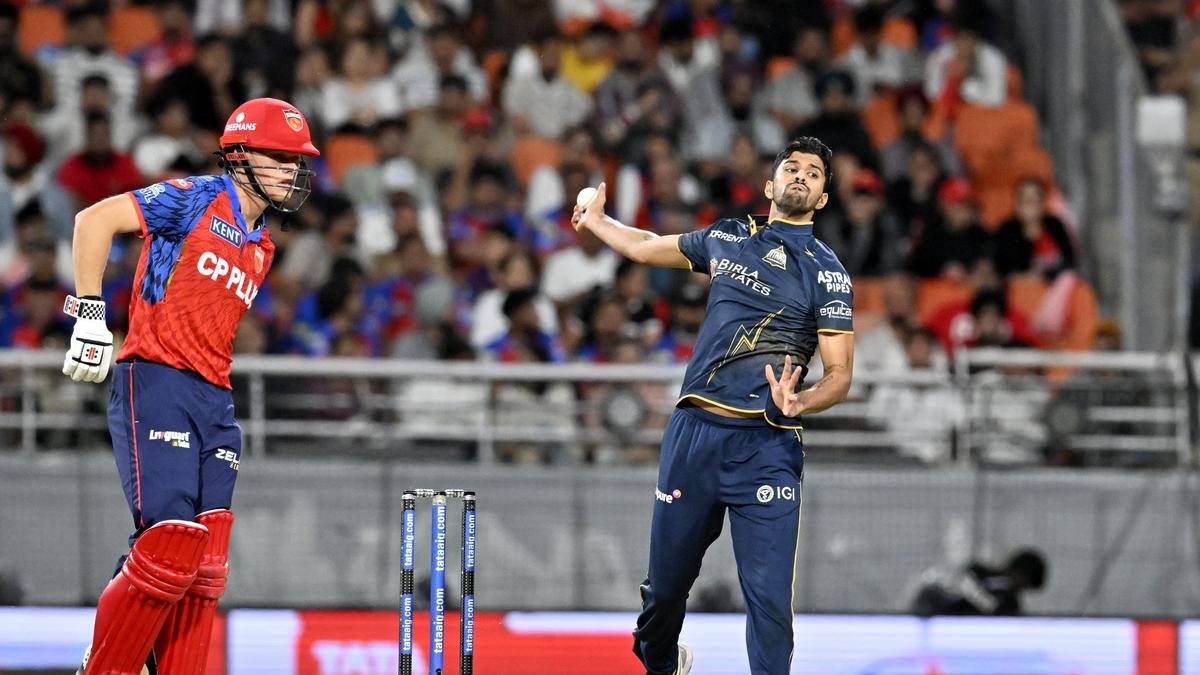
This may be down to the simplicity of an off-cutter’s execution. Conceptually, it is delivered by ‘cutting’ the ball across the seam clockwise upon release, forcing it to move into a right-handed batter after bouncing.
Despite its effective simplicity and perceived ordinariness, the humble off-cutter emerged as one of the primary wicket-taking tools for the fast bowlers at the recently concluded T20 World Cup 2026.
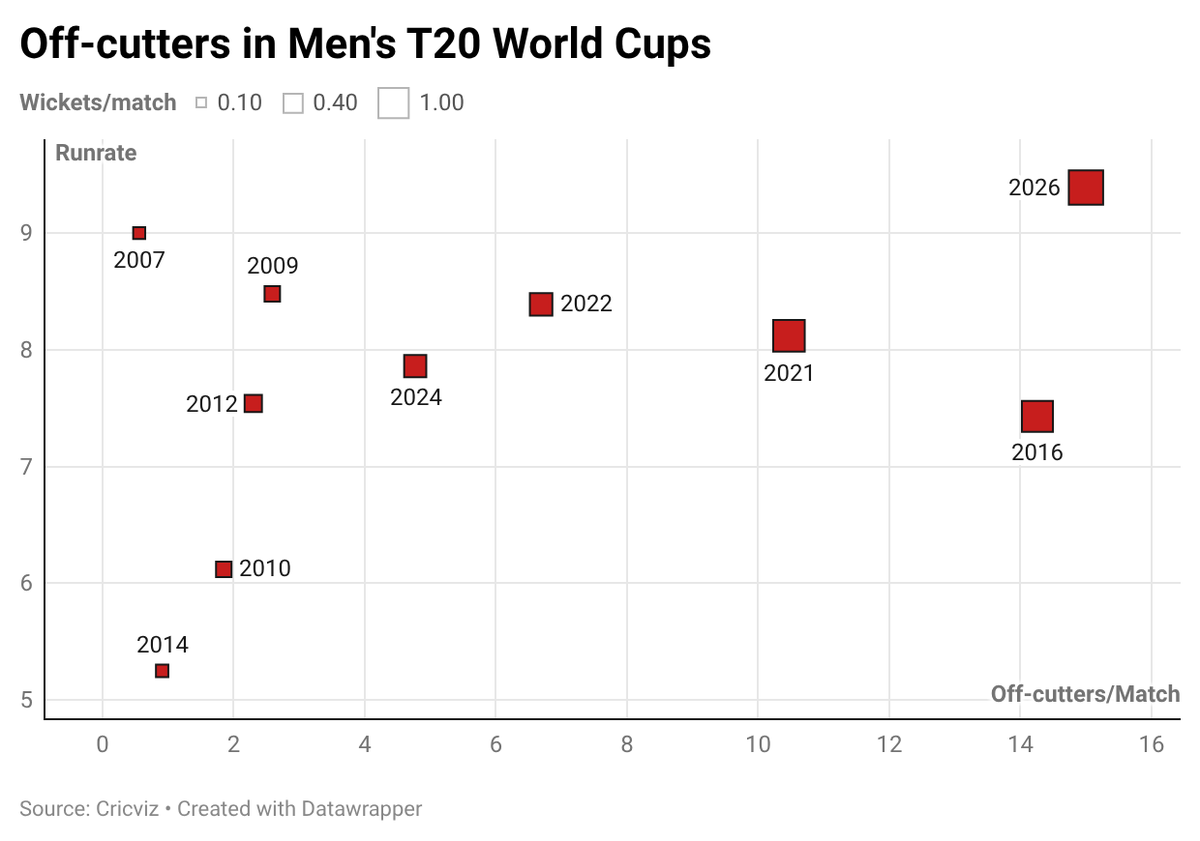
Of the 357 wickets claimed by the quicks at the tournament, 68 were taken using the off-cutter. This is, by some distance, the most wickets secured using this ball type in a single edition of the T20 World Cup.
There were 795 off-cutters at the T20 World Cup 2026, a significant jump from the previous highest in an edition – 485 (2016).
Predictably, the off-cutters were more effective against the southpaws. At the T20 World Cup 2026, against this delivery type, left-handed batters averaged 14.03; the corresponding figure for the righties was 21.14.
Though it reaped bucketloads of wickets, the off-cutter also proved to be a risk-heavy option for the pacers. The economy for such deliveries in the tournament was 9.39, the highest ever in a single edition.
Much like almost all of the options available to a bowler, the off-cutter is heavily condition-dependent. In smaller grounds with flatter tracks, batters are often afforded a greater margin for error. So, in venues like Chepauk and Eden Gardens, this variation proved to be largely ineffective.
But the Narendra Modi Stadium in Ahmedabad, with its large outfield and black-soil pitch, proved to be fertile ground for the off-cutters in the World Cup – producing a tournament-high 21 wickets, at a meagre 8.25 runs per over.
South Africa, which played five of its eight games in Ahmedabad, used the grippy surface to its advantage to string together a remarkable winning run through the group and Super Eight stages before eventually falling in the semifinal.
RELATED | How South Africa used slower deliveries to reap quick dividends in Ahmedabad
Lungi Ngidi was the ringleader of the Proteas pace attack, which maximised the Ahmedabad conditions. He bowled 63 off-cutters in the tournament – five of his 12 wickets came with this delivery – eight more than the second-best bowler (India’s Jasprit Bumrah).

Ngidi deployed the ‘dipping’ off-cutter, a variant that involves additional use of the wrist, in addition to the fingers, to impart more revolutions on the ball.
| Photo Credit:
VIJAY SONEJI

Ngidi deployed the ‘dipping’ off-cutter, a variant that involves additional use of the wrist, in addition to the fingers, to impart more revolutions on the ball.
| Photo Credit:
VIJAY SONEJI
“Over the years, I’ve realised using different lengths [on slower balls] — yorker, on length or bouncer. So it’s three different lengths with the same ball and the batter has got to guess which one’s coming next,” said Ngidi during the World Cup.
Central to Ngidi’s success was his deployment of the ‘dipping’ off-cutter, a variant that involves additional use of the wrist, in addition to the fingers, to impart more revolutions on the ball. This delivery, before its post-bounce lateral movement, also drops in length, increasing the odds of forcing a mistake from the batter.
During the T20 World Cup, Ngidi had revealed that this was something he had picked up from West Indies’ Dwayne Bravo during IPL 2018, when the two pacers were teammates at Chennai Super Kings.
Bumrah’s off-cutter is also known to induce a very similar effect – an outcome of his unique bowling action and wrist usage.
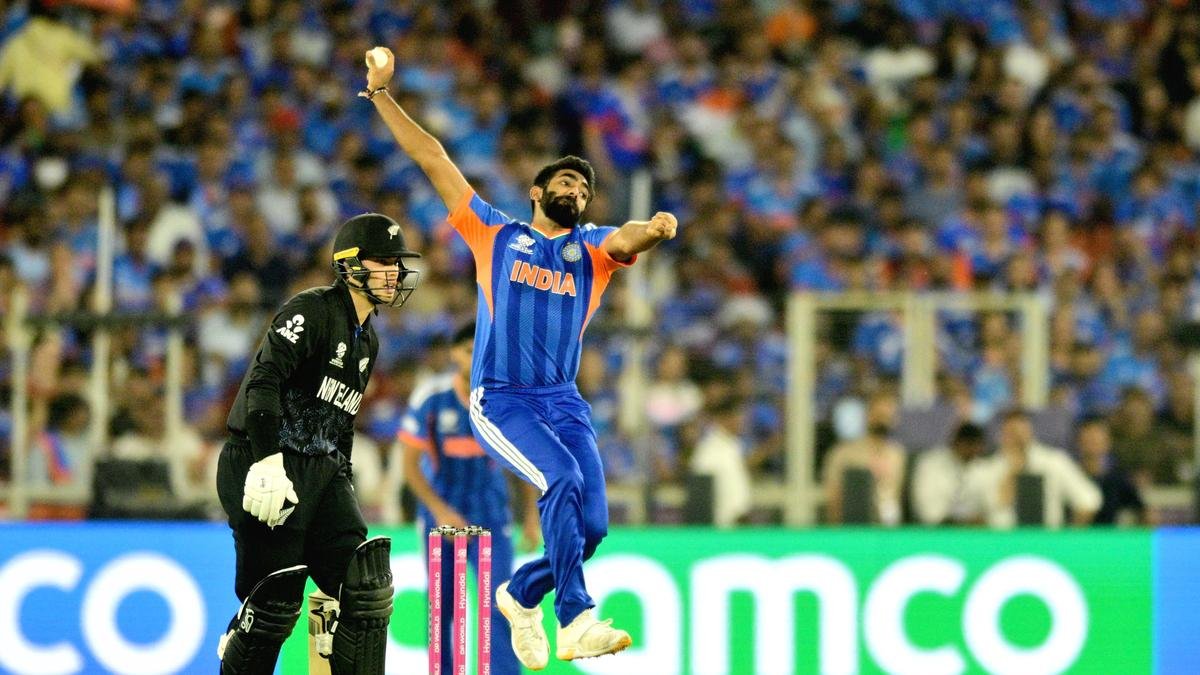
Its devastating effect was on full display in the final, when the Indian pacer scalped four Kiwi wickets with his swerving cutters to set up a massive win for his team.
Bumrah leaned on his experience to devise a bowling plan to exploit the Ahmedabad surface that usually rewards pace-off deliveries. Of the 24 deliveries he bowled in the final, 18 were off-cutters.
“Because of the experience, because I’ve played on belters over here, and I have seen the other teams too, I learned that trying to bowl too fast can make shot-making easier. So I just played smart and tried to think of what the batsmen were trying to do,” said Bumrah after he received the Player of the Final award.
What makes Bumrah’s cutters more potent is the angle from which he delivers them. In the World Cup, 76.7 per cent of his off-cutters were delivered from wide of the crease (over the wicket); only West Indies’ Jason Holder had a bigger such share.
This, along with his anatomically freakish bowling technique, creates an awkward line of attack for Bumrah, granting him an advantage even before his off-cutter bounces. Half of his 14 wickets in the tournament came with this variation.
Much before Ngidi and Bumrah rocked batting units with their mastery over the off-cutter, another bowler had wreaked havoc with this delivery in the tournament – USA’s Shadley van Schalkwyk.
The unheralded American, with his dibbly-dobbly medium pace, snapped up 13 wickets from four group-stage games, including identical four-wicket hauls (4/25) against India and Pakistan.
Van Schalkwyk’s natural pace, or rather the lack of it, meant his cutters held onto the surface a fraction longer, resulting in batters frequently mistiming against him.

United States’ Shadley Van Schalkwyk impressed early on in T20 World Cup 2026, claiming 13 wickets from four group-stage games.
| Photo Credit:
EMMANUAL YOGINI
United States’ Shadley Van Schalkwyk impressed early on in T20 World Cup 2026, claiming 13 wickets from four group-stage games.
| Photo Credit:
EMMANUAL YOGINI
The 38-year-old bowled 18 off-cutters in the World Cup and gained an incredible six wickets from them. The idea, as Van Schalkwyk explained, was to take the batters out of their comfort zone.
“I know my variations. It was about making the ball as slow as possible for them [Indian batters], because it looks like they quite enjoy it when it comes on. So technically, I wanted to take it away from their hitting zones,” he said in an interview with Cricinfo after the India game.
In recent years, armed with superior bats and favourable conditions, batters have gained significant ground in T20 cricket. This World Cup saw pacers hold their ground by returning to an age-old weapon — the seemingly unassuming off-cutter.
Published on Mar 09, 2026
Discover more from News Link360
Subscribe to get the latest posts sent to your email.