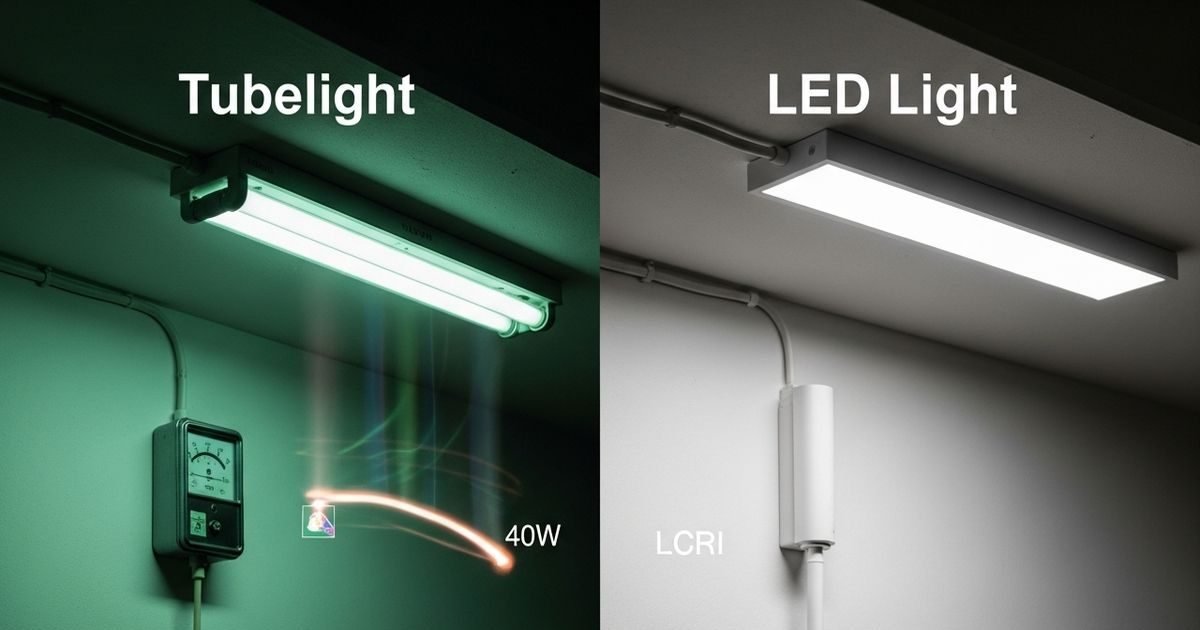
When we switch on, electricity comes. But this gas does not produce light so easily. To produce light the gas first has to be ‘heated’ and ‘excited’. That means a path for electricity has to be made in the gas. This requires very high voltage, which is not available directly from the 220 volt electricity at home. Here a small part called starter comes in handy. There is a small cylinder like part fitted near the starter tube. It consists of a small bulb and a special switch. On turning on the switch: First of all the electricity passes through the starter to the wires (filament) at both ends of the tube.
These wires get hot. When heated they release electrons. A small bulb lights up inside the starter, due to which the starter switch gets heated and closes. Due to this, the wires get more current and they become hotter.
Then when the starter cools down, the switch suddenly opens. This opening causes a very high voltage shock to the choke (another part that is attached to the tube) – up to hundreds of volts!
This shock ‘ionizes’ the gas. Meaning, a path for electricity is created in the gas. The gas starts glowing, UV rays are released. These rays fall on the phosphor and white light is produced.
This entire process takes 2-5 seconds. During this time the tube keeps blinking as the starter tries again and again. If the gas is not completely prepared then the light does not remain stable. Once the gas is fully turned on, electricity starts flowing directly through the tube and the starter’s work is finished.
reason for blinking
Blinking occurs due to the opening and closing of the starter. The wires get hot and cold again and again, small discharges occur. But the gas is not fully prepared, so the light keeps blinking.
Why is this problem not present in today’s LED tube lights?
Delay occurs due to starter and old choke (ballast) in old tube. But in new LED tubes or tubes with electronic choke, high voltage is obtained immediately. That’s why they light up instantly, no blinking, no delay.
When is it too late?
- If the tube is old.
- If the starter is bad.
- In winter (gas is prepared slowly in cold).
- In such a situation, replace the starter or install a new tube.
Tube light takes a long time to burn because the gas inside it has to be heated first and given a high voltage shock to produce light. This work is done by the starter, and it takes some time. That’s why first it blinks, then it shines completely. This is the special thing about the old tube. Today LEDs have arrived, which light up instantly and consume less electricity.
Discover more from News Link360
Subscribe to get the latest posts sent to your email.