
“A labourer carries 100 kilograms on his back,” he says. “How can I say I suffered? A man who cannot feed his family—that is suffering. Everything else is just life.”
He is not being modest for the microphones or cameras. He has clearly thought about this for a long time, and he believes it completely. The trouble is that his own story keeps getting in the way of the argument.
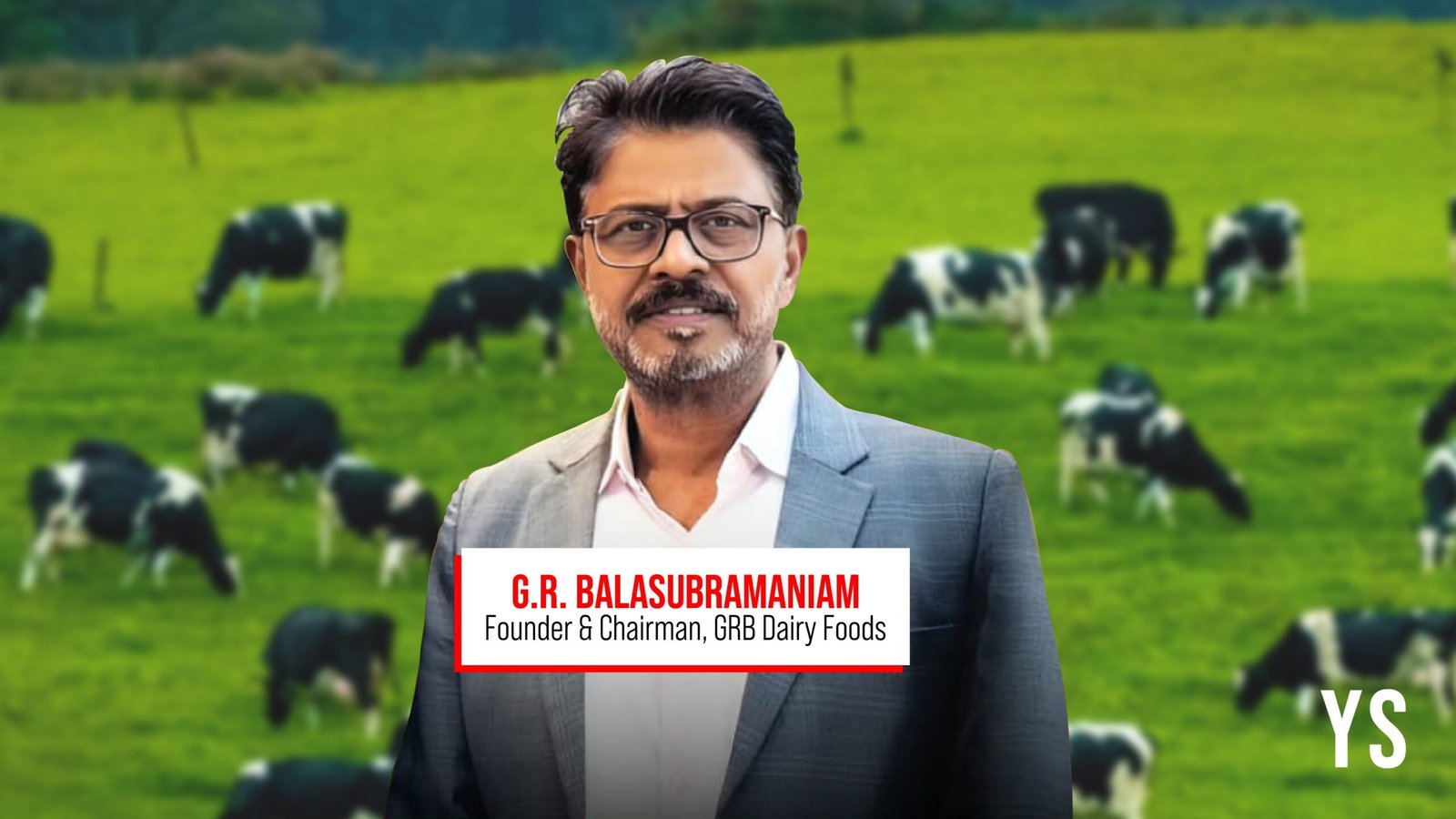
This is a man who never finished school. Who was sent away from his village at 13 to work in a relative’s butter business. Who spent 14 years building up that business only to be quietly sidelined. Who then started his own venture with Rs 3,000 in a 10-by-20-foot rented shop, with no plan, no connections, and a wife to support.
That venture is now GRB Dairy Foods. It does over Rs 1,400 crore in annual revenue. It employs 2,000 people. It sells ghee, sweets, snacks, and spices in more than 40 countries. And more importantly, it has never taken a single rupee from any outside investor.
And its founder will tell you, with a straight face, that none of this was particularly difficult.
This is his story. You can decide for yourself.
Balasubramaniam grew up in Virupatchi, a tiny hamlet near Palani in Tamil Nadu’s Dindigul district. When he was a boy, the village had about 300 people. There was no bus. No electricity. No proper water supply. The nearest school beyond Class 5 was 15 kilometres away.
His father was not a rich man, but not a desperately poor one either. He made a living the way many men in that part of Tamil Nadu did in the 1960s: riding a bicycle from village to village, buying pulses and small produce, selling them in the next town. He also farmed a small piece of land. There were six children to raise.
The father wanted his sons to study. He pushed the eldest hard, arranging for school, paying what he could. The eldest refused. The second son studied, but without much interest or result. Balasubramaniam was the youngest boy, and he was good at school. Sharp, eager, the one who actually wanted to be in a classroom.
But in 1970, when he was barely 13 and in Class 8, the family made a decision. His elder sister and her husband ran a small butter business in Bangalore. The business was growing and they needed help. Hiring outsiders was not how families in that community operated. You sent your own people. So Balasubramaniam, the boy with the most academic promise in the family, was pulled out of school and sent to Bangalore to work.
He did not go back to school.
For the next 14 years, he worked in his brother-in-law’s butter business. He did everything. He went to villages to buy butter from small producers. He delivered it to homes across Bangalore. He kept accounts. He learned how to judge the quality of butter by touch and smell, how to convert it into ghee, how to talk to customers, how to manage cash that came in slowly and went out fast. He did all of this not as a dependent but as someone who had decided, consciously, that this was his own business. Not in a legal sense. It belonged to his brother-in-law. But in the way he showed up every day, it was his.
“I had no other option,” he says. “My father could not take me back. So I told myself, this is my life now. And because I threw myself into it fully, I learned everything. That involvement for those 14 years is the reason I am where I am today.”
In 1983, Balasubramaniam got married. After the wedding, he continued working with his brother-in-law, but the relationship began to shift. There was no big fight, no shouting match. What happened was quieter and, in its own way, harder to deal with. After some minor misunderstanding, his brother-in-law simply stopped giving him any responsibilities. Balasubramaniam still lived under his roof, still ate his food, and still had all the comforts of the household. But he had no work. Nothing to do.
“He never told me to leave,” Balasubramaniam says. “He did not say go. But I had no work. In that situation, how can you stay?”
About 16 months after his wedding, in 1984, he walked out. He was 27 or 28. He had Rs 6,000 in savings. He paid Rs 3,000 as advance rent for a small room. That left Rs 3,000. His father was in no position to help. His brothers were not around. He could not go back to his brother-in-law. He had no formal education and no certificate of any kind. Nobody was going to give him a job.
“I sat not knowing what to do,” he says. “I knew butter, I knew ghee, but I had never been the one making decisions. It felt like a blank. Like nothing was there.”
Rs 3,000 to Rs 1,400 crore
Then a small idea arrived. He organised a chit fund, a rotating savings scheme common in South India where a group of people contribute a fixed amount every month, and one person gets the full pot each month by rotation or auction. His brother-in-law used to run one. Balasubramaniam thought: why not start one myself?
The problem was obvious. He had no money, no standing, no business of his own. Why would anyone trust him with their savings? But it turned out that 14 years of honest, hard work had given him something more valuable than capital. People knew him. They knew he was reliable. He went around asking people to join. Within a single day, the group was formed. By the second month, he drew the pot, about Rs 50,000, and used it to buy his first stock of butter.
He started small. Seventy-five kilograms of butter a month, delivered door to door across Bangalore neighbourhoods on the same cycle-and-hustle model he had grown up watching. But during his years with his brother-in-law, he had noticed something that the others in the business had not bothered to think about. Butter did not last. It went bad quickly. Retailers lost money on spoilage. And the hotels and sweet shops that bought butter were only buying it to convert it into ghee anyway, often badly. They would burn it, or lose yield, or produce ghee that was inconsistent from one batch to the next.
What if Balasubramaniam did the conversion himself? Buy the butter, make the ghee at home, and sell the finished product directly to hotels, sweet shops, and households? He had the skill. His wife helped with production. The response was immediate.
Within a year, his monthly income went from nearly nothing to Rs 25,000. He rented a 10-by-20-foot shop, hired his first few people, and started putting labels on his bottles. The label was simple: a plain sticker with three letters. G.R.B. His own initials. He did not have a grand branding strategy. He did not even register the name. A friend who ran a small printing press made him a hundred labels, single-colour. He stuck them on and started selling.
The one decision that shaped everything that followed was about quality, and it was non-negotiable from day one. The big dairy companies made ghee by mechanically separating cream from milk and processing it at scale. It was efficient and clean, but the product was bland. It lacked the aroma, the granulation, and the depth of flavour that Indian households associated with ghee made at home, the traditional way, from curd-churned butter clarified slowly over heat.
Balasubramaniam’s ghee was made closer to that traditional method. His sourcing was different, his process was different, and the result tasted different. It also cost more to produce, which meant his retail price was Rs 20 to Rs 30 higher per litre than the competition.
When he expanded to Chennai in 1993, his salesmen walked into shops where nobody had heard of GRB and quoted a price higher than the brand the shopkeeper already trusted. They were turned away. Laughed at. Told they were mad.
“My boys came back with a lot of scolding,” he says, and he smiles when he says it.
But he had trained them the way he had trained himself: do not give up after the first visit. Go back. Go back again. Get the shopkeeper to try it just once. Get him to give it to one customer. Let the customer decide.
The customers decided. Once they tasted GRB ghee, they came back for more. Shopkeepers who had refused to stock it started reordering. The word spread not through advertising (GRB did not start advertising until 2000) but through kitchens. One household told another.
“I was asked many times to reduce my price,” Balasubramaniam says. “I never did. If there is no business, that is fine. But there is no compromise on quality. Not then, not now, not ever.”
Through the 1990s, his brothers left to pursue their own paths. He was alone. He bought the raw materials. He supervised production. He loaded the van. He delivered to shops. He collected payments. He came home and did the accounts. His wife ran the production floor and kept the operation alive while he was on the road.
He could see the business growing, but he could also see that he was the bottleneck. Every time he chased a new opportunity, something behind him slipped. He was one man doing five people’s jobs, and the maths was not going to work forever.
The solution scared him. He decided to hire people, even if it meant giving away half his income in salaries. The fixed cost of employees, month after month regardless of how sales went, kept him up at night. But the alternative was staying small forever, and he knew that was a slower kind of death.
He began building what became the first FMCG-style distribution network for ghee in India. He appointed distributors. He hired salesmen and put them on fixed routes, visiting individual retail shops every week, taking orders, building relationships, exactly the way companies like Hindustan Lever sold soap and toothpaste. Nobody in the ghee business had done this before. Ghee was sold in bulk, through wholesale markets. The idea of branding it, packaging it in consumer-sized bottles, and pushing it through retail, shop by shop, was entirely new.
The first factory came up in Dindigul in 1991. A bigger one followed in Hosur in 1999. The brand was registered in 1993. Chennai became the first major market outside Bangalore, and from there, GRB spread across Tamil Nadu, then to Karnataka, Andhra Pradesh, and beyond. A new facility near Madurai now handles expanded production, including sweets and snacks sold under the Town Bus brand.
Today, GRB exports to more than 40 countries, including Singapore, Australia, the UAE, and markets across Southeast Asia, the Middle East, and North America. Revenue crossed Rs 1,000 crore last year. This year, Balasubramaniam is targeting Rs 1,400 crore. Ghee still accounts for about 75 to 80 per cent of the business. In January 2026, the Indian Dairy Association honoured him with the Outstanding Dairy Professional Award for five decades of contribution to the industry. And not one rupee of this has come from outside investors. No venture capital, no private equity, no debt-fuelled expansion. Everything has been built from what the business earned.
The one thing money cannot fix
Balasubramaniam’s two sons, Dhanraj and Balakarthik, now handle much of the company’s operations. Dhanraj looks after commercial strategy and sales. Balakarthik, who has a master’s degree in food processing engineering from the Illinois Institute of Technology in Chicago, runs production. Both are well-educated. Their father mentions this fact with something that is not quite pride and not quite sadness, but both at once.
Because when you ask GR Balasubramaniam about his one regret, the answer comes instantly. There is no pause, no false modesty, no weighing of words.
“I never got to study,” he says. “Even today, that is the one thing I feel is missing. I have struggled with communication so many times. People would say something and I would understand it differently. If I had studied, none of those problems would have existed.”
You might expect a man with his track record to have made peace with this, to have reframed it as the thing that pushed him into business and therefore, in a roundabout way, the thing that made him successful. People have said this to him. He does not buy it.
“People ask whether not studying was actually a good thing, because it forced me into business. I have never once thought of it that way. Not for a single day.”
It is a striking thing to hear from a man who has spent the previous ninety minutes insisting that he has no complaints, that he has never suffered, that his generation’s troubles are nothing compared to the one before. He will wave away every hardship you throw at him. He will refuse to call his journey extraordinary. He will remind you about the labourer carrying 100 kilograms on his back.
But he will not let go of this. The boy who wanted to study and was sent to sell butter instead is still somewhere inside the man who built a Rs 1,400-crore company. And that, more than any revenue number or export milestone, is the most striking thing he told us.
Discover more from News Link360
Subscribe to get the latest posts sent to your email.