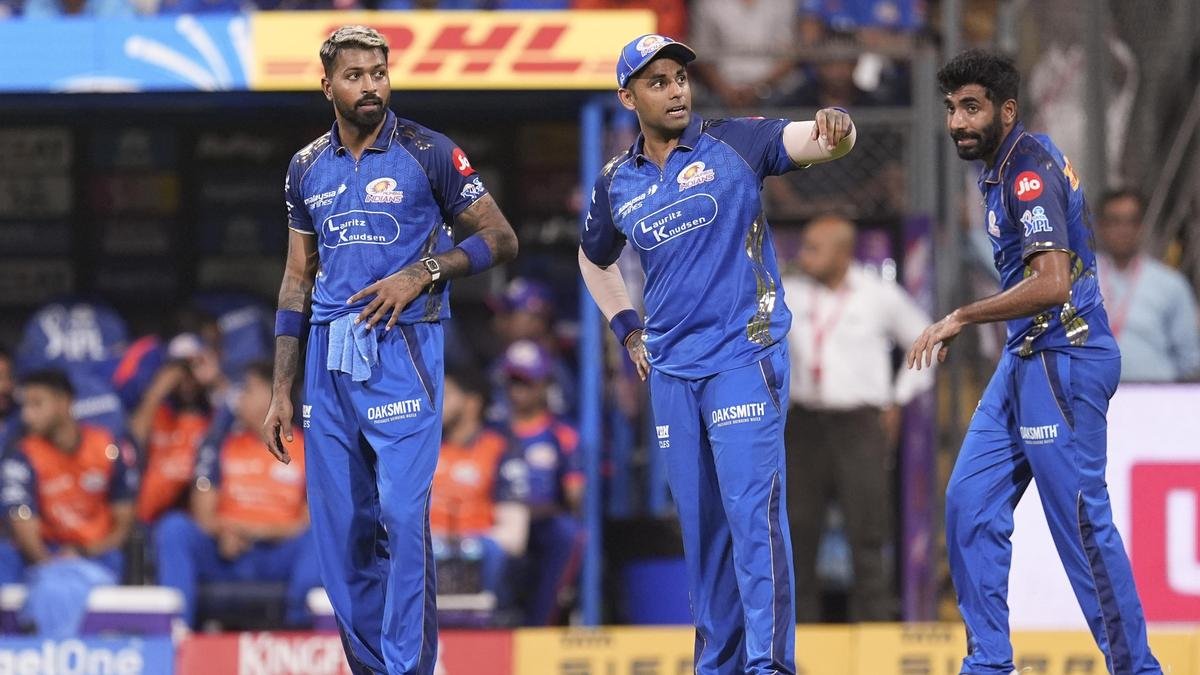
Now, as Mumbai Indians and Chennai Super Kings arrive at M.A. Chidambaram Stadium, the mood is different. The names remain heavy, but the form is light. Five titles each, yes. But reputations do not bat at No. 3 or bowl in the PowerPlay. CSK sits sixth. MI, ninth.
Memory vs momentum
Their last meeting this season still lingers. At the Wankhede, CSK beat MI by 103 runs, the latter’s heaviest defeat in the IPL. Akeal Hosein, used shrewdly with two overs in the PowerPlay, went around the wicket to left-handers, disrupting angles and rhythm. In tandem with Noor Ahmad, he reduced MI to a kind of batting paralysis.
And yet, MI still leads the IPL head-to-head 21–19. But that number is ageing. It has won only two of the last nine meetings, and just one since the start of 2023.
Mumbai’s confusion: roles without clarity
Mumbai Indians’ decision-making has lacked conviction. Take the handling of 21-year-old Krish Bhagat. Against Gujarat Titans (GT), in a match MI won, his role was clearly defined early: overs four and six, just 10 runs conceded against a strong top order. But that clarity did not carry forward. Against Chennai Super Kings, Bhagat was held back from the PowerPlay entirely and then used at the death, in overs 16 and 20, where he conceded 31. The inconsistency runs deeper. Bhagat didn’t feature at all in the following game against Sunrisers Hyderabad, where Impact Player Shardul Thakur was substituted in at the seven-over mark of the second innings but didn’t bowl a single delivery.
“He’s progressing well and working hard to return. We’re monitoring him daily with the medical team. We’ll see how he trains today and assess how he feels tomorrow before making a decision”Mahela Jayawardene, MI head coach on Rohit Sharma
Across matches, the pattern is less about experimentation and more about indecision, roles changing not by design, but by drift. The churn tells its own story. MI has already used 22 players in eight matches, cycling through all eight overseas options after Will Jacks’s inclusion against Sunrisers Hyderabad. There have been 21 changes to its playing XI across games, a constant search for a winning combination.
It extends to a broader bowling identity. It has conceded at 10.83 an over, the worst in the league, and its 37 wickets are among the lowest returns. Even Jasprit Bumrah, typically MI’s metronome, has just two wickets in eight games. The response has been telling. Trent Boult began as the new-ball spearhead, but a lack of PowerPlay wickets has forced a rethink. Bumrah has increasingly been used upfront.
CSK’s method: control, but at a cost?
If Mumbai’s issue is uncertainty, Chennai’s might be over-calibration. It has used 19 players, rotated six overseas options, and made 10 changes to the XI.
Its use of the Impact Player has been instructive, and occasionally questionable. Against GT, after losing two early wickets, they brought in Sarfaraz Khan as batting reinforcement, effectively sacrificing the option of a specialist bowler like Mukesh Choudhary later. On a mixed-soil surface with variable bounce, CSK finished with 158 for 7.
This raises a broader question: is CSK reacting too early, rather than trusting its base combination?
“ In many ways, this is quite a new team with several new players. We wanted to expose some young talent to game situations. After losing the first three matches, we had to make adjustments. Some changes were self-caused, others were due to injuries, which are beyond our control. Ideally, we’d like to settle on an XI or XII we’re comfortable with and let those players grow into their roles. Hopefully, once we build some momentum and string together wins, we’ll have the confidence to stick with a more consistent lineup”Michael Hussey, CSK batting coach on frequent changes to the XI
At Chepauk, CSK’s template has otherwise been consistent. Bat first, build, and stretch. Before the GT game, it had posted 209, 212 and 192 in three home matches, all batting first.
There is, however, a flicker of reassurance. Ruturaj Gaikwad’s return to form against Gujarat Titans, his first fifty in 11 IPL innings, offers CSK a sliver of good news.
Match-up to watch
Mumbai Indians has brought in Keshav Maharaj after Mitchell Santner’s shoulder injury ruled him out of IPL 2026. On paper, it’s a logical swap. Maharaj offers control through the middle overs and, against a Chennai Super Kings top order heavy on right-handers, gives MI a left-arm orthodox option to dictate angles.
But the matchup isn’t as straightforward as it seems. If Shivam Dube, the only left-hander in CSK’s top eight, is promoted up the order, MI faces a dilemma: hold Maharaj back or risk exposing him when the game is accelerating. Add Dewald Brevis into that middle order, and CSK still has enough intent to disrupt spin late, forcing MI to rethink how and when it deploys Maharaj.
Published on May 01, 2026
Discover more from News Link360
Subscribe to get the latest posts sent to your email.