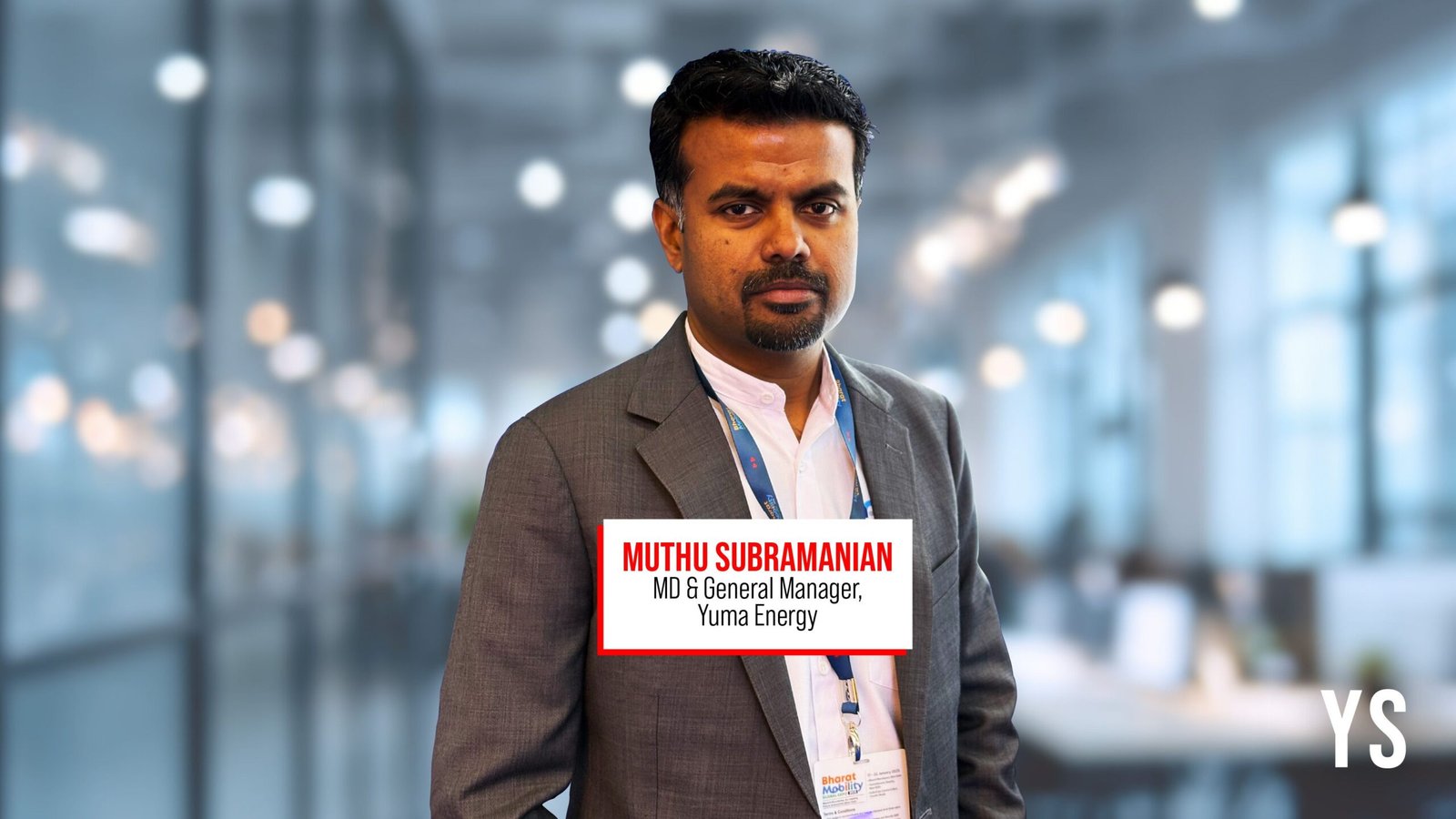
Founded in 2023 as a joint venture between automotive supplier Magna International and electric two-wheeler platform Yulu Energy, Yuma Energy now caters to over 45,000 customers every day through 350 charging stations across the country.
However, the opportunity in this segment remains massive, noted Muthu Subramanian, the Managing Director and General Manager of Yuma Energy. While the JV had focused on supplying BaaS solutions to Yulu bikes, the company is now expanding its clientele.
Since 2025, the company has partnered with E2W companies like Quantum Energy, Motovolt Mobility, Kinetic Green, and e-Sprinto to integrate its battery solutions onto these two-wheelers.
Yuma Energy is also expanding beyond two-wheelers, and has started rolling out BaaS solutions for e-rickshaws in northern India and looking to expand into other electric light commercial vehicles.
In an interview with YourStory, Subramanian discusses how battery swapping companies have evolved in India, future scope of BaaS solutions, and how Yuma Energy is looking to capture the market.
Edited excerpts:
YourStory [YS]: How has India’s battery swapping space evolved over the last few years and where does Yuma Energy see it today?
Muthu Subramanian [MS]: If you look back three years to when Yuma started, we’ve scaled steadily. We are now serving over 45,000 customers every day across 350+ swapping stations in about 18 cities.
That growth reflects a broader shift. Battery swapping is being driven largely by delivery use cases such as quick commerce, food, and logistics. With most riders still on ICE vehicles, a transition to EVs is inevitable, especially given the lower running costs for high daily usage.
In that context, swapping makes practical sense. Instead of waiting 15–20 minutes to charge, riders can get a fresh battery in under two minutes. For delivery workers, that time saving is critical. This makes battery swapping a natural fit as EV adoption grows.
YS: You mentioned being in about 18 cities. What’s your biggest market today?
MS: Across our major metro markets—Bengaluru, Mumbai, Delhi NCR (including Gurugram and Noida), and Hyderabad—Bengaluru currently leads in swap volumes, though not by a wide margin. Mumbai, Delhi NCR, and Hyderabad follow closely.
Beyond metros, we’ve expanded into newer markets over the past 12–18 months, including Jaipur, Lucknow, and more recently, Meerut. In these cities, much of the demand is coming from the e-rickshaw segment, though we also support electric two-wheelers.
Importantly, our stations are interoperable so they can serve both electric three-wheelers and two-wheelers seamlessly.
YS: When did Yuma start providing swapping solutions for e-rickshaws?
MS: We’ve been in these newer markets for over 12 months, with the initial phase focused on piloting and refining the model. In terms of swapping solutions for 2W, over the last two quarters, we’ve started scaling and plan to expand further.
In partner-led cities like Indore, Kochi, Coimbatore, and Kolkata, we operate through third-party partners, more like a franchise model. These partners manage the fleet and run the swapping network, while we stay relatively hands-off operationally.
Our role is to support them with reliable hardware, ensure uptime, troubleshoot issues, and provide the software stack to enable battery swaps and asset monitoring.
YS: What drove the decision to use a partner-led model in some cities, while operating directly in others?
MS: It’s not really city-specific. It comes down to demand and strategic fit.
In markets where demand is still emerging, like Indore, it makes more sense to go with a partner-led model. It keeps the model asset-light while we validate demand.
In higher-demand or more strategic markets, we often run a hybrid approach, combining our own stations with partner-operated ones. That allows us to serve different use cases, customer segments, and vehicle types more effectively.
So overall, we’re scaling in both formats, depending on what works best for the market.
YS: How have the battery packs evolved to now serve e-rickshaws?
MS: For low-speed vehicles, we were using an older-generation battery pack designed specifically for that use case.
Now, we’ve developed a new battery that fits the same form factor but delivers nearly double the capacity along with higher power. This allows us to support not just low-speed vehicles, but also mid-speed scooters and even three-wheelers that require more performance.
YS: Has Yulu launched its mid-speed vehicle variant, and are you seeing any synergies with your mid-range battery pack there?
MS: Yeah, so we’re working with them on those. When they launch those vehicles, then our new generation packs will be catering to those vehicles also.
YS: You’ve partnered with several E2W OEMs. How challenging is it to customise and fit your battery to different vehicles?
MS: Our battery pack is designed to be flexible across different vehicles, factoring in power needs, size, and packaging constraints.
When it comes to integration, we typically have two approaches. One is a plug-and-play “vehicle kit,” where we provide everything the OEM needs to adapt our battery into their vehicle. The second is a more custom integration, especially in cases with tighter space constraints or when a vehicle can accommodate two batteries. That involves closer collaboration with the OEM.
It’s not particularly challenging from a technical standpoint—it’s similar to integrating any two hardware systems. The key is the time and coordination needed to ensure everything works seamlessly in real-world conditions.
YS: How are battery swapping companies balancing scale, costs, and profitability today?
MS: You’re right, battery swapping is more capex heavy than charging. But the value it delivers—higher uptime, no battery ownership worries, and better resale value by decoupling the battery—makes it viable for users at the right price point.
On profitability, it really comes down to utilisation at the station level. If each node sees strong usage, the model works. Some locations are already hitting those levels, while others are still ramping up but as demand builds, profitability follows.
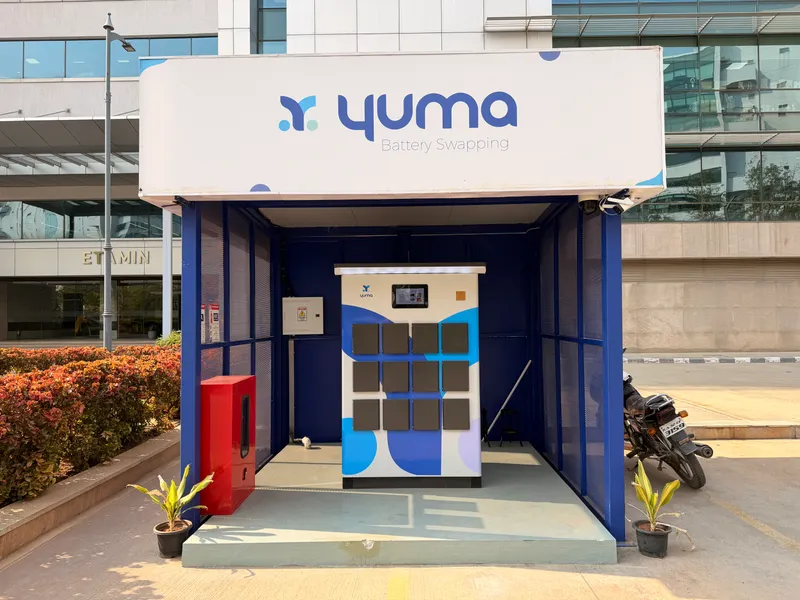
A Yuma Energy battery swapping station
YS: When do you see the company becoming profitable?
MS: We’re not profitable yet because we’re still in build mode. It’s only been about three years, and we’ve scaled quickly from around 50 stations to 350. That kind of rapid expansion naturally delays profitability, but we’re actively working toward it.
YS: Do you see any ceiling to how much battery swapping can scale today?
MS: As of today, I don’t really see a ceiling. There’s still a large base to convert. Out of roughly 1–1.2 million gig riders, only about 10–15% are on EVs, and that market itself could grow to 4–4.5 million by 2030.
Beyond that, swapping isn’t just for delivery riders. There’s a clear convenience play for everyday users: no range anxiety and no need to plan charging. In Tier II and III markets, concerns around battery life and resale could actually make swapping more appealing.
So, when you add it all up, demand isn’t the constraint. The opportunity is still pretty wide open.
YS: Given your reliance on gig workers in ecommerce and quick commerce, do you see that as a risk? And are other use cases starting to emerge?
MS: In the short term, we’re riding the demand from ecommerce and quick commerce, and that’s actually helping us scale and refine the model.
But it won’t stay limited to that. Many gig workers will eventually move on to other roles and continue using swapping, creating a natural pull beyond delivery. On top of that, we’re already seeing interest from personal users, as well as segments like e-rickshaws and L5 autos—both passenger and cargo.
So while delivery is the starting point, multiple use cases are already emerging or in the pipeline.
YS: What’s held back battery-as-a-service from taking off in personal commuting compared to commercial use?
MS: Two key reasons, really. First, EV adoption itself has only picked up recently so the base market is still evolving.
Second, awareness is low. As an industry, we haven’t done enough to educate personal users about battery swapping or clearly communicate its advantages.
That’s the gap. Once users understand the convenience and value, adoption should follow.
YS: How is Yuma using AI to track battery health and improve performance?
MS: We’ve always been a data-driven company, even before jumping on the AI bandwagon. Data sits at the core of how we run operations.
For instance, we can forecast demand up to six hours in advance with about 98% accuracy. That helps our ops team monitor station-level battery availability and proactively fix potential shortages before they become issues.
Now, we’re layering in AI/ML to make this more proactive, surfacing insights automatically instead of teams having to query dashboards. It’s especially useful for operations, where quick decisions matter.
On the product side, our engineering teams are using AI to generate and run large-scale test cases such as hundreds of thousands of scenarios, before launch. What used to be manual is now faster and more thorough, significantly reducing deployment timelines.
YS: How do you handle batteries that degrade or get damaged? Or those that can’t be used in the network anymore?
MS: We’re only about three years in, so most of our batteries still have two to three years of life left, nothing at full end-of-life yet.
For damaged batteries, we first analyse what went wrong to improve the product. If usable, we repurpose them for R&D and testing. If not, we send them to certified recyclers.
For the future, we do see a strong second-life opportunity, like power backup, but we’re still evaluating how to approach that.
YS: Is your customer base still largely Yulu riders, or has it diversified beyond that?
MS: Yulu is still the dominant customer, constituting about 90% of the business today.
That said, we’re actively scaling beyond that, especially in e-rickshaws and other fleet segments. We expect non-Yulu business to grow to around 20–25% by the end of the year.
YS: You acquired Greentech Motors and Services to strengthen in-house manufacturing and R&D. How has that integration worked so far, and what kind of synergies are you seeing?
MS: It’s been a year since the acquisition of Greentech Motors and Services, and the integration has gone smoothly, helped by the fact that we’d already been working together for over a year before that.
On the R&D side, the big win has been co-location. The engineering teams are now under one roof, which has made collaboration much tighter. In fact, our current-generation battery pack was originally developed by Greentech, and now we’re able to iterate faster and improve performance continuously.
In manufacturing, we’ve scaled significantly. Greentech had a smaller setup earlier, but with backing from Magna International, we’ve been able to ramp up capabilities. Our Chennai plant is now producing over 5,000 battery packs a month (around 60,000 annually), and we’re already evaluating further capacity expansion to meet growing demand.
YS: How has vertical integration helped you on costs and overall efficiency?
MS: Vertical integration has helped us on three fronts—cost, quality, and speed.
Because we control the full stack, from battery, charging systems, and swapping infrastructure, we can build, test, and deploy much faster. It also means we can fix issues quickly after rollout, without depending on external vendors.
On the ground, this shows up in performance. For example, our fully automated (DIY) swapping stations—designed, built, and deployed in-house—deliver a 99%+ success rate. Most users can swap within a minute, and even if there’s an issue, we can resolve it remotely in real time.
That level of reliability and responsiveness is hard to achieve without vertical integration—it reduces delays, improves product quality, and keeps costs under control over time.
YS: What’s the split today between manned and fully automated (DIY) swap stations?
MS: Right now, it’s roughly a 70–30 split with about 70% manned stations and 30% fully automated.
That mix is intentional. High-demand locations like those doing 1,000+ swaps a day, work better as manned stations, where throughput is high and there’s on-ground support for users.
Automated stations, on the other hand, help us scale more densely and cost-effectively in lower-demand areas.
So going forward, it’s not one replacing the other. We’ll continue with a hybrid model: manned for high-traffic hubs and support, automated for wider network expansion.
YS: How did your revenue grow last year?
MS: We’ve been growing steadily—both month-on-month and year-on-year. This year, we’re expecting around 20% growth, with momentum likely to pick up as we scale newer business lines.
On expansion, we’re targeting over 30 cities over the next few quarters, and will continue adding more as demand builds.
Discover more from News Link360
Subscribe to get the latest posts sent to your email.