Ajay Kumar Verma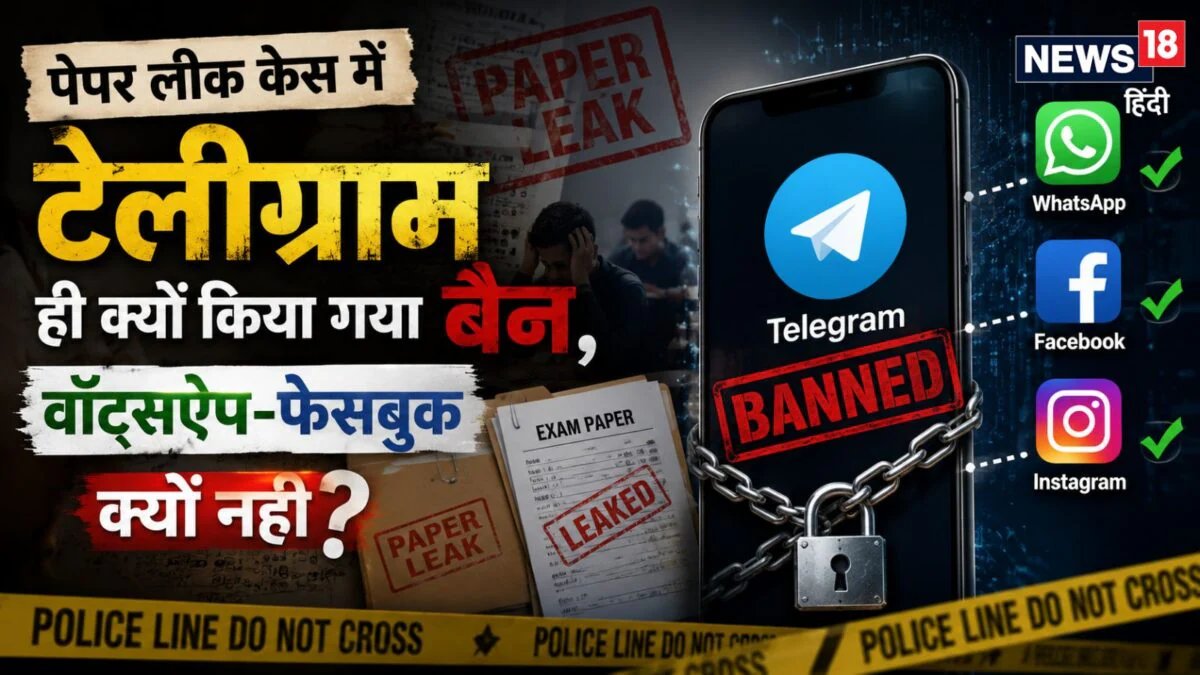

Last Updated:
In the NEET paper leak, the government banned Telegram till June 22, but did not ban WhatsApp, Facebook or other messaging apps. Telegram CEO Pavel Durov challenged this decision of the Indian government in the court. When this matter was debated in the court, the government lawyer pointed fingers at a special feature of Telegram, which makes it different from WhatsApp. This was cloud architecture. Let us tell you the complete details about it…


Due to NEET paper leak, the government has banned Telegram till June 22.
New Delhi. Regarding the ban on Telegram in the country, there is only one question in everyone’s mind that why did this app get banned in the NEET paper leak case? People are asking on social media that when WhatsApp and Facebook are also running smoothly, then what crime has Telegram committed? Now the curtain has been lifted from this suspense. The government lawyer has told in the court what is the reason behind banning Telegram. It was told that it has been banned because of its cloud architecture. By the way, let us tell you that this is also the biggest feature of this app.
The lawyer appearing in the court on behalf of the government told the court that the main reason for banning Telegram is its cloud based system. Illegal things and illegal content like paper leak spread very fast on Telegram. Since all its data is present on cloud servers, there are huge difficulties in stopping or moderating it. Whenever the government asks the company to remove this content or cooperate in the investigation, a lax attitude is seen from Telegram’s side. This is the reason why the government had to take strict action on this.
What is Telegram’s cloud architecture?
Telegram is a cloud service. The messages, photos and videos of any normal private chat, group chat, channels or public group on Telegram are stored forever on Telegram’s servers (cloud). The company calls this its biggest feature so that when the user logs in from any new phone or computer, he gets all the old data immediately, without any personal backup. However, from security point of view it is a compromise on privacy.
Telegram claims that its data is secure and its decryption keys are distributed among different data centers. But the truth is that these chats can be accessed on the orders of Telegram staff or legal authority (like court or government), because server-side decryption is possible.
There is definitely an option of ‘Secret Chats’ in Telegram, which is end-to-end encrypted and is not saved on the server, but generally people use normal cloud chats only. Large files up to 2GB are easily shared on this cloud storage, taking advantage of which criminals spread paper leaks and pirated content indiscriminately. This is the biggest difference, which has put Telegram on the verge of ban, whereas WhatsApp has survived because of its privacy-first policy.
Why not ban WhatsApp?
Now let’s talk about WhatsApp. It may come to your mind that even on WhatsApp, fake news and wrong things are shared, so why doesn’t the government ban it? In fact, the government also puts pressure on WhatsApp to follow strict rules like traceability (who initiated the message) and SIM linking. But WhatsApp’s system is completely different.
End-to-end encryption (E2EE) is by-default in WhatsApp. This means that the message you sent can only be read by the recipient. This message remains on WhatsApp’s own servers only for some time and gets deleted as soon as it is delivered. WhatsApp does not have its own cloud storage, all the data remains in the local storage of your phone. In such a situation, it is not possible for WhatsApp to access anyone’s content.
About the Author

Malkhan Singh has been in the world of news and content for the last 17 years. In the journey from print media to digital media, names of many renowned institutions have been added to the profile. Working with News18Hindi for almost 4 years…read more
Discover more from News Link360
Subscribe to get the latest posts sent to your email.