Ajay Kumar Verma
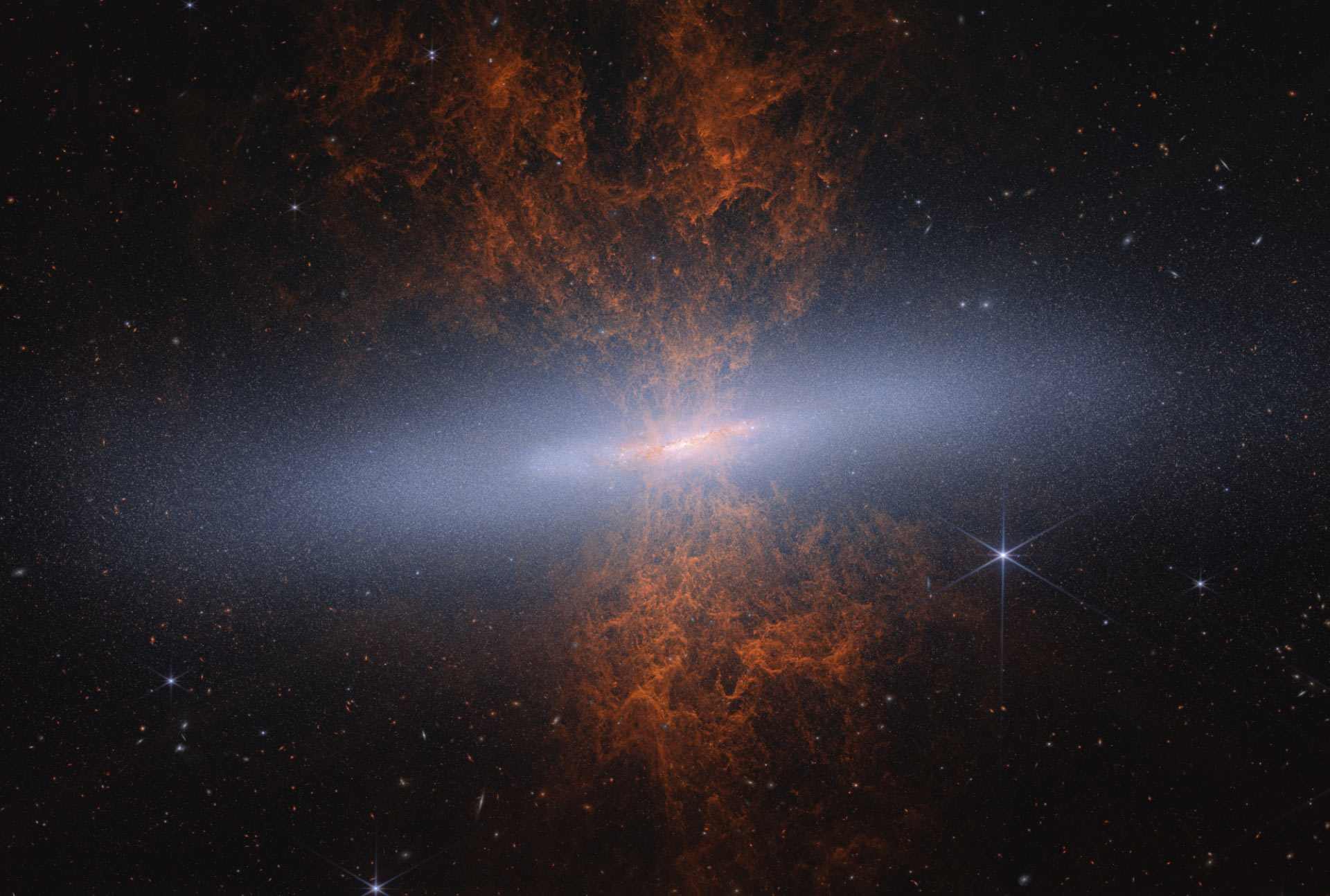
This Webb image shows the edge-on spiral galaxy Messier 82. Image credit: NASA / ESA / CSA / Adam Smercina, STScI, Tufts / Thomas Williams, University of Manchester / Alyssa Pagan, STScI.
Messier 82 is located approximately 12 million light-years away in the northern constellation of Ursa Major.
First discovered by the German astronomer Johann Elert Bode in 1774, the galaxy is approximately 40,000 light-years across.
Messier 82 is also called the Cigar Galaxy because of the elongated elliptical shape produced by the tilt of its starry disk relative to our line of sight.
It is famous for its extraordinary speed in making new stars, with stars being born 10 times faster than in our Milky Way Galaxy.
“Messier 82 is a mess, but it’s a beautiful mess,” said Dr. Adam Smercina, an astronomer at the Space Telescope Science Institute and Tufts University.
“We don’t fully understand what’s going on, especially concerning its evolutionary history.”
“What could have triggered such an elevated rate of star formation? How long has this galaxy been driving plumes of material away from its center?”
“Messier 82 is an ideal galaxy evolution laboratory because it has properties that allow us to probe important physical processes, such as how stars form in such environments and how that activity drives outflows.”
“Messier 82 provides a simultaneous window onto many astrophysical questions, in a way that no other galaxy in the local Universe can.”
Using Webb’s NIRCam (Near-Infrared Camera) instrument, the astronomers revealed never-seen-before details of Messier 82, including its distended disk structure and millions of individual stars.
The Webb image contains approximately 16.5 million individual stars dispersed throughout the galaxy.
The light from these stellar sources is depicted as luminous blue granules.
This is only a small portion of the total amount of stars astronomers think reside in a galaxy like Messier 82, with the majority too faint to be seen.
“The sheer number of stars that we were able to resolve with Webb is incredible,” said Dr. Benjamin Williams, an astronomer at the University of Washington.
“It’s a whole different world from what we’ve been able to see with other telescopes.”
“All of these stars collectively provide a detailed fossil record of the formation and evolution of Messier 82.”
“At first glance, the disk of the galaxy may seem less spectacular because Webb sees through the dust,” said Dr. Eric Bell, an astronomer at the University of Michigan.
“But Messier 82 is a delightfully complex system. Webb’s observations will help us address some ongoing mysteries, such as how star formation has moved within Messier 82 over the last few billion years.”
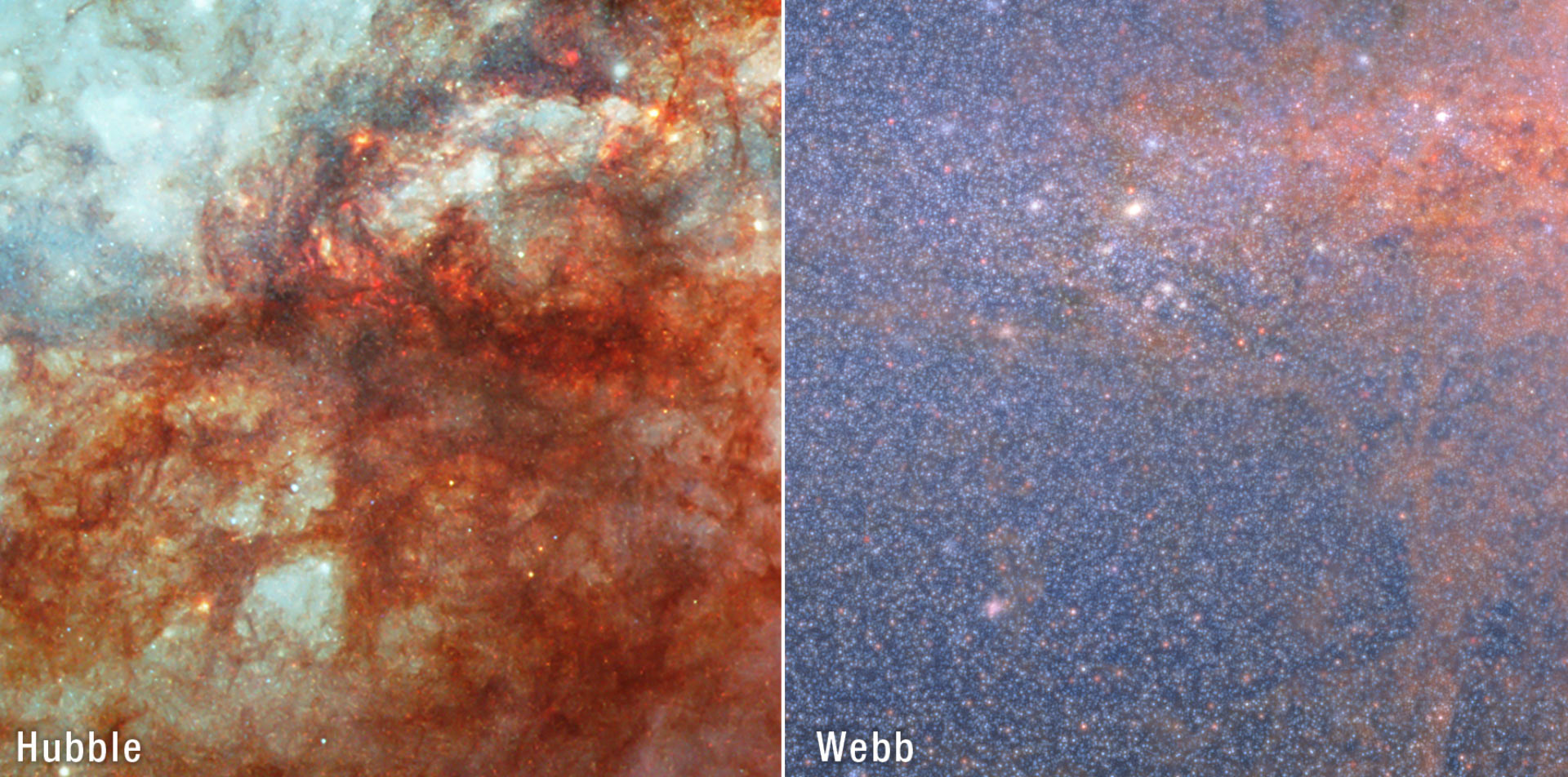
Side-by-side comparison of a portion of Messier 82 as seen by Hubble (left) and Webb (right) space telescopes. Image credit: NASA / ESA / CSA / Adam Smercina, STScI, Tufts / Thomas Williams, University of Manchester / Alyssa Pagan, STScI.
Because of the extreme star formation within Messier 82, which is 10 times faster than the Milky Way Galaxy’s star formation rate, stellar birth will eventually be disrupted.
The galaxy’s stellar frenzy is causing bipolar plumes of material to be ejected above and below the disk.
Though it looks like a tumultuous region, the hourglass-shaped outflows appear to have a layered structure.
The yellow tendrils of material closest to the galaxy’s disk represent ionized gas, whereas the orange material farther away depicts small dust grains.
These grains are called polycyclic aromatic hydrocarbons and are helpful in tracing material in the space between the galaxy’s stars, also known as the interstellar medium.
“Galaxies are such intricate ecosystems that if you truly want to understand them, you have to pull datasets from different missions together,” said Dr. Kristen McQuinn, an astronomer at the Space Telescope Science Institute.
“One mission cannot fully answer all of the questions we have about Messier 82.”
“Combining the data collected by different telescopes, like Webb and Hubble, is powerful.”
“When you marry the datasets, you expand what you can probe, and the questions that you can pose are even more complex.”
Discover more from News Link360
Subscribe to get the latest posts sent to your email.