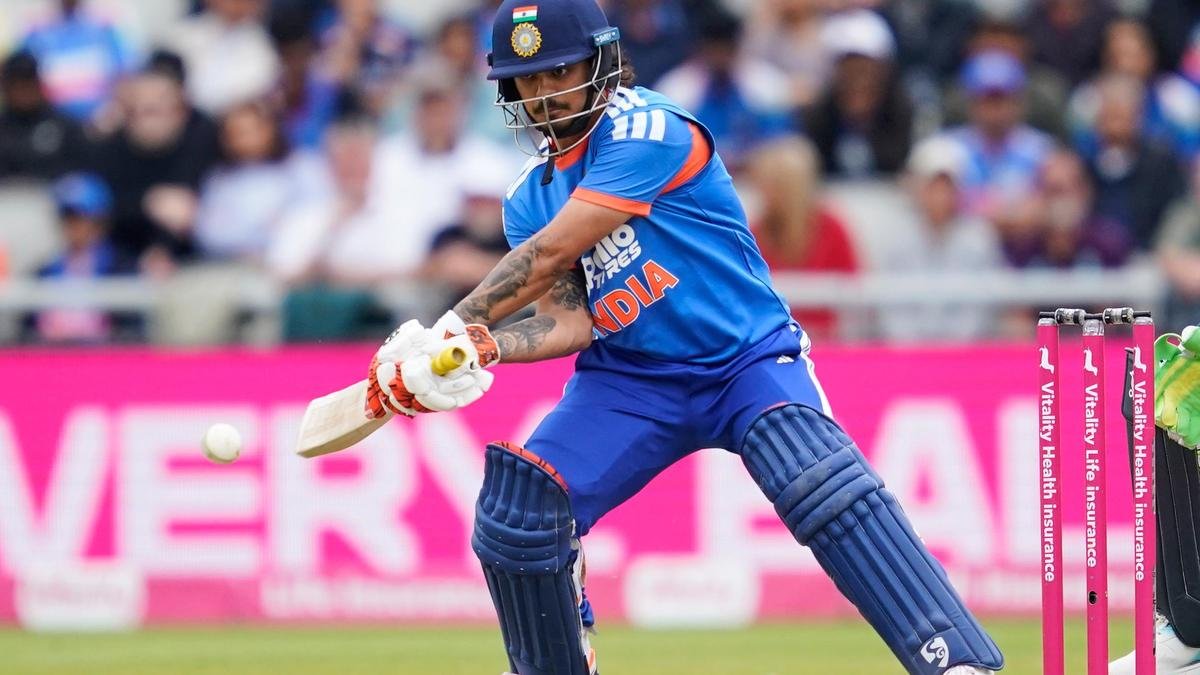
The 27-year-old was nowhere near the Indian setup eight months ago. Today, he has not only played a crucial role in India defending its T20 World Cup title earlier this year but has also become an integral part of the ODI squad.
Since his return to the senior side in January, Ishan has scored 594 runs in T20Is at a staggering strike rate of 231.2 across 16 innings. In ODIs, he made 159 runs in two games against Afghanistan, including a 71-ball century. In IPL 2026, Ishan also enjoyed a 602-run season with Sunrisers Hyderabad.
His comeback has also made life easier for the selectors in some ways, even if it has come at the expense of a few deserving individuals.
Since the IPL, India has announced multiple white-ball squads for the T20I series against Ireland, England and Zimbabwe, along with an ODI squad for three matches in England. Ishan has featured in all of them, thanks to his outstanding form.
But for every Ishan inclusion, another equally deserving name has missed out. Yashasvi Jaiswal wasn’t picked for the England ODIs, while Sanju Samson was left out of the squad touring Zimbabwe later this month. One player’s resurgence has, directly or indirectly, altered the equation for others.
Ishan is a multi-dimensional cricketer: a wicketkeeper, a left-handed batter and someone who can slot in almost anywhere, from opening to the middle order. Jaiswal, meanwhile, is a specialist left-handed opener, while Samson, despite being a wicketkeeper, is best utilised in the top three.
“He (Ishan) is a very versatile cricketer. He can bat at the top of the order, he can bat in the middle, and, of course, the fact that he is a top-class wicketkeeper as well adds tremendous value,” India’s assistant coach Ryan ten Doeschate had said during the ODI series against Afghanistan in June.
“If you look at the squad composition, he stands out because of how he performed under pressure in the T20 World Cup and how he has stepped into this team and already played a crucial role.
“I think he ticks a lot of boxes and, like I said, purely because of that versatility, he is someone you want in your squad,” ten Doeschate had said.
With Ishan now highly valued by both the selectors and the team management, his versatility allows India to free up an additional spot elsewhere in the squad. Rather than carrying specialists, the selectors can afford greater flexibility, whether that means picking an extra all-rounder, adding another bowling option or giving more game time to someone like Rohit Sharma, who only plays one format.
In ODIs
In Rohit’s case, with India building towards the 2027 ODI World Cup, maximising game time is important. Although his returns have been inconsistent (204 runs at an average of 34 in six games) and his fitness continues to be monitored, he remains the first-choice opener alongside captain Shubman Gill. That could change over the coming months, but for now, the management continues to back the former captain.
That leaves Jaiswal in a difficult position. With Rohit and Gill expected to open whenever available, Jaiswal’s only realistic role is as a reserve opener. Ishan, however, can provide cover at the top, keep wickets and move into the middle order if required. In a 15-member squad, that versatility carries greater value than having a specialist reserve opener.
Jaiswal has done little wrong. In fact, he was dropped just a day after scoring a century against Afghanistan, but Ishan’s stock has risen significantly.
“We all know he’s (Yashasvi) a phenomenal player. It’s not easy for any player because, when everyone is available, he’s unfortunately the one who sometimes misses out. Since Virat (Kohli) bhai wasn’t available in this (Afghanistan) series, he got the opportunity to play a couple of games,” Gill had said.
In T20Is
T20Is are a fickle format in which consistency is difficult to guarantee.
With the next T20 World Cup still two years away, India has the luxury of experimenting.
For the T20I series against Ireland and England, the selectors retained most of the World Cup-winning squad but moved away from Suryakumar Yadav altogether, both as captain and as a player. Apart from recalling Shreyas Iyer, they also picked 15-year-old prodigy Vaibhav Sooryavanshi but did not play him in the first three matches: two against Ireland and the opening T20I against England.
But with Samson failing to make an impact in those three games, the Gautam Gambhir-led management handed Sooryavanshi his debut in the second T20I against England. Having identified him as a potential long-term investment, the selectors also felt it was the right time to expose other fresh faces to international cricket.
The Zimbabwe tour has traditionally served as a platform to test emerging talent. On the previous tour, Abhishek Sharma announced himself and has since cemented his place at the top of the order.
Now, with Ishan firmly established as India’s first-choice wicketkeeper in the format, the selectors have called up Prabhsimran Singh, another opener who can also keep wickets, in place of Samson to assess him as a potential backup.
Prabhsimran has been a consistent run-scorer for Punjab Kings, making 1,059 runs at a strike rate of over 164 across the last two IPL seasons. He has also performed well in domestic cricket for Punjab and earned multiple opportunities with India A.
While this is unlikely to be the end of the road for Samson in T20Is, given that he has been selected for India’s squad for the 2026 Asian Games, or for Jaiswal in white-ball cricket, multi-dimensionality and long-term planning are the key factors driving selection at the moment. From the selectors’ perspective, it seems neither currently sits at the top of the pecking order.
Then again, things can change very quickly. Last December, Ishan smashed a century in the Syed Mushtaq Ali Trophy final and led Jharkhand to its maiden title. It didn’t just revive his international career but also set off a chain reaction.
Published on Jul 07, 2026
Discover more from News Link360
Subscribe to get the latest posts sent to your email.